Woodworking instructors will tell you to nail down your miter cuts before anything else, and there's a reason for that. A picture frame looks deceptively simple: four pieces of wood meeting at corners. The actual challenge in a DIY wooden picture frame project is those corners. Get them wrong and the whole thing gaps, wobbles, or refuses to hold glass.
Two variables determine whether your first frame succeeds or gets tossed: the accuracy of your 45-degree cuts and the method you use to hold the joints while the glue cures. Neither is obvious from looking at a finished frame in a store. Wood species matters too, though beginners almost always overthink that part.
Here's the tension worth sitting with before you buy lumber: a one-day frame project is absolutely achievable, but "one day" assumes you've thought through the clamping step in advance. Improvised clamping fixes after a glue-up has started are where beginner frames fall apart, sometimes literally.
What You'll Need Before You Start
Keep your materials list short. For a single 8x10 frame, you need roughly 5 linear feet of molding or dimensional lumber, wood glue, 1.25-inch brad nails or corrugated fasteners, sandpaper in 120 and 220 grit, and a finishing product. That's it.
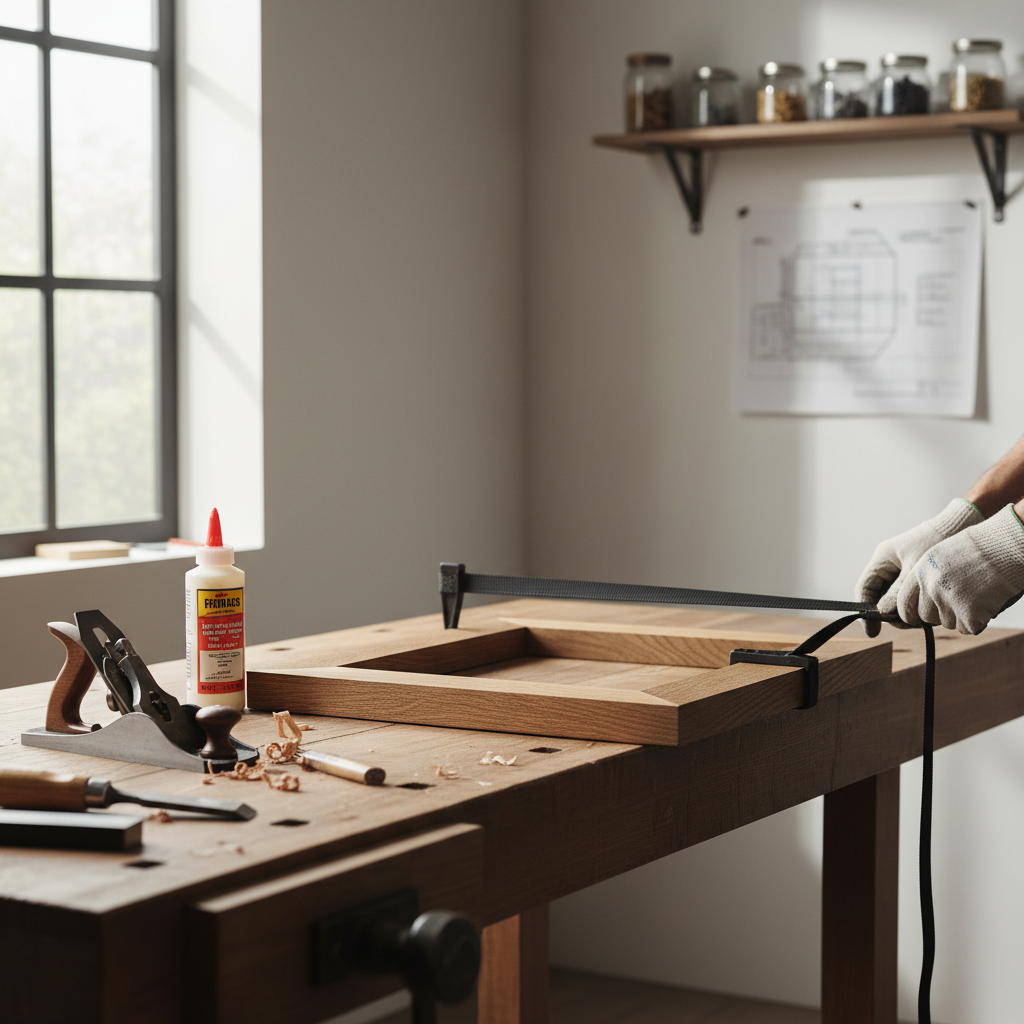
For tools, a miter saw (or a miter box with a hand saw) handles the angle cuts. A brad nailer speeds things up considerably, but a hammer works. Frame clamps, also called band clamps or strap clamps, are the piece most beginner guides skip over. You can improvise with rubber bands and painter's tape on small frames, but anything larger than 5x7 really benefits from a proper strap clamp. They cost around $10 to $15 at any hardware store.
You'll also need a rabbet, which is the groove cut into the back of the frame that holds the glass, mat, and backing. Buying pre-rabbeted molding from a craft store eliminates this step entirely. For a first project, that's the right call.
Choosing Your Wood
Poplar is the right starting point for most beginners in the US. It's stable, machines cleanly, takes paint well, and is widely available at home centers like Home Depot and Lowe's in both dimensional lumber and molding profiles. A 1x2 poplar board runs around $1.50 to $2.50 per linear foot depending on location and current lumber prices.
Pine is cheaper and easier to find, but it dents easily and its grain can telegraph through paint finishes in ways that look unprofessional. If you want a natural wood look with a clear finish, oak gives you a clean grain that stains predictably. Avoid hardwoods like maple or walnut for your first frame: they require sharper tooling and more precise technique to cut cleanly at 45 degrees.
Or rather: the wood species matters less than the moisture content. Warped or cupped lumber makes bad frames regardless of species. At the store, hold the board at one end and sight down its length. Any twist or bow visible from that angle will cause problems. Pick straight stock, even if it means digging through the pile.
Pre-made molding from a craft store (Michaels, Hobby Lobby) gives you the rabbet already cut and a profile that looks finished. The trade-off is less control over dimensions and species. For a first project where the goal is a completed, hanging frame by end of day, pre-rabbeted molding is a completely legitimate choice and not a shortcut you should feel bad about.
Cutting and Assembling the Frame
Measure the opening size first, not the outside dimension. For an 8x10 photo, your rabbet opening needs to be at least 8x10, with most framers adding a hair (about 1/16 inch) of clearance so the glass and mat slide in without binding.
Each frame piece gets cut at 45 degrees on both ends, with the long point of the miter equal to the outside dimension of that side. For an 8x10 frame built from 1.5-inch-wide molding, your two long pieces (top and bottom) have long points of 13 inches; the two short pieces have long points of 11 inches. Double-check these numbers against your specific molding width before cutting.
Cut one piece, test-fit it, then use it as a reference for the opposite piece. Matching pairs this way compensates for minor saw calibration errors. A gap at any corner under 1/32 inch is acceptable. Anything wider is a cut to redo.
Assembly goes: dry-fit all four corners first (no glue), check that opposite sides are equal length and corners meet cleanly, then glue and clamp. Apply glue to both mating surfaces of each joint. Set the strap clamp around all four corners simultaneously, tighten slowly and evenly, and check that the frame lies flat on your work surface. Brad nails driven across each corner from the back reinforce the joint while the glue cures. Let it sit undisturbed for at least an hour before handling. Skip the dry-fit and you'll discover a gap mid-glue-up with no good options left.
This is where the information most one-day guides don't make explicit becomes critical: corner gaps that appear after the clamp comes off almost always trace back to one of two causes. Either the miter angles were slightly off from a miscalibrated saw, or the clamp pressure wasn't even across all four joints. Fixing the saw calibration is a 30-second job with a square; fixing uneven clamping means slowing down and watching the frame as you tighten.
Finishing and Fitting
Sand the assembled frame lightly with 120 grit to remove any glue squeeze-out, then move to 220 grit for a smooth surface. Always sand with the grain on visible faces.
For paint, a coat of shellac-based primer (Zinsser BIN is the standard choice for interior woodwork) seals the wood and prevents grain raise under latex paint. Two thin coats of paint after that give better results than one thick coat. For a natural finish, wipe-on polyurethane (Minwax Wipe-On Poly is widely available) is forgiving and produces a consistent sheen on poplar and oak without the brush-mark risk of oil-based varnish.
Fitting the glass, mat, and backing: cut or order glass to match your rabbet opening, not the photo size. Standard 8x10 glass is easy to find pre-cut. Lay the glass in first, then the mat, then the photo face-down, then the backing board (thin hardboard or foam core works). Secure the backing with glazier's points pushed in every 4 to 6 inches with a flathead screwdriver, or use a dedicated point driver if you plan to make more frames.
I'd start with a sawtooth hanger for the first frame: one screw in the center back, quick to install, and adequate for frames up to around 16x20 inches. Wire hangers with screw eyes look more professional and center the hang point better, but they require measuring precisely to keep the frame level. Get the first frame finished and on the wall first.
When This Approach Has Limits
A miter-and-glue frame built from dimensional lumber or craft-store molding is the right project for a beginner learning the process. But it's not the right approach for every situation.
Frames larger than 16x20 inches built this way tend to rack over time. The corner joints in a glued miter frame aren't carrying much mechanical load; they rely almost entirely on the glue surface area. Larger frames need splined miters (a small piece of wood let into a slot across the corner joint) or metal frame joining hardware to stay square under the weight of glass and backing.
If you're framing original artwork or a photograph with sentimental value, the wood species and finish matter more than they do for a decorative project. Oil-based finishes off-gas for weeks and can damage paper-based media if the frame is sealed too tightly. Archival framing uses acid-free mats, UV-filtering glazing, and appropriate airspace behind the artwork. That's a different project with different materials, and worth researching separately before you build the frame.
Getting the Frame on the Wall
Check that the corners are fully cured (24 hours for most wood glues, despite what the label says about handling time). Touch-up any paint nicks from the assembly process. Then hang it.
The most common finishing mistake is skipping the felt or cork bumper pads on the bottom two back corners. Without them, the frame tilts forward from the wall and marks the paint when it shifts. Four self-adhesive felt pads from any hardware store fix this permanently.
If you built this frame and it came out well: the next one will take half the time. The miter cuts and clamping setup are the entire learning curve. Everything else is just following the same sequence more confidently.