Carpenters will tell you to pick your wood before you pick your design, and there's a reason for that. A plant stand seems straightforward enough, a few boards, some glue, maybe a handful of screws, but the wood species you grab at the home center quietly determines whether the thing holds a thirty-pound pot for a decade or wobbles apart after one wet season on the porch.
This guide is specifically for people building their first or second woodworking project, not experienced cabinetmakers looking to mill their own lumber. If you've got a miter saw or a circular saw, a drill, and a free Saturday afternoon, you can finish this in three to four hours.
What most builders get wrong isn't the cutting. It's the joint strategy and the finish. Skip the right sealer on an outdoor stand and you'll be rebuilding by next spring, no matter how tight your joinery is. That tension between how simple this looks and how many small decisions actually matter is worth sitting with before you start shopping for boards.
Wood Selection: The Decision That Controls Everything Else
The single most important choice happens in the lumber aisle, before you've made one cut. For an outdoor plant stand, you have two honest options: cedar and pressure-treated pine. For an indoor stand, poplar or pine both work and cost less.
Cedar is the practical favorite for outdoor projects. It's naturally rot-resistant, lightweight at around 23 lbs per cubic foot, and holds screws well without splitting as badly as denser hardwoods. A single 1x6x8 cedar board typically runs $10 to $16 at a big-box store like Home Depot or Lowe's. You'll need three to four boards for a basic tiered stand. That puts your lumber cost around $35 to $55 before hardware.
Or rather: cedar resists moisture, but it doesn't ignore it. Left unfinished outdoors, cedar grays within one season and checks (develops surface cracks) within two. A penetrating oil finish like Cabot Australian Timber Oil or any linseed-based exterior oil applied before first use extends the life significantly. This is the step most first-time builders skip, and it's the reason their stand looks rough by fall.
Pressure-treated pine costs less per board but requires specific stainless-steel or hot-dipped galvanized fasteners. Standard zinc screws corrode against the preservative chemicals, and that corrosion stains the wood and weakens the joint within a year. If you use pressure-treated lumber, budget an extra $8 to $12 for the right screws. Don't skip that.
For indoor-only stands, none of the moisture rules apply. A 1x4 or 1x6 pine board from the common board section, sanded and painted, is perfectly fine and cuts your material cost roughly in half.
The Cut List and Assembly: What the Plans Usually Leave Out
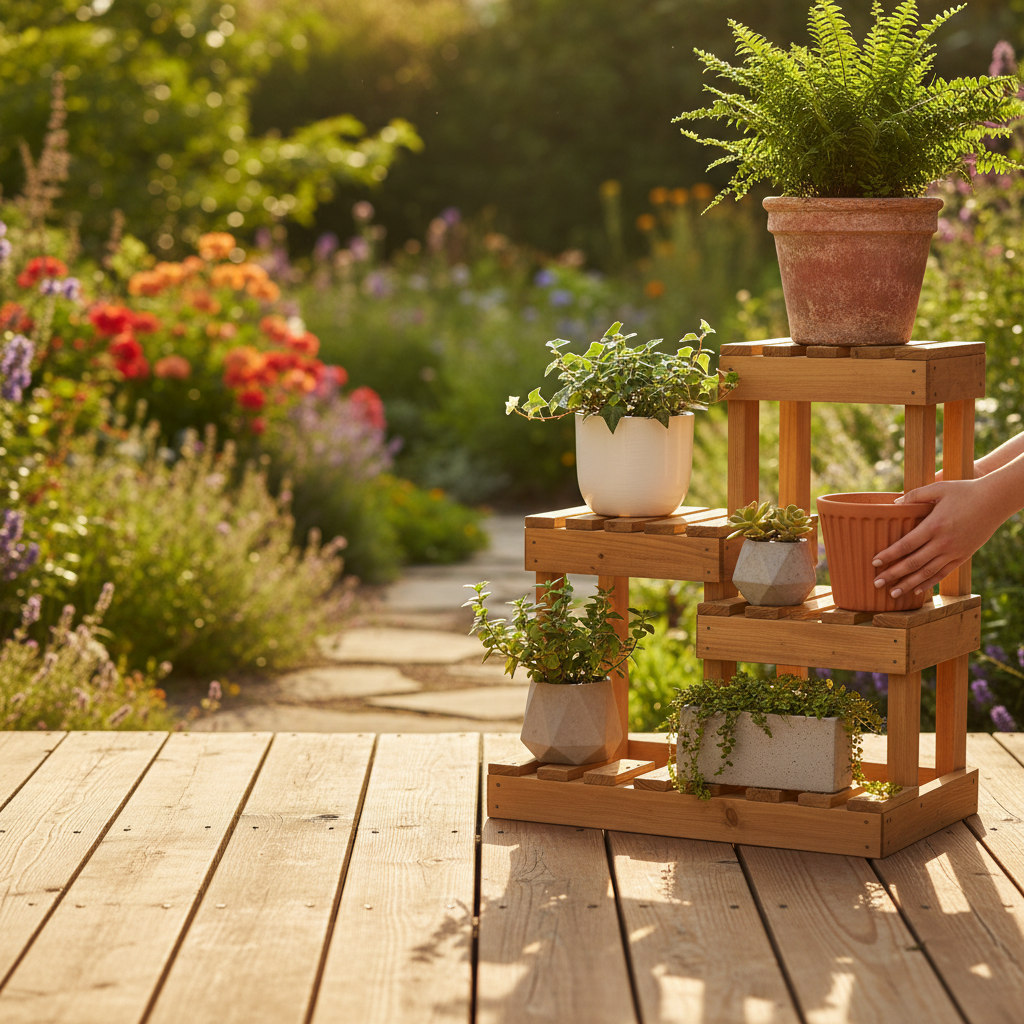
A three-tier plant stand with a footprint of roughly 18 inches square needs these components at minimum: four legs at 36 inches each, three shelf frames, and cross bracing if you want it stable enough for heavy pots. The shelf frames are the part most simplified plans get wrong.
A frame built from 1x2 stock with a 1x6 or 1x8 panel dropped in will hold more weight with less flex than a single wide board sitting on top of the legs. The frame distributes load to all four legs instead of bending at the center. For pots over 15 pounds, this matters. For small succulent arrangements, it doesn't.
Cut sequence: legs first, then long shelf frame pieces, then short shelf frame pieces, then panels. Cutting all the same-dimension pieces in one pass keeps your measurements consistent. A 1-degree variance in leg length makes the stand rock; cutting all four legs in the same fence setup eliminates that.
Spacing between shelf levels is a real decision, not an aesthetic one. A 10-inch gap between tiers accommodates most 6-inch nursery pots with room to water. A 14-inch gap handles 8-inch pots and trailing plants. Commit to one before you cut, because changing it after assembly means re-drilling the leg attachment points.
- Use 1-5/8 inch screws for 3/4-inch stock joining 3/4-inch stock
- Pre-drill pilot holes to prevent splitting, especially near board ends
- Clamp before fastening, every single joint
Assembly goes legs-down on a flat surface, attach the bottom shelf first, then square it with a framing square before adding the middle and top tiers. If you fasten the top shelf first and then try to square the whole structure, you're fighting the geometry instead of working with it.
Finishing and Load Capacity: The Part Most Builds Get Wrong
An unfinished cedar stand outdoors will survive one summer looking good. By the second, the surface checks and the end grain absorbs enough moisture to start the slow process of pushing joints apart. The fix is simple: two coats of an exterior penetrating oil, applied before the stand ever sees rain or irrigation water. Let each coat dry fully (check the can, but 24 hours between coats is a safe rule). Done once at the start, this adds years to the stand's life with essentially no ongoing maintenance beyond a refresher coat every two to three years.
Load capacity is worth thinking through once, especially for a tiered stand. A stand built with 3/4-inch thick shelves on 36-inch legs will deflect noticeably under a 40-pound pot if the shelf span exceeds 14 inches without a frame. Add a frame (the 1x2 border described in the previous section) and that deflection disappears for practical planting purposes. A common guideline among finish carpenters is that unsupported 3/4-inch pine over 18 inches of span will visibly flex under 30 or more pounds. Frame your shelves and this isn't a constraint you'll bump against.
The biggest consequence of skipping the finish step isn't appearance. It's structural. Repeated moisture cycling (wet from watering, then drying in sun) is what causes wood to check and joints to loosen. A stand that's never finished outdoors will feel wobbly within 18 months because the mortise-and-tenon or pocket-hole joints are being stressed by wood movement the finish would have slowed. You can refinish a gray stand, but you can't un-loosen a joint without disassembly.
I'd start with the oil finish the same day you finish assembly, before you put any pots on it. Waiting until the next weekend means you've already had one dew cycle on unprotected wood.
When a Bought Stand Makes More Sense
This build is worth your afternoon when lumber is accessible, you already own the basic tools, and you want a specific size or configuration the stores don't carry. It's also a genuinely good first woodworking project because the tolerances are forgiving and nothing structural depends on perfect joinery.
Skip the build if you need a metal stand for a very heavy pot (over 50 pounds) or if you're placing it in a space that stays consistently wet, like directly under a drip irrigation emitter. Wood stands in those conditions need resealing yearly at minimum, and a powder-coated steel stand from a garden center is a more durable match for that use case. Buyers who skip that calculation end up rebuilding the same stand every couple of years.
The realistic alternative is a pre-made tiered wooden stand from a retailer like IKEA, Target, or a garden center, which runs $30 to $80 depending on size and material. The trade-off is standard dimensions (usually 10-inch or 12-inch shelves, fixed spacing) and thinner stock that flexes more under heavy pots. If your pots are lightweight and the dimensions work, buying is faster. If you want 14-inch shelves at specific heights for specific pots, you won't find that off the shelf.
Building It This Weekend
Start with your wood selection based on where the stand will live. Cedar for outdoors, pine or poplar for indoors. Buy your fasteners to match: galvanized or stainless for pressure-treated, standard coated screws for cedar and pine.
Cut all your pieces before assembly begins. Clamp and square at each stage. Apply the exterior finish before the stand sees its first watering can.
The whole project, including a hardware store run, fits inside a Saturday morning if your cut list is ready before you leave. That's the part worth spending ten minutes on the night before.