Carpenters will tell you to nail down your lumber choice before you pick up a single tool, and there's a reason for that. The species and thickness of your wood determines not just how your headboard looks, but whether it stays square after the first season of humidity changes. A headboard built from the wrong board stock can rack, split at the joints, or refuse to hold fasteners cleanly.
This guide is for complete beginners who want a solid, attractive wooden headboard finished over a single weekend. It won't cover platform bed frame construction, upholstered panels, or floating wall-mount systems. The project assumes you own a drill, a miter saw or circular saw, and a tape measure. Nothing more exotic than that.
The tension most beginners don't anticipate is this: headboard joinery looks simple in photos, but the moment you introduce pocket screws into boards that aren't properly squared, the whole panel drifts out of alignment and no amount of clamps fixes it after the glue sets. Getting the prep right is where the weekend actually gets spent.
Choosing Your Lumber: The Decision That Controls Everything Else
The single most consequential choice in this project isn't the design. It's whether you use dimensional pine, common board poplar, or a project panel. Each behaves differently under a drill bit and responds differently to stain.
Dimensional pine (sold as 1×6 or 1×8 at Home Depot and Lowe's) is the most forgiving option for a first build. It's widely available in 8-foot lengths, typically costs between $8 and $14 per board depending on grade, and accepts wood glue and pocket screws without splitting when you pre-drill. The downside: pine dents easily and shows grain variation that can look uneven under a dark stain. If you're planning a natural or light finish, that variation is actually part of the appeal.
Poplar is the professional trim carpenter's choice for painted projects. It machines cleanly, holds paint without grain bleed-through, and stays straighter than pine over time. It costs a bit more, usually $12 to $18 per 1×6 board, but if you're painting your headboard white or a solid color, poplar will give you a cleaner result with less prep sanding.
Or rather: the real difference isn't just aesthetics. Poplar's tighter cell structure means pocket screw joints seat more securely, which matters when the headboard takes side-load stress from pillows and leaning. For a stained natural-wood finish, pine wins on character. For paint, poplar wins on surface quality. Pick your finish first, then pick your lumber.
Avoid construction-grade 2×4s for the face panels. They're surfaced rough on two sides and cupped far more than finish lumber, making flush panel assembly nearly impossible without a thickness planer you almost certainly don't own.
Tools, Fasteners, and the Pocket Screw System
You need a pocket hole jig. Full stop. A Kreg R3 or the slightly larger Kreg 320 runs between $25 and $45 and turns what would be a frustrating dowel-alignment exercise into a 20-minute task. Pocket screws pull adjacent boards tight with enough clamping force to close gaps that hand pressure can't manage, and the joint is strong enough that most beginner headboards never need additional reinforcement.
Beyond the jig, your tool list is short: drill with #2 Phillips bit, miter saw or circular saw with a straightedge guide, 120-grit and 220-grit sandpaper, clamps (at least four, ideally six), and wood glue. A speed square for checking corners is worth the $8 it costs.
For fasteners, use 1-1/4 inch coarse-thread pocket screws for 3/4-inch boards. Fine-thread screws are for hardwood and sheet goods. Coarse thread in pine or poplar bites aggressively and won't strip as you drive them. Buy the screws in the 100-count box rather than the small packets. You'll use more than you expect, and having extra costs almost nothing.
What you don't need: a biscuit joiner, a router, a brad nailer, or a belt sander. Guides that list those tools are describing a more advanced project than a beginner weekend build requires.
The Build: Cutting, Squaring, and Assembling the Panel
A standard queen headboard panel runs about 62 inches wide and between 36 and 48 inches tall, depending on the look you want. A 36-inch height reads as low and modern; 48 inches reads more traditional. Cut your boards to the same length first, checking each one against the others before drilling anything.
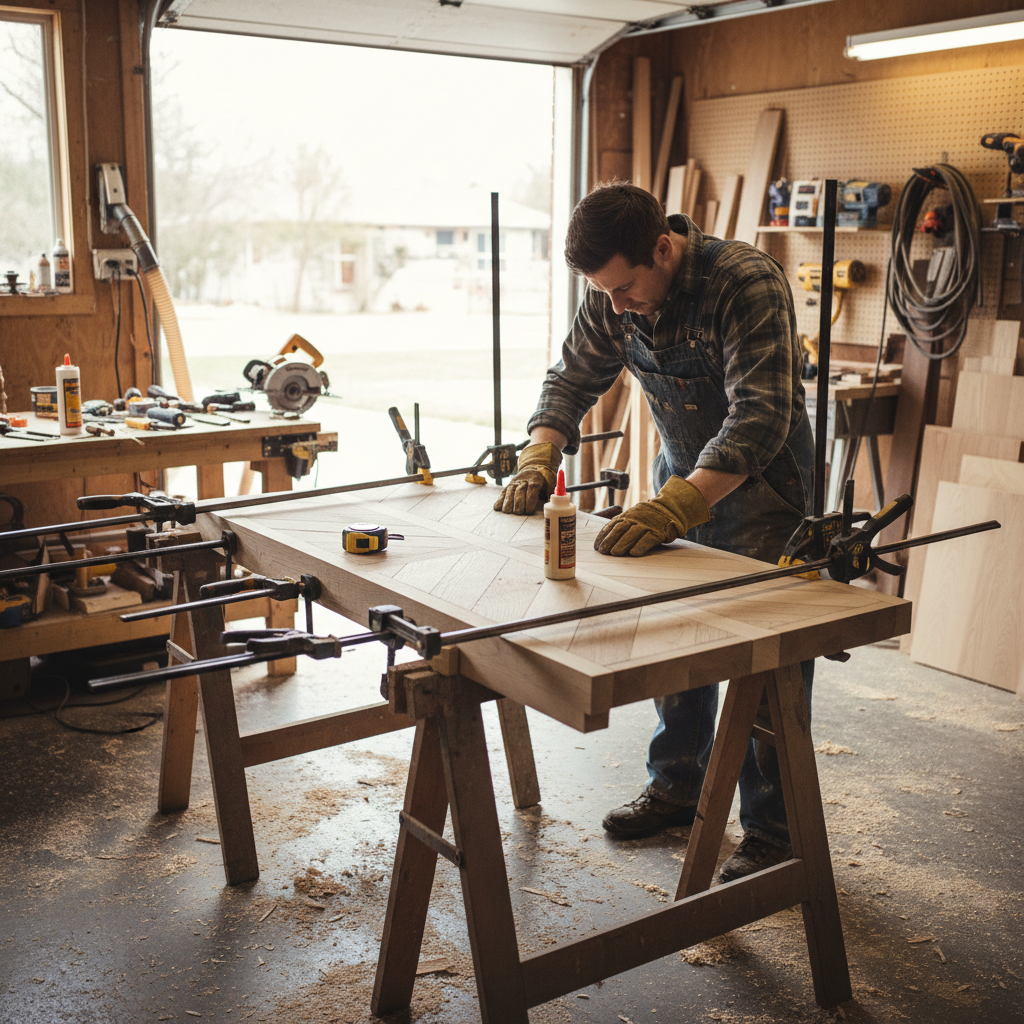
Lay all boards face-down on a flat surface. A garage floor or a couple of sawhorses with a sheet of 3/4-inch plywood bridging them both work fine. The surface doesn't need to be perfectly level, but it does need to be flat. An uneven assembly surface is the most common reason beginner panels come out twisted.
Run a bead of wood glue along each mating edge before clamping. The glue joint, once cured, is stronger than the wood fibers themselves. The pocket screws are really just clamps holding everything in position while the glue dries. Don't skip the glue thinking the screws alone are enough. They aren't, particularly on a panel this size that will flex slightly with seasonal wood movement.
Clamp the panel together, check the diagonal measurements corner to corner, and adjust until both diagonals are equal. That's your squareness check. Drive the pocket screws once the panel is square. Let the glue cure for at least two hours before moving on to sanding.
If you skip the squareness check and just drive your screws, you'll end up with a parallelogram instead of a rectangle. It won't be obvious until you hang it against the wall, and by then the glue has set.
Finishing: Sanding, Staining, and Sealing Without the Frustration
Sand in stages. Start with 120-grit across all faces and edges, then finish with 220-grit. The 120-grit removes milling marks and levels any slight height differences between boards at the joints. The 220-grit closes the grain enough that stain absorbs evenly rather than blotching at the joint lines.
If you're staining pine, apply a pre-conditioner (Minwax Pre-Stain Wood Conditioner is the most commonly available product at hardware stores nationwide) before the stain coat. Pine's uneven density causes stain to absorb in dark blotches around the growth rings without it. The pre-conditioner takes 15 minutes to apply and dries in about 30 minutes. Skipping it is the most consistent finishing mistake beginners make, and it produces a result that looks like a mistake rather than a design choice.
Apply your stain with a foam brush or lint-free rag, wipe off the excess within 3 to 5 minutes, and let it dry fully before the topcoat. Two coats of water-based polyurethane over the stain gives you a durable surface that resists the oils from hands and hair. Water-based poly dries faster than oil-based (about 2 hours between coats versus overnight) and doesn't yellow pine the way oil-based formulas do over time.
The better question is whether you actually need a topcoat at all. For a headboard that won't see direct moisture or heavy abrasion, a single coat of Minwax Wipe-On Poly is genuinely sufficient and much easier to apply without brush marks. Reserve the full two-coat sanded system for headboards with painted finishes, where surface durability matters more.
Mounting: Getting It Onto the Bed Frame Without Gaps or Wobble
Most standard metal bed frames have pre-drilled mounting holes in the headboard brackets at the head end. The hole spacing is typically 2 inches wide on center, matching a 2×4 leg you attach to the back of your headboard panel.
Cut two vertical legs from 2×4 stock, each about 10 inches taller than your finished headboard height. That extra 10 inches is the portion that slides down between the mattress and the frame rails, held in place by bolts through the frame's headboard bracket holes. Standard bolt size for most US bed frames is 5/16-inch diameter. Bring a bolt from your frame to the hardware store rather than guessing.
Attach the 2×4 legs to the back of the headboard panel with 2-1/2 inch wood screws, two screws per leg at the top and two at the bottom of each leg. Position the legs so the top of each leg is flush with the top of the panel. Check that the legs are parallel before driving the screws, or the headboard will cant sideways when mounted.
Slide the finished assembly onto the bed frame, insert the bolts through the frame brackets and legs, add a washer and nut, and tighten by hand until snug, then a quarter turn with a wrench. Don't overtighten. The connection is load-bearing in shear, not compression, and overtightening in soft 2×4 pine will strip the wood around the bolt hole within a few months of normal use.
| Step | Tool or Material | Common Beginner Mistake |
|---|---|---|
| Lumber selection | 1×6 pine or poplar | Using rough construction 2×4 face boards |
| Joinery | Pocket hole jig, wood glue | Skipping glue and relying on screws alone |
| Squaring the panel | Tape measure, clamps | Not checking diagonal measurements before driving screws |
| Stain prep (pine) | Pre-stain conditioner | Staining without conditioner, causing blotching |
| Mounting | 2×4 legs, 5/16-inch bolts | Overtightening bolts into soft pine legs |
Run through that list before you start each stage and you'll avoid the five mistakes that send most beginner headboards to the garage unfinished.