Carpenters who build furniture for a living will tell you to dimension your lumber before you draw a single cut line, and there's a reason for that. A TV stand or media console sounds like a beginner project until you realize it's essentially a wide, shallow cabinet that has to stay square under a load that can exceed 100 pounds, sit level on imperfect floors, and look deliberate rather than assembled. The gap between those two descriptions is where weekend projects go wrong.
This guide covers building a straightforward media console from dimensional lumber or sheet goods over a Saturday and Sunday, the kind of piece that holds a 55-to-65-inch television, a receiver, and a game console without flexing. What it won't cover is veneered plywood cabinets with face frames and inset doors, which require a different skill set and more than two days. If you're after a custom built-in, this isn't your article.
The honest tension in a weekend build is this: the steps that make furniture strong (dry-fitting, clamping time, staged finishing) require patience that a two-day deadline punishes. You can finish this project in a weekend, but only if you've bought and prepped your material beforehand. Show up Saturday morning with rough boards and you'll finish Sunday night with something that still needs a week of drying time before you can set anything on it.
What You're Actually Building and Why the Dimensions Matter
A typical media console runs 48 to 60 inches wide, 16 to 18 inches deep, and 18 to 22 inches tall. Those aren't decorative conventions. The height puts a 55-inch TV screen at roughly eye level when you're seated on a standard sofa, and the depth accommodates A/V components while keeping the piece from looking like a shelf. Deviating significantly from those ranges is fine, but understand what you're trading.
Go deeper than 20 inches and the piece starts looking like a sideboard. Go shallower than 14 inches and a 65-inch TV's own base may overhang the front edge. Go taller than 24 inches and you'll want to wall-anchor the TV, because the center of gravity shifts badly. The Consumer Product Safety Commission has documented thousands of tip-over injuries annually from unsecured furniture, and a tall, narrow media cabinet with a large TV is exactly the geometry that produces them. If you build taller than the ranges above, anchor the piece to a wall stud using a furniture anti-tip strap before you load it.
Or rather: anchoring isn't just for tall builds. Any freestanding media console holding more than about 80 pounds of combined TV and components should be strapped to the wall if children are in the home. The weight alone doesn't cause tip-overs; the leverage from a child pulling on the front edge does. Build the anchor point into your design from the start, because retrofitting a bracket through a finished back panel is genuinely annoying.
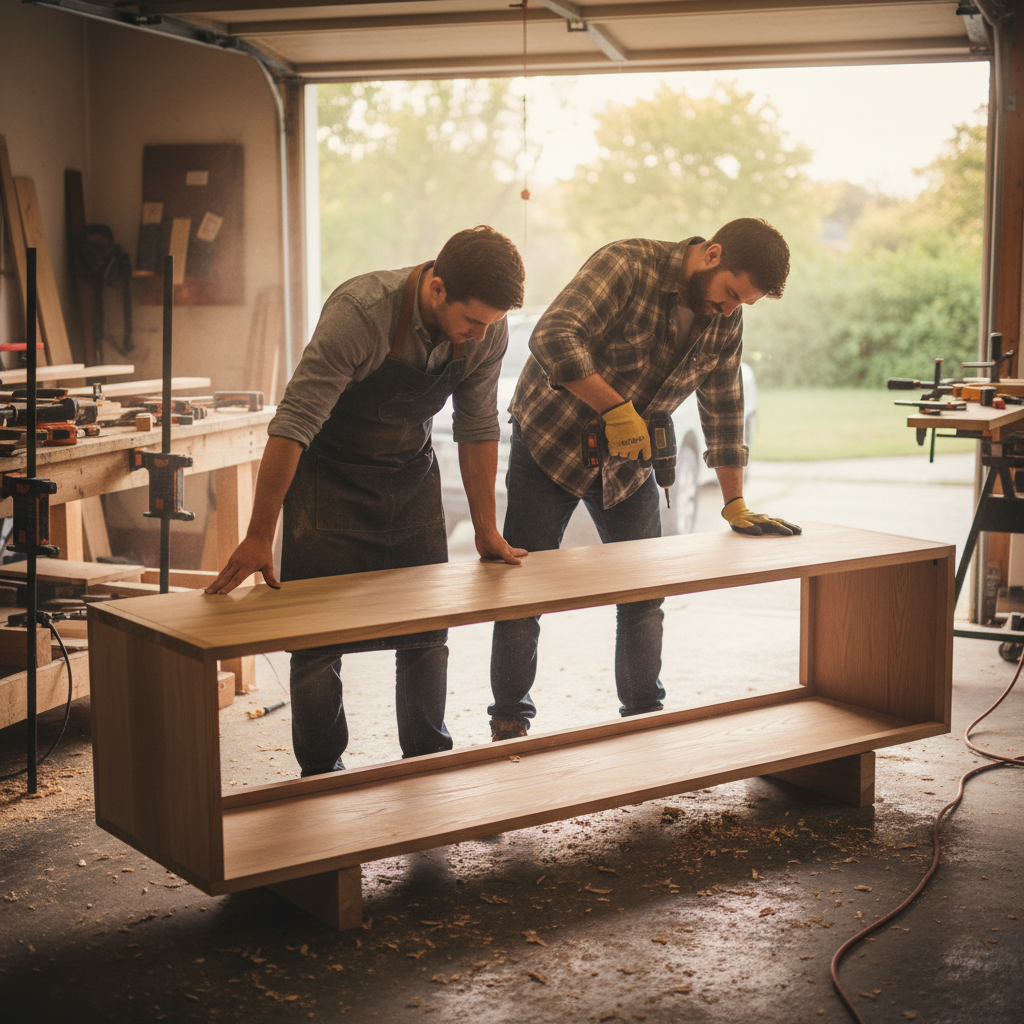
The build this article describes has two fixed shelves, an open center bay for a receiver or streaming device, and solid side panels. No doors. Doors add hardware, fitting time, and a full extra skill (hanging doors true in a frame) that makes this a three-weekend project, not two days.
Material Selection: What Actually Holds Up
The choice most builders get wrong is treating all sheet goods as equivalent. They're not. For a media console, you have three realistic options, each with a different failure mode.
3/4-inch hardwood plywood (birch or maple face veneer) is the most common choice for good reason. It's dimensionally stable, takes paint and stain predictably, and 3/4-inch is stiff enough to span 48 inches without a center support, though adding one is still smart. The edge grain needs filling or banding. A 4x8 sheet of cabinet-grade birch plywood runs roughly $70 to $110 at a big-box store depending on your market, and you'll need two sheets for a 60-inch console with a back panel.
I'd start with birch plywood if you've never built case furniture before. It's forgiving of minor measurement errors, and you can cut it with a circular saw and a straightedge guide rather than a table saw.
Dimensional pine or poplar works well for a solid-wood build and gives the piece a different feel, but you'll need to edge-glue boards to get panels wide enough for the sides and top. That means clamps (a lot of them), glue drying time, and surfacing the glue joint flat before assembly. Doable in a weekend if the glued panels are dry before Saturday, not if you're gluing them that morning.
MDF is the budget option. It machines cleanly, paints beautifully, and costs less than plywood. It also weighs significantly more, doesn't hold screws well near edges without special fasteners (pocket screws into MDF end grain will work loose over time), and has no tolerance for moisture. For a media console that will stay in a climate-controlled room and never move, MDF painted with a good primer is fine. For anything else, it's not great.
Whatever material you choose, buy it the week before. Let it acclimate to your shop or garage for a few days. Wood and sheet goods that come straight from a warehouse that wasn't climate-controlled will move as they adjust, and that movement will open joints you thought were tight.
Joinery: What Holds and What Fails Under Load
This is where most guides get comfortable with vague language. "Join the sides to the top" doesn't tell you what happens when the joint fails three years later because you used drywall screws into face grain.
For a media console, you have three joinery approaches that are genuinely appropriate for a weekend skill level.
Pocket screws (using a Kreg jig or similar) are fast, strong when used correctly, and require no specialized woodworking background. A pocket screw driven at the correct angle into the face of a panel, pulling the mating piece tight, produces a joint that's adequate for furniture under static load. The critical detail: drill the pocket in the piece you want hidden (the shelf, not the side panel), and use the correct screw length for your material thickness. The Kreg jig guide specifies screw length by thickness; follow it. Using too-long screws will blow through the face of your panel.
Dado joints cut with a router or table saw give you a mechanically interlocking shelf that can't sag or pull away from the side panel under load. A 3/4-inch dado cut 3/8 inch deep across the inside face of each side panel, with the fixed shelf fitted into it, is the strongest option available without specialized tooling. It requires a router with a straight bit and an edge guide, or a table saw with a dado stack. If you have either, use this method for the fixed shelves. The router approach takes longer but doesn't require the table saw.
Biscuit joints align pieces and add some shear resistance, but they're not structural on their own. Use them for alignment during glue-up, not as primary fasteners.
Avoid relying on glue alone for structural joints in case furniture. Wood glue on a long-grain-to-long-grain joint (like a face glue-up of two boards) is extremely strong, often stronger than the wood itself. But glue on end grain, which is what you get when you glue a shelf end to a side panel, is weak. End-grain joints need mechanical fasteners. Pocket screws, dados, or both. The failure mode for an end-grain-glue-only joint is that it holds fine until someone puts a heavy amplifier on the shelf and then it lets go slowly over months, finally giving way when it's loaded.
But here's what that failure actually looks like in practice: the shelf doesn't collapse suddenly. It creeps downward, opening a gap at the joint, until the shelf is visibly tilted. By then you've already scratched whatever was sitting on it and probably bent a cable. The fix requires unloading the whole cabinet, which means moving your TV. Build the joint right the first time.
Weekend Schedule: What Goes on Which Day
Saturday is for milling, cutting, and dry-fitting. Sunday is for glue-up, fastening, and finishing. That division isn't arbitrary. Glue needs time, and any finish (even a fast-drying water-based polyurethane) needs at least one overnight cure before you put weight on it.
Check these four things before Saturday morning: lumber acclimated at least 48 hours, all hardware purchased (screws, pocket jig, sandpaper through 180 grit, finishing supplies), a cutting list with every part dimensioned, and clamps counted. You need at minimum six bar clamps or pipe clamps for a 60-inch console glue-up. Showing up with two bar clamps is a common mistake that forces you to glue in stages, which breaks the weekend schedule.
Saturday morning: Break down sheet goods or rough lumber to rough size (about an inch oversize in each dimension). This is the step where a track saw or a circular saw with a straightedge guide earns its keep. Cut plywood on a sheet of rigid foam insulation on the floor to support the panel and protect your blade.
Saturday afternoon: Cut all parts to final dimension. Mill dados if your design uses them. Drill pocket holes. Sand all inside faces to 150 grit before assembly (you cannot reach inside faces after the case is together). Dry-fit the entire piece without glue or fasteners, using clamps to hold it. Check for square by measuring diagonals: if both diagonals are equal, the case is square. If they differ by more than 1/8 inch, find the cause before you glue anything.
Sunday morning: Glue-up and fastening. Apply glue to mating surfaces, bring the case together, drive pocket screws or seat the dadoed shelves, and clamp. Check square again immediately after clamping, before the glue sets. A cabinet that's out of square when the glue dries is out of square permanently. Let the glue cure for a minimum of two hours (Titebond original reaches full strength in 24 hours, but two hours of clamping gives you a working joint).
Sunday afternoon: Apply finish. Sand the exterior with 180 grit after assembly to knock down any raised grain or minor misalignment at joints. Wipe down with a tack cloth. Apply your first coat of finish. A water-based polyurethane like Minwax Polycrylic dries to the touch in two hours, which means you can apply a second coat late Sunday afternoon. You won't want to put anything on it until Monday evening, though. Loading the shelf with a 90-pound television hours after the final coat is how you get permanent impressions in the finish.
If you ignore the drying time and load the console Sunday night, the finish won't be properly cross-linked yet and the weight will mark it. The marks are permanent without refinishing.
Finishing and When Things Go Wrong
The finish step is where weekend projects most often compress into a mistake. A few specifics that matter here.
For a painted finish, use a shellac-based primer (Zinsser BIN is the standard) over bare wood, especially MDF or poplar. Oil-based primer raises grain less than water-based on porous wood. Latex paint over unprimed MDF will raise the surface fibers into a texture you can't sand out without going back to bare material. Prime first.
For a clear or stained finish on birch or maple plywood, test your stain on a scrap of the same sheet before you commit. Birch plywood's face veneer is thin (often 1/28 inch or less on lower-cost sheets) and absorbs stain unevenly where the veneer splice lines run. A pre-conditioner applied before staining helps, but you might discover the wood takes the color you wanted on the scrap and looks blotchy on the actual panel. This is not a flaw you can fix at assembly time.
The most common structural problem people discover at assembly is racking: the case wants to lean to one side because the back panel isn't attached yet. A 1/4-inch plywood back panel nailed into a rabbet around the perimeter is the correct fix, and it's the step that most beginner builds skip. A case without a back panel depends entirely on joint rigidity to resist racking. With a back panel, even a modest one, the whole structure becomes a torsion box and stays square under load. Nail it on. Don't skip it.
(The back panel also hides cable management chaos, which you'll thank yourself for later.)
Finishing Strong: What to Do Before You Set the TV Down
If the build used pocket screws as the primary joinery, give the glue a full 24 hours before loading the shelves with anything significant. The screws hold the joint mechanically, but the glue is what prevents long-term creep.
If you're in a home with children, install the anti-tip strap now, before the TV goes on. Locate a wall stud with a stud finder, drive a 2.5-inch screw into it, and attach the strap to the back upper rail of the console. This takes ten minutes and the straps cost under $15 at most hardware stores. The alternative is a tip-over incident, and those are not recoverable situations.
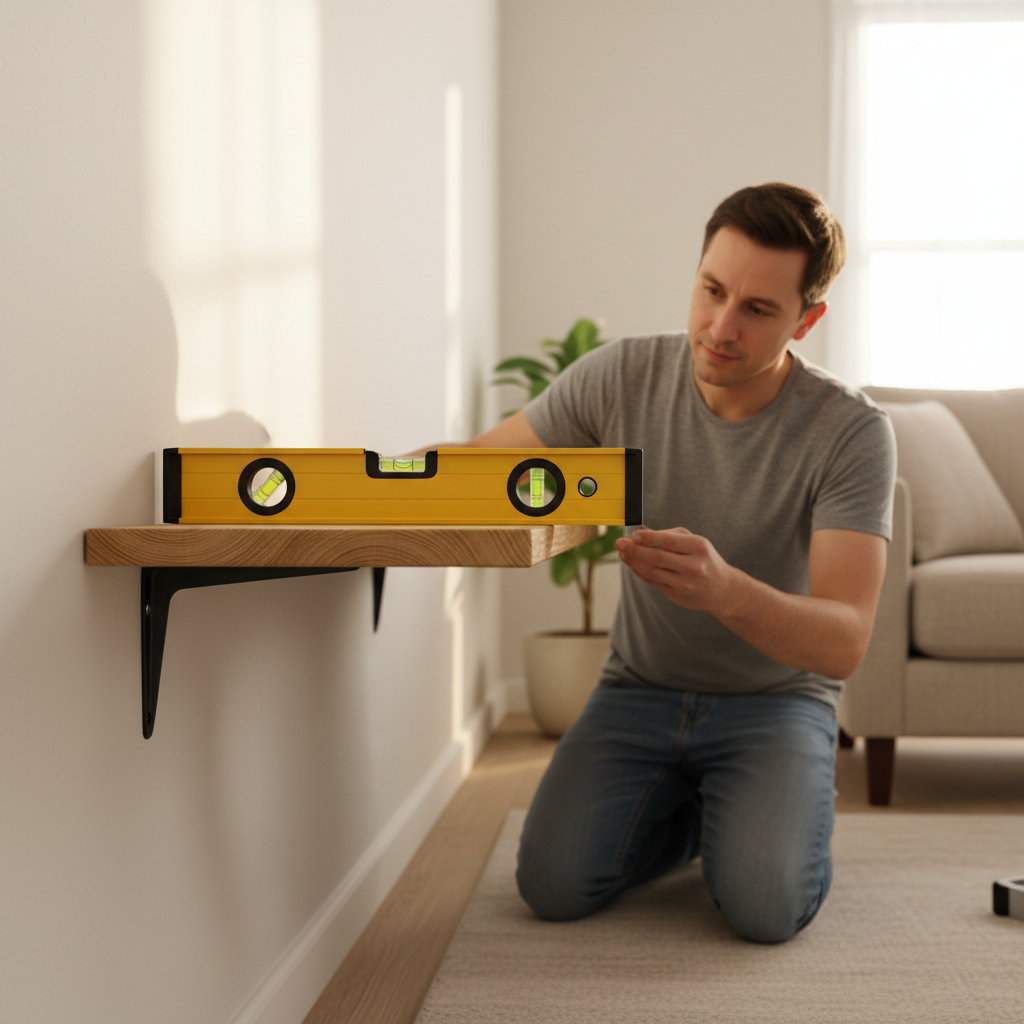
Once the finish has cured for at least 48 hours, use adhesive felt pads on the bottom corners to protect your floor. If the floor is noticeably unleveled, adjustable leveling feet (furniture feet with a threaded insert) let you dial in level without shimming. Drill the insert into the bottom corners before finishing, not after.
Test the case by pressing firmly on each shelf from above and from the front edge. A well-built case should feel completely solid. Any flex at the shelf-to-side joint means the joinery is underperforming and needs reinforcement before loading. Add a pocket screw or a corner block. Do not assume it'll be fine once the TV is on.