Carpenters will tell you to build a box before you build anything else, and there's a reason for that which has nothing to do with boxes.
A bookshelf is the box they mean. It's the first project that forces you to solve more than one problem at once: a flat surface, a right angle, a load-bearing joint, and a finish that has to survive contact with real objects in a real room. Cutting boards and small shelves teach you how a saw feels. A bookshelf teaches you what happens when four separate pieces of imprecise work meet at a single corner.
The tension most beginners don't expect is this: woodworking rewards patience in theory, but a bookshelf punishes impatience in ways that don't show up until the last step. You can cut every board to the right length and still end up with a shelf that rocks, gaps, or refuses to stand square. The gap between knowing how to cut and knowing how to build opens right there, and most early projects never put you in front of it.
This article is for people starting woodworking who want to know what a bookshelf will actually teach them, not just what they'll make. It is not a build guide, and it won't tell you which bookshelf plan to buy.
The Skills a Bookshelf Teaches That Simpler Projects Don't
A cutting board asks one thing of you: keep the blade straight. A small wall shelf asks two: keep the blade straight, and drive a screw without splitting the wood. A bookshelf asks something categorically different, which is why it sits at a different rung on every serious woodworking curriculum.
The skill that separates bookshelf-builders from board-cutters is cumulative error management. Every measurement you take introduces a small margin. On a single piece, that margin disappears into the finished object. On a bookshelf, four or six pieces with their own small margins meet each other. A 1/32-inch deviation per board adds up to a visible gap at the joint, a shelf that won't sit level, or a back panel that has to be forced into place. No birdhouse or picture frame puts you inside that problem.
Or rather: it's not just that the errors accumulate. It's that on a bookshelf, the errors compound directionally. A side panel that's 1/8 inch out of square doesn't just produce a 1/8-inch gap. It rotates the entire assembly, which means your shelves slope, your back panel fights you, and the piece wobbles on the floor even though every individual piece measured fine. Understanding that distinction changes how you approach the ruler before your first cut.
Joinery is the second thing. A cutting board has no joints. A birdhouse has butt joints held with nails. A bookshelf, built properly, requires you to choose between a dado joint, a pocket screw joint, a rabbet for the back panel, or some combination. Each choice carries structural consequences that show up under load. Pocket screws are faster; dados are stronger and keep shelves from sagging under book weight over years. Making that decision for real, for a piece you'll actually use, teaches more than any instructional video about the same choice made in the abstract.
Then there's wood movement. Solid wood expands and contracts across the grain as humidity changes. In most US regions, that seasonal swing is real enough to crack a joint or bow a panel if you've glued across the grain without accounting for it. Plywood is more dimensionally stable, which is why most beginner bookshelf plans call for it, but even plywood has a good face and a bad face, a strong axis and a weak one. Learning to read the sheet before you cut it is a skill that doesn't come up when you're making something that lives entirely in one plane.
I'd start any new woodworker with a bookshelf rather than a box or a shelf bracket, specifically because it introduces all three of these problems at a scale where the consequences are visible but not catastrophic.
What Measuring Across Multiple Pieces Actually Demands
Marking and measuring on a single board is forgiving. You measure once, mark once, cut once. The margin for error on a cutting board is wide enough that most beginners never notice they're not being precise.
A bookshelf has two side panels that must be identical in length, two or more shelves that must be identical in width, and a back panel that must square the whole assembly. The moment you're cutting multiples, you're exposed to a principle that experienced woodworkers call story stick layout: rather than measuring each piece independently from a tape, you mark all the cuts from a single reference piece, so any small error in your first measurement is shared by every piece instead of compounding differently across each one.
Beginners who skip this and measure each board separately from the tape end up with side panels that differ by 1/16 inch, which sounds trivial until the shelf sits visibly unlevel on a flat floor. The tape measure isn't the problem. Re-measuring is the problem. A bookshelf is the first project that makes you feel that lesson in your hands rather than read it in a book.
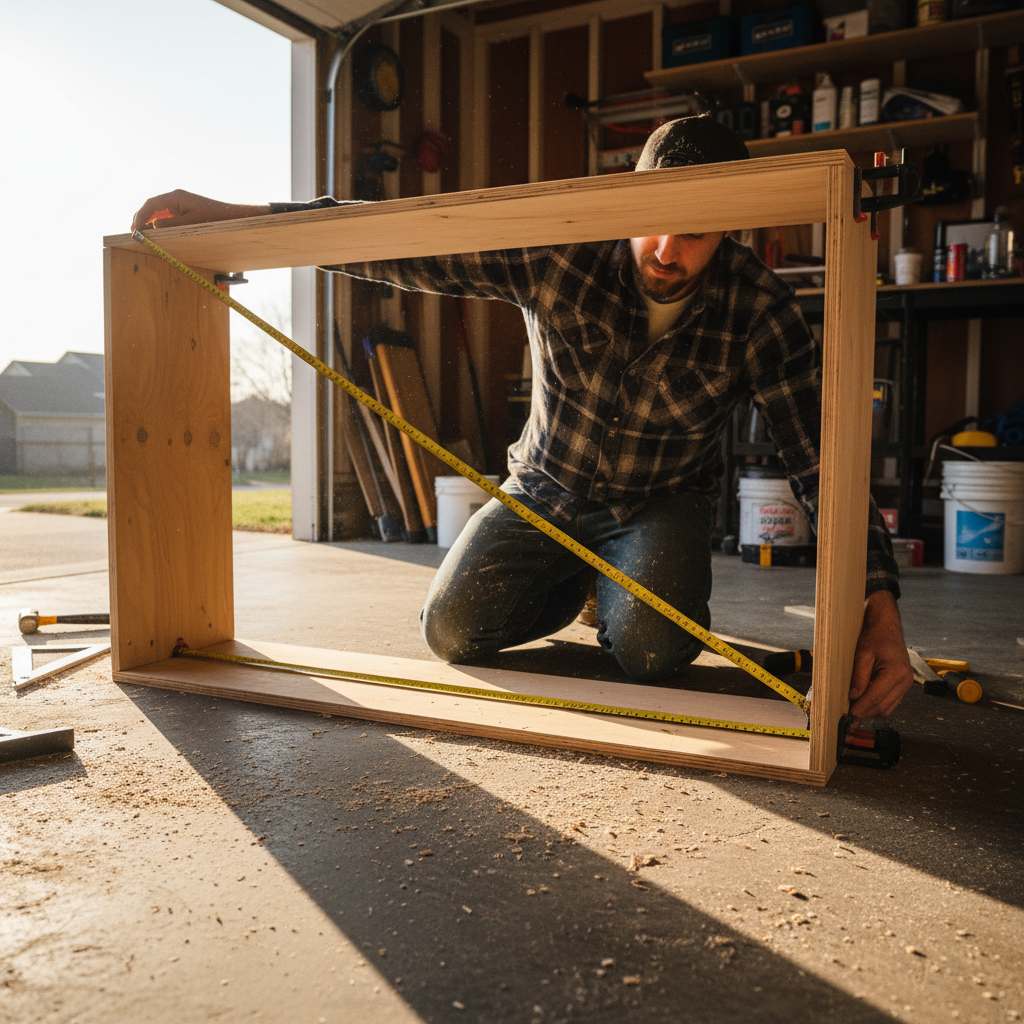
Squaring the assembly adds another layer. After glue-up, you check for square by measuring diagonally corner to corner. If both diagonals match, the assembly is square. If they don't, you clamp across the longer diagonal to pull it into square before the glue sets. This is a technique you'll use for the rest of your woodworking life, on cabinet carcasses, face frames, and door frames. A shelf bracket never requires it. A cutting board never requires it. A bookshelf requires it every time, and if you skip it, the piece will be out of square forever once the glue cures.
Finishing as a Structural Decision, Not a Cosmetic One
Sanding and applying finish to a cutting board teaches you what sandpaper grits feel like and how a wipe-on oil behaves. That's useful. But finishing a bookshelf requires decisions that a cutting board never forces.
Do you finish the interior surfaces before assembly, or after? Finishing before assembly is easier because you can lay the panels flat and avoid brushing into corners. But if your glue joints aren't perfect, finish on the mating surfaces will prevent a strong bond. This is not a preference question. It's a sequencing decision with structural consequences, and getting it wrong means either a weak joint or a finish that looks rough inside the case.
The other finishing decision unique to case pieces is edge treatment. Plywood edges are ugly. You can cover them with iron-on edge banding, solid wood edge tape, or a thin solid wood strip glued on. Each option handles differently, looks differently, and holds finish differently. The choice matters more on a bookshelf than on almost any other beginner project because the edges are visible on every shelf, from the front, every time someone looks at the piece. A cutting board's edges are largely incidental.
Buyers who skip the bookshelf in favor of smaller projects and then attempt a cabinet or media stand typically hit all three of these finishing problems at once, at larger scale, with more expensive materials. That's the cost of the shortcut.
When a Bookshelf Is the Wrong First Project
A bookshelf is not the right starting point for everyone.
If you don't yet own a reliable way to make a straight crosscut, meaning a miter saw, a table saw with a crosscut sled, or a circular saw with a quality straightedge guide, a bookshelf will punish you before you learn anything useful. The project's lessons depend on being able to produce square cuts repeatedly. Without that, you're fighting the tool before you're learning the skill, and frustration replaces education.
Similarly, if you're working with hand tools only and haven't yet learned to use a hand plane or chisel with reasonable control, a bookshelf built with hand tools requires fitting joints to a precision that takes most people months of practice to reach. In that case, a dovetail box or a simple stool built with mortise-and-tenon joints will teach joinery more effectively at the hand-tool stage.
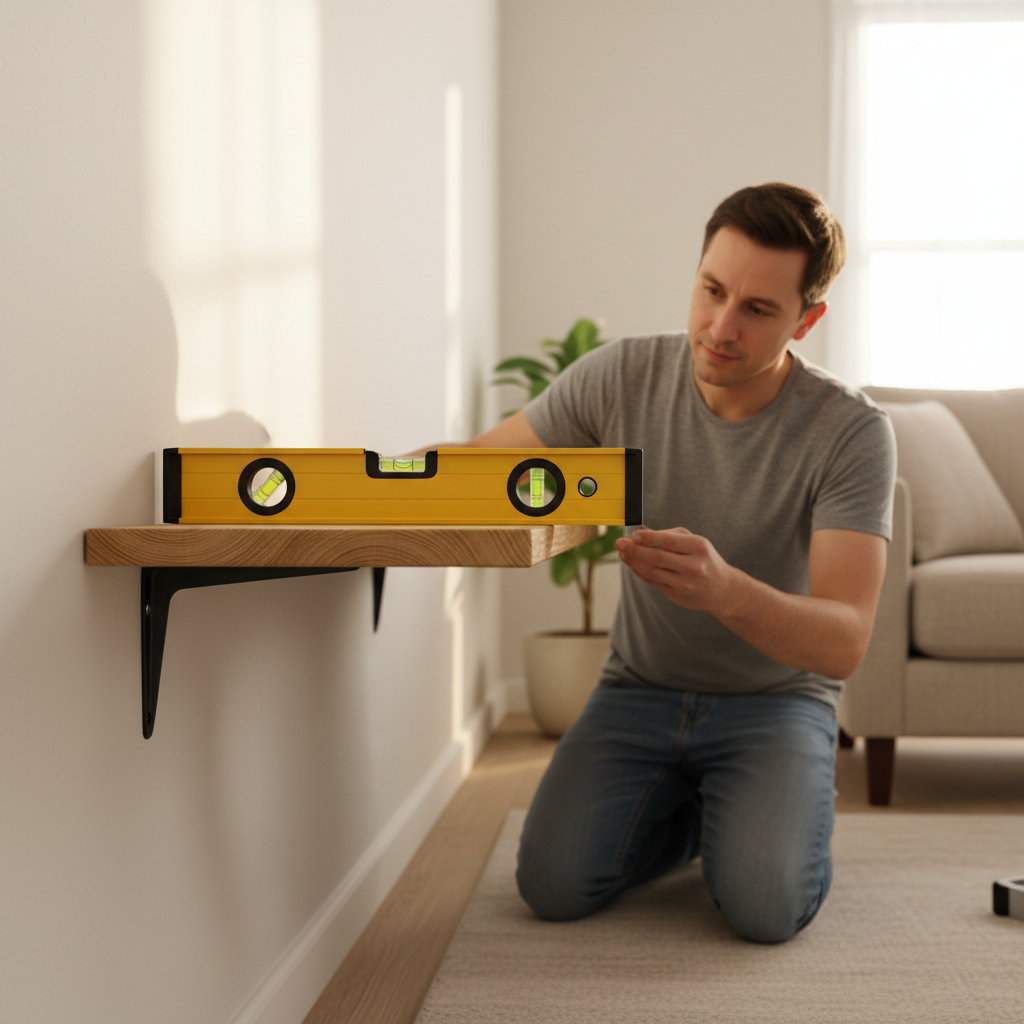
The alternative most beginners actually choose is a set of floating wall shelves. Those teach you to use a level, drive fasteners into studs, and make a clean finish pass on a single board. Those are real skills. But floating shelves don't teach cumulative error management, joinery, or assembly squaring because they have no joints, no case assembly, and no interaction between multiple structural pieces. They're a good first project for someone who needs a win. They're not a substitute for a bookshelf if the goal is to develop as a woodworker.
Build the floating shelves first if you need to. Then build the bookshelf.
A Honest Look at What You're Getting Into
A basic plywood bookshelf with three fixed shelves takes most beginners eight to twelve hours across two or three sessions. That's a practical heuristic, not a guarantee. The first session almost always takes longer than planned.
Materials for a straightforward four-foot-tall bookshelf in 3/4-inch birch plywood typically run $80 to $140 at a big-box store, depending on your region and current lumber prices. Add pocket-screw hardware, sandpaper, and a quart of finish and you're looking at $120 to $180 total. That's more than a birdhouse kit and less than a set of floating shelf hardware for the same linear footage of storage.
What you'll notice when you compare that cost against what the project teaches is that you're buying eight to twelve hours of compressed skill development that would take three or four smaller projects to approximate. The economics are straightforward if the goal is skill-building rather than producing a specific object.
One more thing: a bookshelf exposes how well your shop is set up. If your workbench flexes when you clamp, if your measuring tape has slack in the hook, if your square isn't actually square, those problems become visible during a bookshelf build in a way that smaller projects absorb. That's not a reason to avoid the project. It's a reason the project is valuable.
Starting the Build Right
Pick a plan with fixed shelves rather than adjustable shelf pins for your first build. Dados cut to receive fixed shelves teach joinery, lock the shelf position permanently, and add rigidity to the case. Adjustable shelves on pins are convenient furniture but a lesser learning experience.
Before you cut anything: check your square, tension your tape hook, and cut a test dado in scrap to confirm your router bit or table saw blade is set correctly. Those three checks cost fifteen minutes and prevent most of the problems that send beginners back to the lumber yard for a second sheet of plywood.
The skills this project builds transfer directly: dado joinery appears in cabinet-making, built-ins, and shop storage. Diagonal squaring appears in every box and case you'll build for the rest of your life. Cumulative error management is the foundation of furniture-grade precision. None of those skills come from a cutting board.
Start cutting when your reference pieces are marked, not measured independently. That one habit, learned on this one project, will follow you forward.