
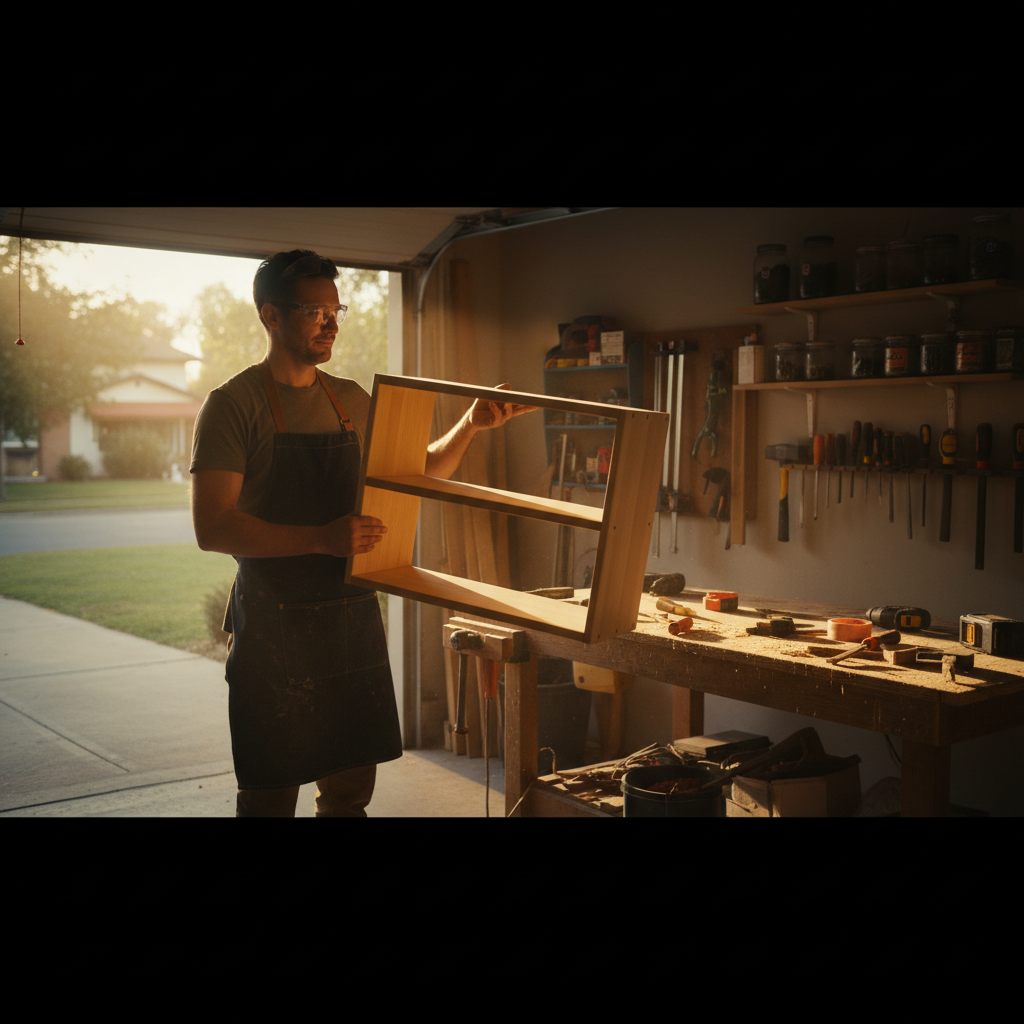
Carpenters will tell you to measure twice before you cut anything, and the reason has nothing to do with saving lumber. It's because the most expensive mistake in a first furniture project isn't the wasted wood - it's the wasted afternoon you spend reassembling something that was never going to work. Building a bookshelf is genuinely manageable as a first project, but the variables that separate a sturdy shelf from a wobbly disappointment are easy to miss when every tutorial makes the process look effortless.
The decisions that actually matter here are wood species, shelf span, and fastener choice - three things that interact in ways that aren't obvious until your shelf is already sagging under a row of hardcovers. A pine shelf running 36 inches between supports will deflect noticeably under a full load of books. That's not opinion; it's basic material behavior. Whether your build succeeds or fails often gets decided at the lumber yard, not in the garage.
What this guide will not cover is cabinetry-grade joinery, router work, or builds requiring a table saw. If you want mortise-and-tenon construction or dadoed shelves cut on a contractor saw, this isn't that article. The reader this is written for has basic tools, limited shop time, and wants a bookshelf that looks intentional and holds real weight without requiring a second attempt.
Here's the tension worth sitting with before you buy anything: the simplest-looking bookshelf designs are often the ones that demand the most precision, because there's nowhere to hide a measurement error when the piece is just four boards and some fasteners.
Choosing the Right Wood Before You Touch a Saw
The single decision that controls everything else in this build is wood selection, and it's the one step where beginners consistently get bad advice. Most beginner guides tell you to grab whatever dimensional lumber is cheapest at the home center. That works fine for a small shelf holding decorative objects. For a shelf that will actually hold books - which run between 20 and 40 pounds per linear foot once packed - you need to think about two things: species stiffness and board quality.
Stiffness in lumber is described by its modulus of elasticity (MOE). For shelves, higher MOE means less sag over a given span. Common dimensional pine (sold as #2 common or whitewood at big-box stores) has a relatively low MOE compared to poplar or hard maple, meaning a 36-inch pine shelf will deflect more under load than the same shelf in poplar. I'd start with poplar if you want a paintable hardwood at a reasonable price - it's widely available at Home Depot and Lowe's, machines cleanly, and holds screws better than pine.
Or rather: poplar is the better choice for painted shelves specifically. If you want a stained or natural finish, poplar's greenish-gray grain looks blotchy under stain and you're better off with alder, which accepts stain evenly and costs comparably. The point isn't to memorize species charts - it's to understand that your finish choice and your wood choice are linked decisions, not independent ones.
What to check at the lumber yard: sight down every board from one end, reject anything that cups or bows more than 1/8 inch over its length, and look for boards with tight grain lines (more lines per inch = denser, stiffer wood). Spend ten minutes picking boards. This is not optional. A warped board will telegraph through your finished piece no matter how carefully you assemble it.
One practical note on thickness: standard dimensional 1×10 or 1×12 lumber (which actually measures 3/4 inch thick after milling) is the right choice for shelves up to 32 inches wide. Go beyond 32 inches with 3/4-inch material and you will get visible sag under a full book load within a year. Either add a center support, reduce the span, or move up to 1-inch-thick stock (sold as 5/4 board).
Tools You Actually Need (and What You Can Skip)
A beginner bookshelf build doesn't require much. The honest list is short: a circular saw or miter saw for crosscuts, a drill/driver, a pocket hole jig (the Kreg R3 or similar), clamps, a square, a tape measure, and sandpaper in 80, 120, and 220 grits. That's it. You do not need a table saw, a router, or a biscuit joiner for this build.
The pocket hole jig deserves its own sentence because it's the tool that makes this project feasible for a first-timer. Pocket screws create strong, hidden joints that pull boards together tightly during assembly, and they forgive the minor alignment errors that plague beginners. Without one, you're either face-nailing (which looks rough) or attempting dowel joints (which require more setup than the project warrants).
Clamps matter more than most guides admit. You need at least four bar clamps or pipe clamps long enough to span your shelf width. Assembly goes wrong when boards shift before fasteners seat. Clamp first, then drive screws.
Skip the brad nailer for structural joints - nails alone won't hold a loaded shelf long-term. Fine for attaching a back panel, not for the carcass.
The Assembly Sequence That Prevents Most First-Timer Mistakes
The sequence matters as much as the technique. Assembling a bookshelf out of order is how you end up with a clamp you can't reach or a screw you can't drive. Here's the order that works:
- Sand all faces and edges before assembly. You cannot sand inside corners after the case is together.
- Drill pocket holes in the ends of each horizontal shelf board (not into the verticals).
- Assemble the top and bottom first: clamp one vertical side panel flat on your work surface, attach the top shelf, then the bottom shelf, driving pocket screws while the clamps hold everything square.
- Check for square by measuring diagonals. Both measurements must match within 1/16 inch before you add the second vertical.
- Add the second vertical, clamping and checking square again before driving fasteners.
- Install interior shelves last, after the outer carcass is rigid.
The diagonal measurement step is non-negotiable. A case that's even slightly out of square will rack over time, the doors (if any) won't hang right, and the whole thing will look off even if you can't immediately name why. Buyers skip this step till burned.
If you do nothing else in this build, do these two things: pre-sand every surface before assembly, and check diagonal measurements before adding the second side panel. Everything else is recoverable. A twisted carcass is not.
What happens if you skip the squaring step entirely? The shelf might look fine the day you build it. But wood moves seasonally, and a case that's even 1/4 inch out of square will develop a visible lean within a year as the joints work under that stress. You'll be looking at a wobble that no amount of shimming fully fixes.
Finishing Without Making It Look Like a First Project
The finish is where a bookshelf either looks like furniture or looks like a shop project, and the gap between the two is mostly about prep, not product.
For a painted finish: fill all pocket holes with pocket hole plugs or wood filler, let it dry fully, then sand flush with 120-grit before priming. Use a shellac-based primer (Zinsser BIN is the standard choice) if you're painting over pine or poplar - it blocks tannin bleed and gives you a cleaner topcoat surface. Two coats of a water-based cabinet paint (Benjamin Moore Advance is well-regarded for this) applied with a foam roller will give you a finish that looks sprayed at a fraction of the effort. Skip latex wall paint; it stays tacky on furniture surfaces and doesn't harden properly.
For a stained finish on alder or similar: raise the grain by wiping the surface with a damp cloth, letting it dry, then sanding with 220-grit before applying stain. This prevents the grain from popping up rough after the stain goes on. Apply a pre-stain wood conditioner first (Minwax makes one widely available) - it prevents blotchy absorption, which is the telltale sign of an amateur finish on open-grained woods.
One thing that makes a significant difference and almost never appears in beginner guides: ease all your edges with 120-grit sandpaper before finishing. Run a light pass along every sharp corner and edge. Sharp corners on furniture look machine-made; slightly eased edges look built. It takes three minutes and changes the whole character of the piece. (It also prevents finish from pulling away from sharp edges, which is a practical reason on top of the aesthetic one.)
Sand to 220-grit between every coat of finish, whether paint or clear coat. Don't skip this. The difference between a one-coat finish and a two-coat finish with intermediate sanding is immediately obvious when you run your hand across the surface.
When This Build Is the Wrong Approach
A simple bookshelf built from dimensional lumber is the right starting project for most people. But there are situations where this approach will disappoint you, and it's worth being direct about them.
If you need a span wider than 48 inches without a center upright, dimensional lumber isn't your material. You're looking at either a built-in with additional support from wall-mounted standards, or a switch to cabinet-grade plywood with solid wood edge banding - a more involved build. Similarly, if the piece will live in a high-humidity space like a basement or laundry room, pine and poplar will move considerably with seasonal moisture changes. In that environment, use a finish with better moisture resistance (oil-based polyurethane rather than water-based) and expect some seasonal movement regardless.
The reader who should not follow this guide is someone building a piece intended to hold more than 50 pounds per shelf on spans over 36 inches. At that load and span, 3/4-inch dimensional lumber will sag, and the right answer is either a thicker shelf, a center support, or a different material entirely. A common guideline among furniture builders is to keep loaded shelf spans under 32 inches for 3/4-inch stock carrying heavy loads - call that a practical rule of thumb, not an engineering standard.
Getting the Build Done
Start at the lumber yard, not the hardware store. Pick your boards in person, check every one for warp, and do the math on your shelf spans before you buy. If you're painting, buy poplar. If you're staining, buy alder. Cut your parts to final dimension, sand everything before assembly, and build the outer carcass before you install interior shelves.
Use pocket screws for the carcass joints. Check diagonal measurements before the glue dries or the second screw goes in. Ease your edges. Prime before painting if you're using pine. Sand between coats.
The tools you need are a drill, a pocket hole jig, four clamps, and a saw. The knowledge you need is mostly about what not to skip. Get the wood selection and the squaring step right, and the rest follows.