Carpenters will tell you to build something you'll actually use before they discuss joinery technique, and there's a reason for that. A project with a real destination keeps you honest when the first cut goes slightly sideways. Weekend woodworking projects for beginners live or die on that principle: the build has to be short enough to finish in two days but meaty enough that you come away having learned something that transfers to the next thing you make.
Three factors actually decide which project is right for you: the tools already in your garage, the species and dimensions of lumber your local home center stocks, and whether you're chasing joinery fundamentals or finishing confidence. Those aren't the same skill set, and conflating them is the most common reason a first project stalls on Saturday afternoon.
Here's the tension nobody names directly. The projects most commonly recommended to beginners, the simple box and the step stool, are genuinely achievable, but they can be finished almost entirely with butt joints and wood glue, which means you can complete them without learning to measure a square corner under real conditions. You finish the weekend with a shelf and no replicable skill. That gap is what this guide addresses.
Why Project Selection Is a Skill Decision, Not a Complexity Decision
The reframe that matters here: a beginner woodworking project is not a simplified version of a real project. It is a deliberate skills acquisition vehicle, and the project you choose should be chosen for the specific skill bottleneck it forces you to solve.
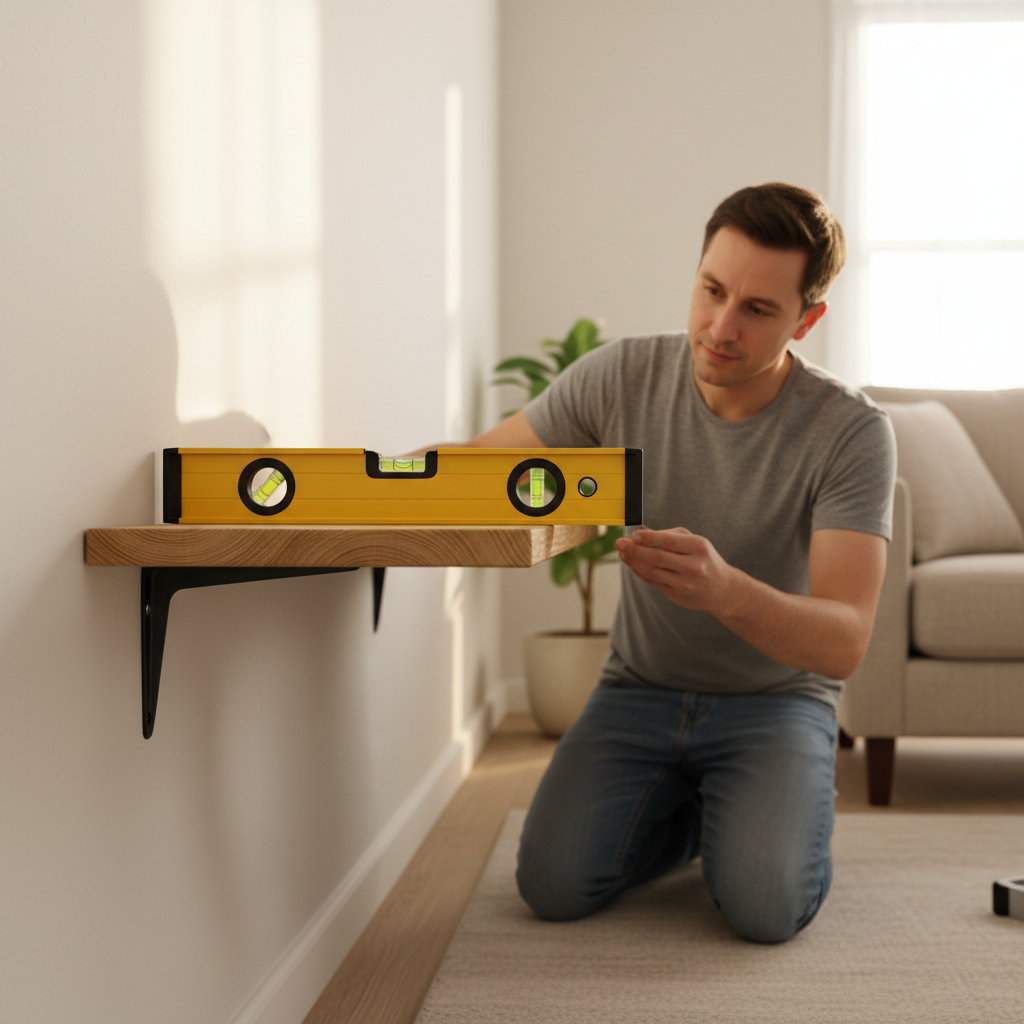
Take a wall-mounted coat rack. On the surface it looks like the simplest possible build: a board with hooks. But a well-designed coat rack requires you to drill evenly spaced holes on a consistent centerline, set a drill bit to a controlled depth, countersink screws flush without blowout, and mount to studs or use appropriate anchors for real load. Those four operations appear in almost every subsequent project you'll ever make. A floating shelf, by contrast, teaches you one thing, dado routing or pocket screws, and then stops.
Or rather: the shelf teaches cutting to length accurately, which is genuinely foundational. But a coat rack stacks four transferable operations into a single afternoon, and that density of learning is what makes it worth prioritizing over something that only feels harder.
This article focuses on projects a beginner can complete with basic tools available at any home center, including a circular saw or miter saw, a drill driver, and clamps. It does not cover projects requiring a table saw, router table, or lathe. If you're working with hand tools only, the rankings shift somewhat, and the workbench build covered later becomes even more relevant.
The Four Projects Worth Your Weekend
Cheap guides miss the fact that project selection is also a materials decision. Every project below is designed around dimensional lumber you can buy at Home Depot or Lowe's in standard sizes, with minimal waste cuts.
The strongest four choices, ranked by skill density rather than difficulty:
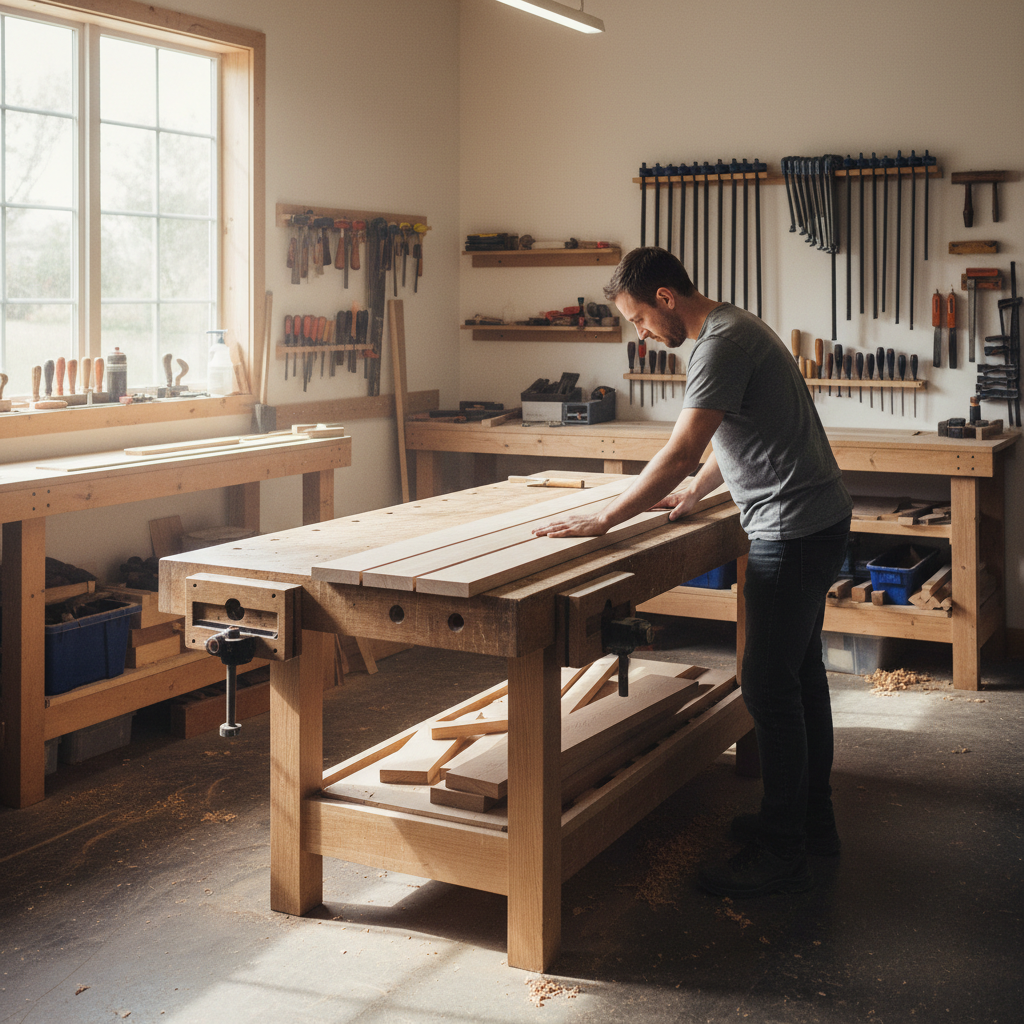
- Simple workbench (4×4 legs, 2×6 top): Teaches layout, square assembly, and structural fastening in a single build. You'll use the result for every project that follows, which raises the stakes appropriately.
- Wall-mounted coat rack with shelf: Forces consistent hole spacing, countersinking, and wall anchoring. Finishes in one day and lives in your house.
- Small bookcase with a fixed shelf: Introduces dadoes or pocket screws, teaches you to check for square during glue-up, and requires a real finishing sequence.
- Tapered serving tray with handles: The most forgiving on the list for fit and finish, but it demands careful crosscuts and teaches you to sand through grits properly, which most beginners skip.
A critical note on the workbench: most beginner guides dismiss it as too ambitious. That's wrong. A 30-inch by 60-inch bench using construction-grade 2×4s and 2×6s costs roughly $60 to $90 in lumber at current home center prices, and the assembly process, drilling pocket screws into a face frame, keeping legs plumb while tightening, checking diagonal measurements to confirm square, covers more fundamentals in one build than three decorative shelf projects combined. I'd start with the workbench if your garage or basement has the floor space.
If space is genuinely the limiting factor, the coat rack is the right call. Not because it's easier, but because it's the next most skill-dense option at a fraction of the footprint.
What Each Project Actually Teaches
Skill transfer is the only metric that matters for a first build. Here's how each project maps to the operations you'll repeat for years:
| Project | Primary Skill | Secondary Skill | Tool Requirement |
|---|---|---|---|
| Simple workbench | Square assembly under load | Structural fastening, layout | Drill driver, miter or circular saw |
| Coat rack with shelf | Consistent hole layout | Countersinking, wall anchoring | Drill driver, level |
| Bookcase with fixed shelf | Dado or pocket-screw joinery | Glue-up squareness check | Drill driver, clamps, router optional |
| Serving tray | Accurate crosscuts | Progressive sanding sequence | Miter saw, random-orbit sander |
The table above shows why the workbench earns the top spot despite its size. No other project on this list teaches square assembly under structural load, the condition where mistakes become visible and expensive. Every other project on this list can hide a slightly out-of-square assembly behind a coat of paint or a thin shim. A wobbly bench leg cannot hide.
The serving tray is the right choice if your primary goal is finishing confidence rather than joinery confidence. Buyers of hand-planed or sanded serving trays at craft markets frequently comment on finish quality before anything else, which tells you something about where aesthetic judgment lands in real-world woodworking feedback.
When the Standard Advice Breaks Down
The standard recommendation for a first woodworking project is a simple box: four sides, a bottom, a lid if you're ambitious. This advice is not wrong, but it breaks down in one specific and common situation. If you're learning from YouTube tutorials rather than in-person instruction, a simple box gives you almost no natural checkpoint where a mentor or a second pair of eyes would catch a compounding error. You can build the entire thing out of square and not realize it until the lid doesn't close.
Projects with functional tolerances, a coat rack that has to hang level, a bench that has to bear weight without racking, force you to verify your work at intermediate stages. That verification habit is the actual skill being developed. Without it, you can complete ten projects and still not know how to build something that performs reliably.
The workbench and coat rack both have built-in verification gates: a level, a square, a diagonal measurement. The serving tray has almost none, which is why it belongs last on the skill-density list despite being technically accessible.
There is also a tool mismatch problem worth naming. A beginner who only has a jigsaw and a cordless drill can build a serving tray and a coat rack reasonably well. The workbench becomes significantly harder without a miter saw or circular saw guide, because long rip cuts on 2×6 stock with a freehand jigsaw produce edges that are difficult to join cleanly. Know your tool inventory before committing to a project.
How to Set Up for a Successful Build Weekend
Preparation accounts for more of your outcome than skill does at the beginner stage. The three things to sort before Saturday morning: a cut list with exact dimensions written out, lumber bought and acclimated for at least 24 hours inside your workspace, and a finishing plan decided in advance.
That last one catches beginners most often. Open your lumber receipt right now and look at how many board feet you actually bought versus how many the project plan calls for. A common guideline in hobby woodworking is to buy 15 to 20 percent more lumber than your cut list requires, to account for defects, bad cuts, and grain matching. That's not an official standard, it's a practical heuristic that experienced builders use consistently, but it's worth treating as a floor rather than a ceiling on your first build.
Acclimation matters more than most beginner guides acknowledge. Dimensional lumber purchased from a home center has typically been stored in a climate-controlled or semi-controlled environment, but your garage in July or January is a different moisture environment entirely. Boards that sit in your workspace for 24 to 48 hours before you cut them are less likely to cup or bow after assembly, which is a failure mode that ruins a glue-up in ways you can't easily reverse.
What you don't need for any of these projects: a pocket-hole jig is helpful but not required for the coat rack or serving tray. A random-orbit sander is worth the $40 to $60 investment at a hardware store before starting the tray. Clamps are non-negotiable for the bookcase glue-up; four 24-inch bar clamps is a reasonable minimum. If you skip the clamps and try to substitute screws alone, the case will pull out of square as the wood moves seasonally, and you'll be refastening shelves within a year.