Carpenters will tell you to solve your dust collection problem before you buy a single power tool, and there's a reason for that. A two-car garage gives you roughly 400 square feet of usable floor space once you account for walking clearance, and how you divide that space determines whether your shop is functional or just expensive storage. Setting up a beginner woodworking shop in a two-car garage isn't complicated, but the order of decisions matters more than most people expect.
Three variables shape every choice you'll make: the garage's electrical capacity, how you plan to move sheet goods through the space, and whether you're keeping one bay clear for a vehicle. None of those factors are trivial. A 15-amp circuit won't run a table saw and a shop vac simultaneously, and discovering that after you've bolted the saw to a workbench is a pain you don't need. The dust question is worth dwelling on, because fine wood dust is a genuine respiratory hazard, not just a mess.
The tension most beginners don't anticipate is this: the tools that make woodworking easier are often the ones that make a small garage harder to work in. A 10-inch cabinet saw gives you precision and power, but it needs 4 feet of clearance on every side for ripping full sheets. That tradeoff sits at the center of every layout decision you'll face here.
Laying Out Your Garage Workshop Before You Buy Anything
Start with a tape measure, not a shopping cart. Sketch your garage on paper and mark the door swings, the overhead door track, any fixed shelving, and the location of your electrical panel. Two-car garages in the US typically run 20 by 20 feet or 20 by 22 feet, though attached garages on newer construction sometimes go deeper. Your actual working area is smaller than the footprint suggests once you respect the 36-inch clearance the National Fire Protection Association recommends around electrical panels.
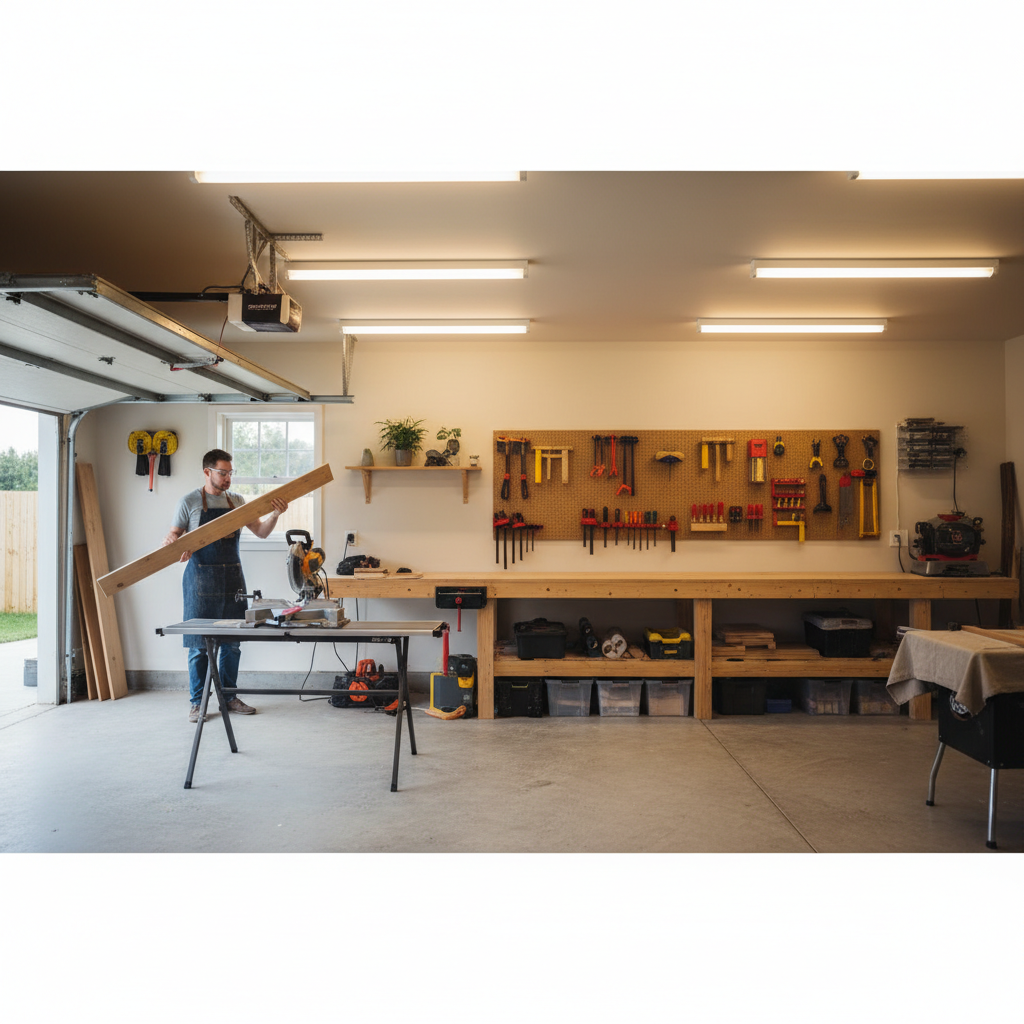
The most useful mental model for a small shop is zones: a cutting zone, an assembly zone, and a storage zone. Cutting zone gets the table saw or track saw setup. Assembly zone gets the workbench. Storage zone gets the wall. These three don't need to be permanently fixed, but they need to be defined before you position outlets or lighting, because moving both later is expensive and annoying.
Or rather: the zones aren't really about the tools, they're about the direction lumber travels. Wood enters your shop rough and long, gets crosscut, gets ripped, gets jointed, gets assembled. If your cutting zone forces you to carry a 10-foot board around a workbench to reach the saw, you've built friction into every single project. Plan the flow first, then place the tools.
If you're keeping one bay for a car, that cuts your usable shop space to around 180 to 200 square feet. That's workable, but it means a contractor-style table saw on a mobile base rather than a cabinet saw, and it means your assembly table probably doubles as a workbench. That's not a compromise; plenty of serious hobbyists work in exactly that footprint.
Electrical: The Constraint Most Guides Understate
A standard residential garage has one or two 20-amp circuits. That's enough for hand tools and a single mid-size power tool running at a time, but not enough for a shop with a table saw, a dust collector, and overhead lighting all drawing simultaneously. Before you buy a table saw, check your panel. A licensed electrician can add a dedicated 20-amp circuit for around $200 to $400 in most US markets, depending on how far the run is from your panel. That cost belongs in your tool budget.
The minimum electrical setup for a functional beginner shop is two dedicated 20-amp circuits: one for the table saw, one for everything else. If you add a dust collector that runs concurrently with the saw, that second circuit needs to be genuinely separate, not just a different outlet on the same breaker. This is not optional advice. Running a 15-amp saw and a 10-amp dust collector on the same 20-amp circuit will trip the breaker reliably and, in older wiring, creates a heat risk.
Lighting matters more than most beginners budget for. Overhead fluorescent shop lights or LED shop fixtures in the 4,000 to 5,000 lumen range per fixture give you shadow-free working light. Plan for at least two fixtures over your main cutting area. Shadows cause measurement errors, and measurement errors ruin projects.
The Five Tools That Actually Build Your First Projects
Buyers who walk into a home center and buy everything at once almost always end up with a shop full of tools and no workflow. The five-tool sequence below reflects what you can actually build with at each stage, not just what looks complete on a pegboard.
A miter saw comes first. It crosscuts lumber accurately, it's safe for beginners, and it handles 80 percent of the cuts in most introductory projects. A 10-inch sliding compound miter saw handles boards up to about 12 inches wide. A circular saw with a straightedge guide handles sheet goods until you're ready for a table saw. Those two tools, combined with a random-orbit sander and a drill-driver, will get you through your first dozen projects. I'd start with that four-tool kit rather than stretching the budget toward a table saw in year one.
The table saw is the most useful and most dangerous tool in a small shop. A contractor-style saw on a mobile base, such as the DEWALT DWE7491RS or a comparable Bosch or Ridgid model in the $500 to $650 range, gives you ripping capability without occupying permanent floor space. Keep the blade guard and riving knife installed. The number of beginner injuries that happen because someone removed the blade guard for "just one cut" is not small.
That framing misses something. The real argument for starting without a table saw isn't safety; it's that most beginner mistakes happen in the planning and measuring stage, not the cutting stage. Learning to measure, mark, and plan before you ever run a board through a blade makes you a better woodworker faster than upgrading tools does. Add the table saw when your projects outgrow the miter saw and circular saw combination, not before.
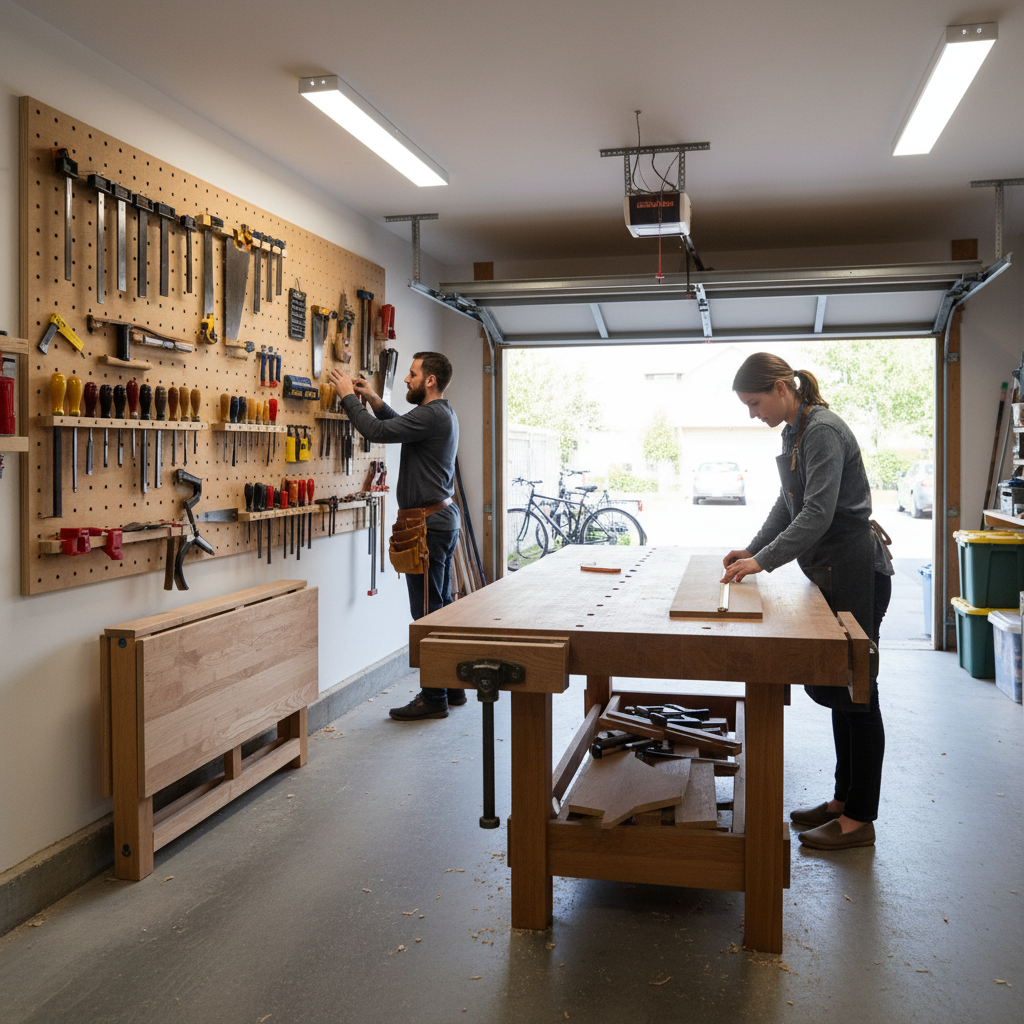
A workbench is not optional. A door blank on sawhorses works for year one. A proper bench with a face vise comes when you start hand-tool work or need to clamp pieces for assembly. Budget $50 to $150 for a solid beginner bench setup; don't spend $600 on a Roubo-style bench before you know what hand-tool work you actually want to do.
Dust Collection: The Part That Protects Your Health and Your Tools
Fine wood dust, particularly from hardwoods like oak and walnut, is classified as a potential human carcinogen by the International Agency for Research on Cancer. That's not a reason to panic; it's a reason to set up dust collection before your first cut, not after you've been breathing sawdust for six months.
For a beginner shop, a two-stage dust collector in the 1.5 to 2 HP range handles chip collection from a table saw, miter saw, and sander running sequentially. The Harbor Freight Dust Collector with a Wynn Environmental filter upgrade is the entry-level recommendation that appears consistently across hobbyist woodworking communities, typically running under $250 with the filter. A shop vac with a fine-dust filter handles cleanup and works as a secondary collection point at the sanding station.
What you also need, and what most beginner guides don't mention clearly: a dust mask rated N95 or higher for any sanding operation, and an N95 or P100 respirator for finish sanding or applying finishes. The dust collector catches the chips; it doesn't catch the airborne particles from sanding. Those particles stay suspended for hours. Open the garage door when you sand. That's not optional either.
If you skip dust collection and rely on a shop vac alone, fine dust will coat every surface in your garage, including your car if you're sharing the space, and you'll inhale a meaningful quantity of it over time. The consequence isn't immediate; wood dust exposure is a cumulative health concern, which is exactly why it's easy to ignore until it isn't.
Setting Up Your Beginner Woodworking Shop: What to Do First
If your garage has one 15-amp circuit, call an electrician before you buy a table saw. That single step prevents the most common beginner shop failure: buying tools that can't run together.
Run your layout on paper first. Sketch zones, mark panel clearance, mark door swings. If you're sharing the space with a vehicle, confirm your working footprint before committing to any tool that isn't on a mobile base.
Build your tool set in stages: miter saw and circular saw first, then a sander and drill-driver, then a table saw when your projects demand ripping. Don't buy a jointer or planer until you've run out of things to build with the five-tool kit. Most beginners never actually need a jointer in year one.
Dust collection goes in before the first cut. A 1.5 HP two-stage collector, an N95 respirator, and the habit of opening the garage door while sanding costs less than $300 and protects both your health and your tools. The shop vac alone is not a substitute.
One thing this guide doesn't cover: finishing and spray application. That's a separate ventilation and fire-hazard conversation that goes beyond the scope of a basic shop setup. If you plan to spray lacquer or oil-based finishes, get specific advice on explosion-proof ventilation before you do.