Carpenters will tell you the bench is the most load-bearing decision in a garage shop before you buy a single tool, and there's a reason for that. A workbench in a shared garage isn't just a surface. It's a negotiation between competing uses of the same square footage, and the wrong call doesn't become obvious until someone parks a car on half your workspace or your bench starts racking under a vise.
The folding vs. fixed workbench question comes down to three variables most buyers don't weigh together: usable floor space when the bench is stowed, the static load your projects actually demand, and how many people share the garage and on what schedule. Miss any one of those and you'll either buy a folder that flexes under real work or bolt down a fixed bench that turns every non-shop day into an obstacle course.
There's a genuine tension here that most product comparisons skip. A folding bench can recover floor space, but it can't fully replicate the rigidity of a bolted-down, wall-mounted unit. A fixed bench maximizes work surface and stability, but it claims territory permanently. In a single-user garage, that trade-off is simple. In a shared space, it's the whole decision.
What Actually Differs Between the Two Options
The mechanical difference isn't just that one folds. It's that folding benches are cantilevered or bracket-mounted systems, which means their rigidity depends entirely on the wall structure they're attached to and the quality of the pivot hardware. A wall-mounted folder attached to 16-inch on-center studs with 3/8-inch lag bolts can hold 400 - 500 lbs of static load. One mounted into drywall anchors will fail under a heavy vise. That distinction matters more than brand or price tier.
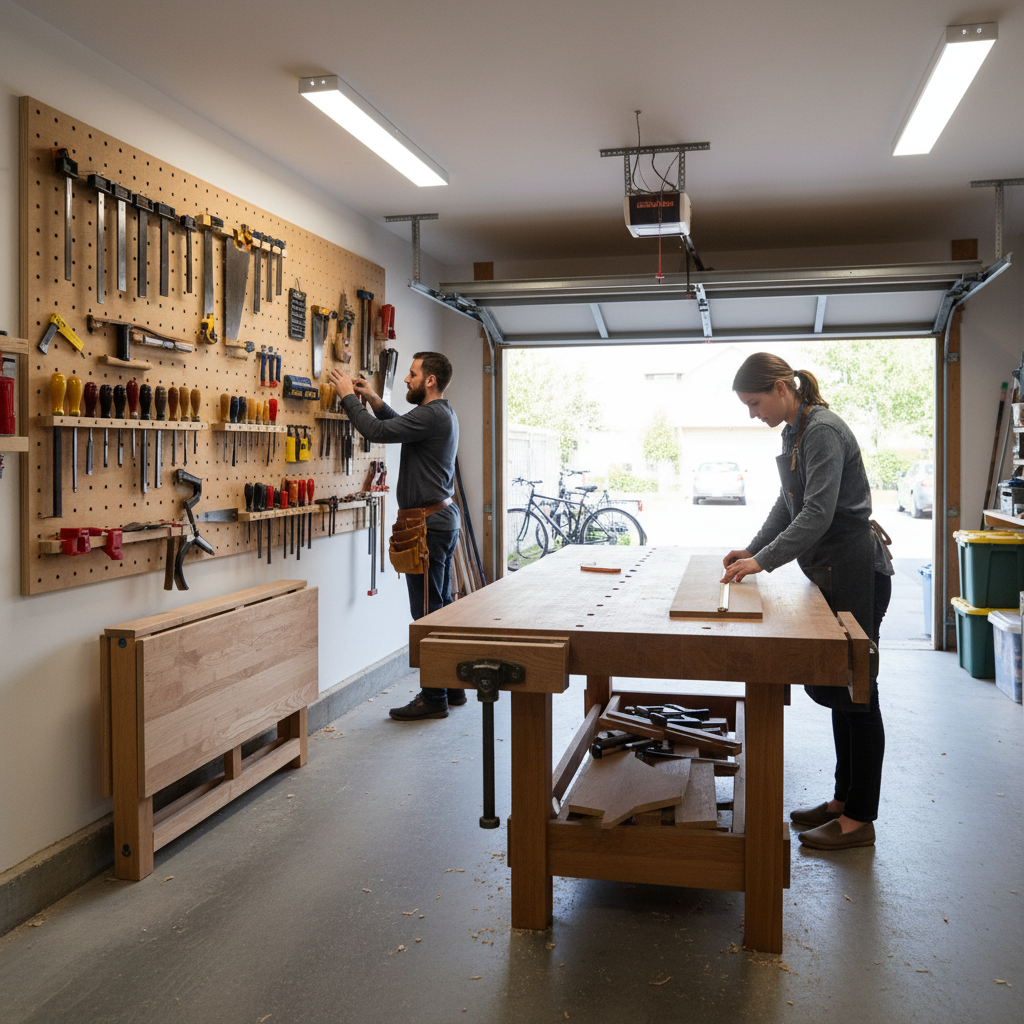
Fixed benches come in two structural types that buyers often conflate: freestanding units (four legs, no wall attachment) and wall-anchored units (rear legs or ledger bolted to studs). Freestanding benches are portable in theory but heavy in practice, often 80 - 150 lbs assembled. Wall-anchored fixed benches are the most rigid option available in a residential garage and can realistically support woodworking vises, metalworking, and repetitive mallet work without any flex. Or rather: they can, provided the ledger runs across at least three studs. Two studs is the minimum you'll see cited, but three is where racking resistance becomes reliable for serious shop work.
Folding benches reclaim floor space when stowed, typically 8 - 12 inches of depth off the wall versus a fixed bench's 24 - 30 inches. In a two-car garage where one bay gets used for parking, that depth difference is the difference between clearing the car door and not. That's not a minor convenience point. It's the functional case for the folder in shared spaces.
The weight capacity gap between a quality folder and a quality fixed bench is real but often overstated in marketing. A well-built folding bench (think wall-mounted designs with steel brackets, not the lightweight folding tables sold as workbenches) handles most hand-tool woodworking, assembly, and light power-tool work without complaint. The tasks where fixed wins decisively are sustained pounding, heavy vise work, and anything requiring the bench itself to act as a clamping surface.
The Shared Garage Calculus
Here's what makes a shared garage categorically different from a single-user shop: you don't control the baseline floor use. A gym user needs floor space. A parking occupant needs floor space. A hobbyist who stores seasonal gear needs floor space. The workbench doesn't just need to fit; it needs to fit without penalizing other users on the days they're not sharing the space with you.
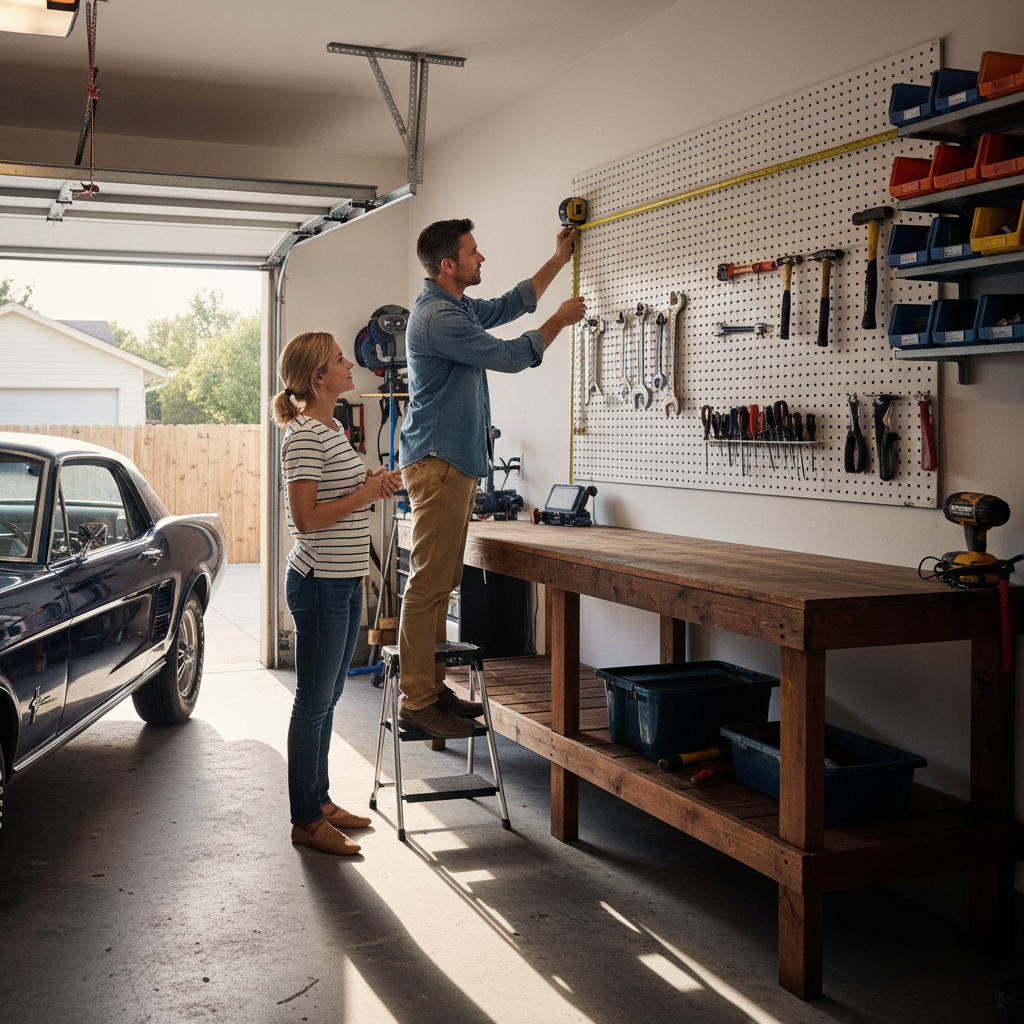
Run a simple space audit before committing. Measure your garage's depth from the back wall to where the car nose sits when parked, then subtract 18 - 24 inches for comfortable door swing. What remains is your available fixed-bench depth. If that number is less than 24 inches, a fixed bench will either block car access or be too shallow to work on comfortably. That's the threshold where a folding bench stops being a compromise and becomes the correct answer.
The user-schedule factor is underweighted in most buying guides. If the garage is shared by two people who use it simultaneously (one parking, one working), a fixed bench on a shared wall creates conflict regardless of its technical quality. If the users operate on different schedules, a fixed bench is far less disruptive. Honestly, the scheduling conversation is more important than the bench spec sheet. Have it first.
A common guideline in shop layout planning (not an official standard, but widely practiced among woodworkers) is to allow a minimum 42 inches of clear floor space in front of the bench for safe tool operation and material handling. Apply that number to your garage layout before deciding. If a fixed 24-inch bench plus 42 inches of clearance eats into the parking lane, you have your answer.
When Fixed Wins and When It Doesn't
Fixed benches are the right call for garages where one user has clear priority, the parking situation is resolved, and the work involves sustained loads. Woodworkers who use a leg vise or end vise, metalworkers doing any cold-forming or filing, and anyone doing repetitive mallet work need the mass and rigidity a fixed bench provides. A quality fixed bench also doubles as clamping infrastructure: you can add bench dogs, holdfasts, and wagon vise hardware that folding benches simply can't accommodate structurally.
The downside case for fixed benches is specific and worth naming directly: if you ever sell the house or reorganize the garage significantly, a wall-anchored fixed bench leaves hardware holes in your studs and potentially a ledger that's annoying to remove. That's not a dealbreaker for most people, but renters should be aware that any wall-anchored installation requires landlord permission and may forfeit a security deposit. This article is not covering rental-specific build-outs or garage conversions; that's a different decision with lease-agreement implications.
Folding benches win in two scenarios that rarely get stated together. First, any shared garage where floor clearance is genuinely contested (below the 24-inch depth threshold after car clearance math). Second, garages where the workbench user's work is primarily assembly, finishing, or light hand-tool work rather than heavy joinery or metalwork. A fold-down bench for assembly and a set of portable sawhorses for rough work is a legitimate shop setup, not a compromise. Plenty of skilled woodworkers work this way by choice.
The failure mode for folding benches is incremental load creep. You start light, get comfortable with the bench, start clamping heavier material, add a small vise, and suddenly you're at the limits of what the bracket system was engineered for. Check the rated static load for any folding bench before buying. Anything under 300 lbs is better suited to craft and hobby work than shop work. And check whether that rating applies to a uniformly distributed load or a point load, since vise work concentrates force at the attachment point.
Making the Decision: A Practical Framework
Work through four questions in order. They're not equally weighted, and the first one can end the analysis early.
- After car clearance, do you have 24+ inches of usable wall depth without blocking another user? If no: folding bench, full stop.
- Will you regularly do sustained vise work, mallet work, or metalworking? If yes: fixed bench, provided question one is satisfied.
- Do the garage users operate on simultaneous schedules more than three days a week? If yes: weigh the spatial conflict heavily, even if fixed is technically possible.
- What's your wall structure? Locate studs before buying either option. Folding benches need solid stud attachment. Fixed wall-anchored benches need it even more. A magnetic stud finder or a dedicated stud sensor gets this done in ten minutes.
I'd start with the wall-depth measurement because it's the only purely objective gate in the list. The other three involve judgment calls. That one doesn't.
The framing most buyers get wrong is treating this as a workbench quality question. It's a space-allocation question that happens to involve a workbench. The best fixed bench in the world is a bad choice if it turns a shared garage into a single-user shop without anyone agreeing to that arrangement. Settle the space negotiation first, then spec the bench.
If you go fixed, two regional context points matter in the US: most residential garages are built on 2x4 or 2x6 framing at 16 inches on center, which gives you solid attachment points every 16 inches along the back wall. Confirm your stud spacing before buying a bench that assumes a specific ledger span. And if your garage has a concrete back wall rather than wood-framed drywall (common in older construction), you'll need concrete anchor bolts rather than lag screws, which changes both the tool requirements and the removal calculus significantly.
That framing misses something. The choice isn't just fixed versus folding. It's also whether a hybrid setup makes sense: a wall-mounted folding bench for daily light work, supplemented by a freestanding rolling workstation (a heavy-duty version of a workbench-on-wheels) pulled out when you need mass. That combination costs more than either option alone but resolves the rigidity-versus-space tension directly for high-use shared garages. It's worth pricing before you commit to one or the other.
What Happens If You Skip This Decision
Garage workbench regret is almost always a space regret, not a quality regret. People who skip the space-allocation analysis tend to buy the better-looking or better-reviewed fixed bench, install it, and spend the next two years navigating the conflict they created with whoever else uses the garage. The bench doesn't move easily once it's anchored and loaded with tools. You're committed.
The more pointed version: if you install a fixed bench in a shared garage without resolving the floor-space question, you haven't bought a workbench. You've taken territory. The other user will feel that, even if they don't say it immediately. And the operational friction of constantly navigating around a bench that consumes clearance on days you're not using it erodes goodwill faster than most people expect.
Folding benches have their own version of this. Buy a folder rated for 200 lbs, start pushing it toward heavier work, and the first sign of failure is usually loosening at the wall bracket, not a dramatic collapse. But loosening under load means your workpiece moves, your cut drifts, and the safety margin drops. A folding bench used past its engineering limit is a worse outcome than a fixed bench in a slightly inconvenient location.
The Bottom Line
If your available wall depth after car clearance is less than 24 inches, buy a quality wall-mounted folding bench rated for at least 300 lbs static load and confirm your stud layout before drilling. If you have the depth and your work demands sustained loads, a wall-anchored fixed bench is the more capable surface and worth the permanence trade-off.
But get the space negotiation done before you buy anything. A workbench decision that skips that conversation isn't a shop decision. It's a conflict waiting to install itself on your wall.