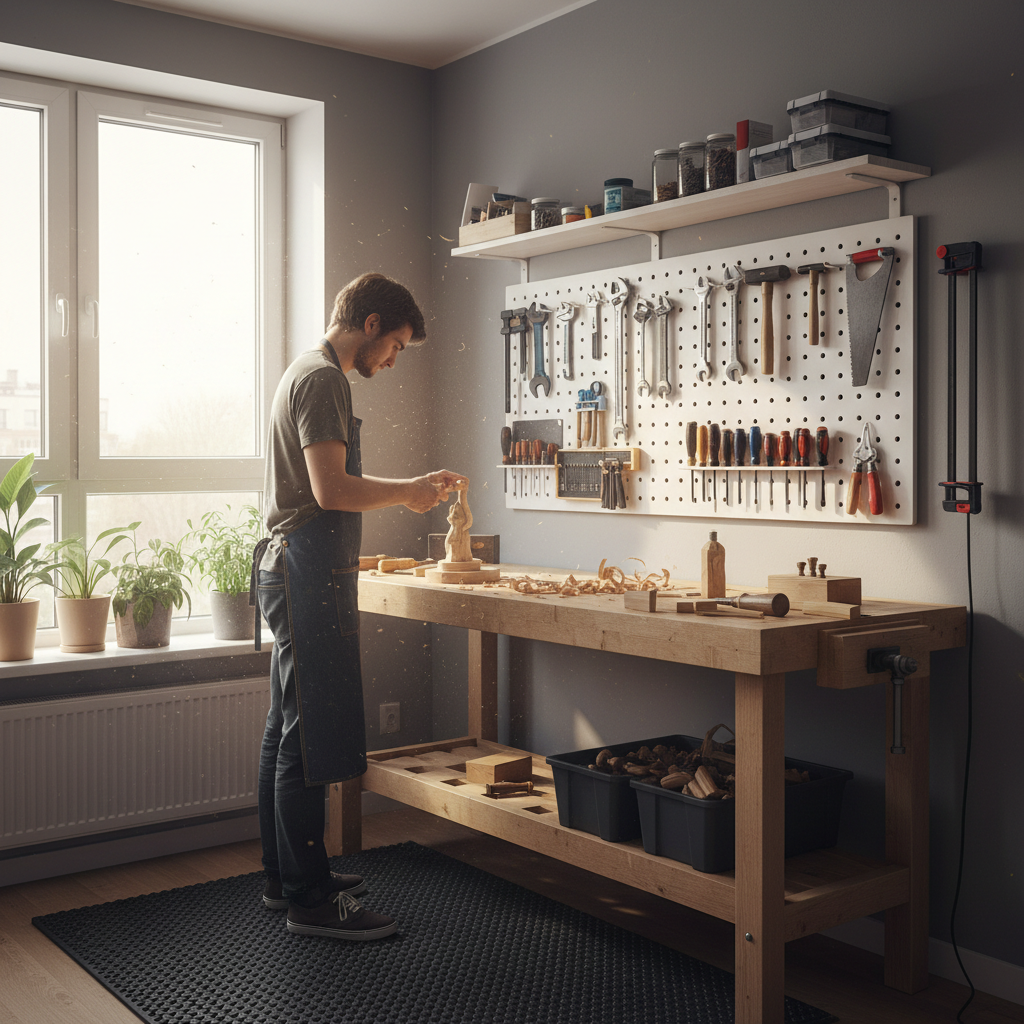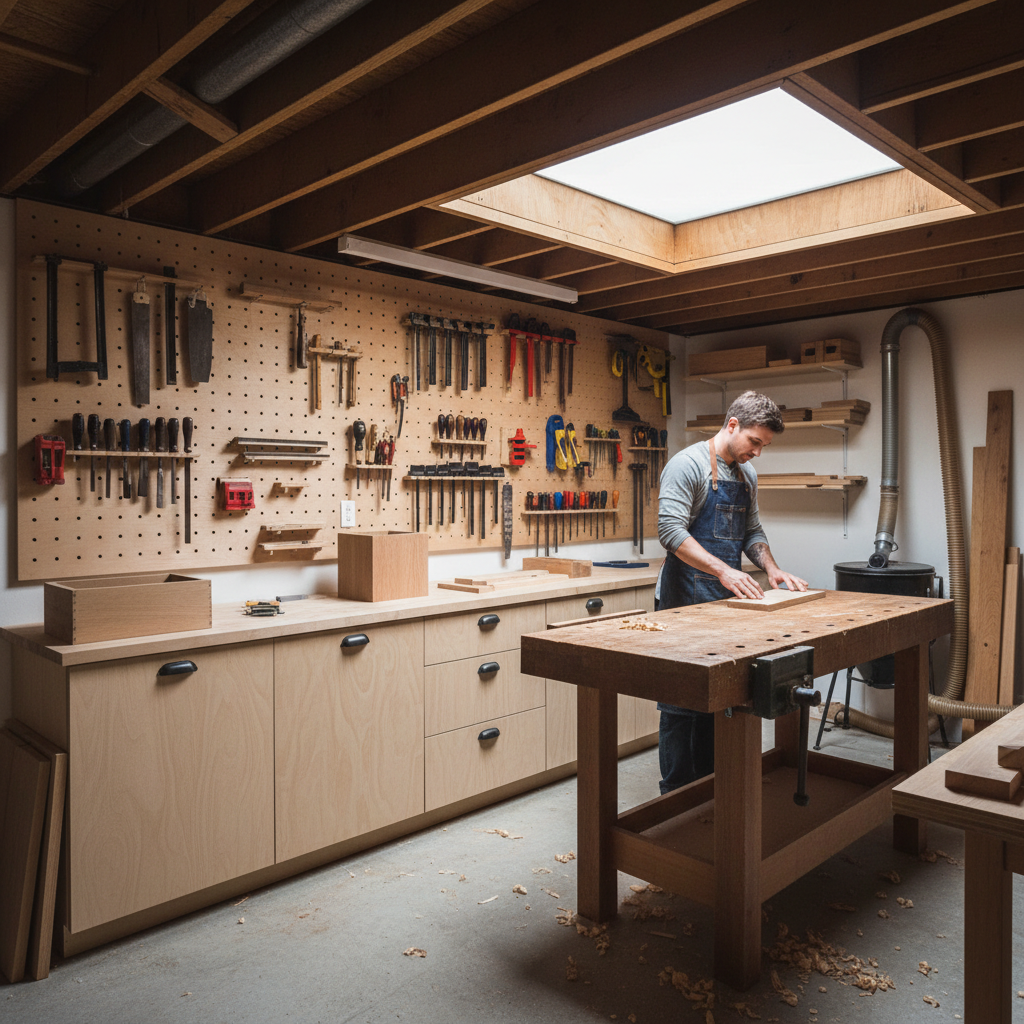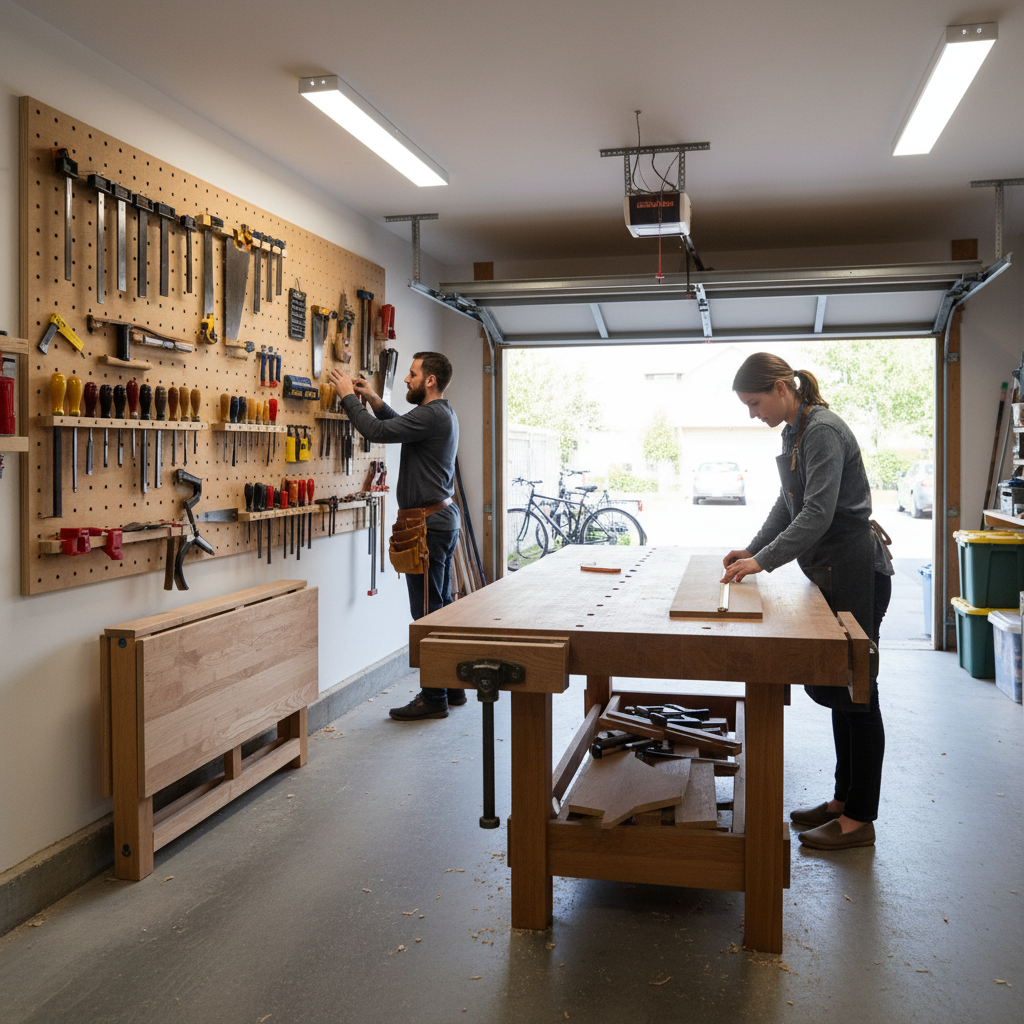
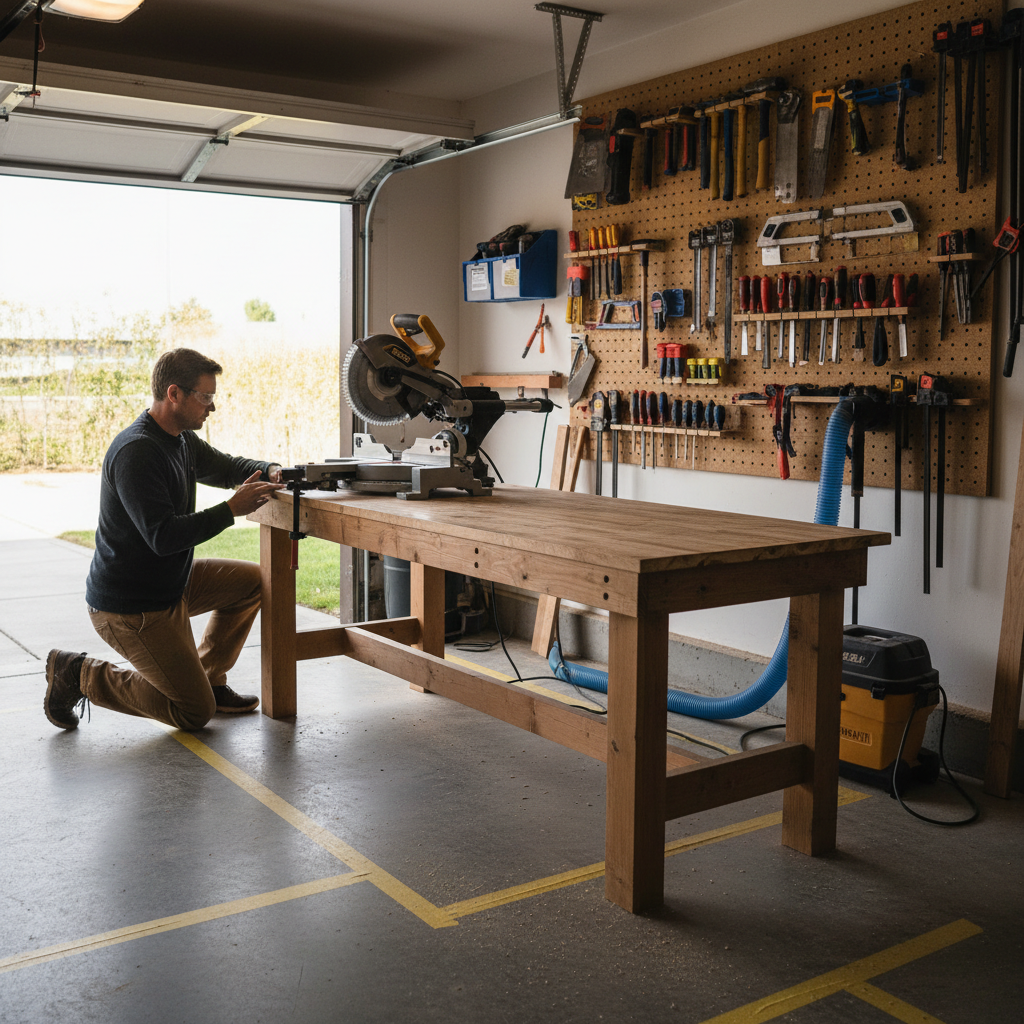
Veteran woodworkers will tell you to buy the workbench first, before anything else, and there's a real reason for that. The bench isn't just a surface: it defines how everything else in a one-car garage gets arranged, and a shop arranged wrong around a misplaced bench is a shop you'll fight for years. Setting up a beginner woodworking shop in a small garage involves three interlocking constraints most first-timers don't see until they're already committed: floor space, electrical capacity, and dust management. Get any one of them wrong and the other two stop working.
The tension nobody mentions is that the tools beginners are told to buy first (a table saw, a thickness planer) are exactly the tools that expose every layout, electrical, and dust problem simultaneously. You can spend $1,200 on a contractor table saw and discover your garage's 15-amp circuit trips the moment you rip through a 2-inch oak board. That's not a worst-case scenario; it's the most common one.
This guide is written for someone with a one-car garage (roughly 200 to 220 square feet of usable floor space) who wants to build furniture, cabinets, or small projects and doesn't yet own any stationary power tools. If you're fitting out a two-car garage or converting a basement, the electrical and layout math differs enough that much of the specific guidance here won't apply directly.
Start With the Bench and the Layout, Not the Tools
Before you buy a single power tool, tape the floor. Literally. Use painter's tape to mark where your workbench will sit, where a table saw would go, and where your car (if it's still sharing the space) needs to clear. A standard one-car garage runs about 10 by 20 feet. After accounting for a 6- to 7-foot workbench along one wall, a 3-foot clear zone around any stationary tool, and enough room to feed an 8-foot board through a saw, you'll have less open floor than you expect. Usually around 60 to 80 square feet of workable maneuvering space. That's tight.
The reframe that changes how you approach this: a one-car woodworking shop is not a small version of a large shop. It's a different workflow discipline, where tools move to the work rather than the other way around. The practical consequence is that mobile bases for any stationary tool over 100 pounds aren't optional convenience items; they're what makes the space function. A table saw on a mobile base can be rolled to the center of the garage for a ripping session and pushed back to the wall afterward, reclaiming the floor for assembly.
For the workbench itself, a solid-wood bench with a face vise and a tail vise in the 6- to 7-foot range is the right target. You don't need to build a Roubo masterpiece on day one. A torsion-box bench with 3/4-inch plywood faces and MDF core will be flat enough for years of work and can be built for around $150 to $200 in materials. What matters is height: your bench height should put your palm flat on the surface when your arms hang relaxed at your sides. Most pre-built benches are built for a 5-foot-10 person. If you're shorter or taller, that matters more than the bench's brand.
Wall space is the other underused asset. A French cleat system covering one full wall (a grid of 3/4-inch plywood strips cut at 45 degrees) lets you rearrange tool storage without drilling new holes every time your workflow changes. The total material cost for a 4- by 8-foot cleat wall runs around $40 to $60 in plywood.
The Electrical Reality You Need to Face Early
A typical attached one-car garage in a US home built after 1978 will have at least one 20-amp, 120-volt circuit, often two. That sounds like enough until you run the numbers. A 10-inch contractor table saw draws around 13 to 15 amps at full load. A shop vacuum running simultaneously draws another 5 to 9 amps. On a single 20-amp circuit, you're at or over the limit before you've turned on a light.
Or rather: the issue isn't just tripping breakers. Running a motor near its amperage ceiling continuously shortens its life and creates a fire risk if the wiring in the circuit is undersized or the connections are loose, which is not uncommon in older garages. This is a YMYL-adjacent reality, and it's worth being direct about it: have a licensed electrician assess your panel and your garage circuit before you add stationary tools that draw more than 12 amps. The cost of an electrical assessment is typically $75 to $150; the cost of rewiring a circuit that was undersized runs $200 to $500 depending on the run length and your local market.
The practical answer for most beginners is a dedicated 20-amp, 120-volt circuit for the table saw (or whatever your largest draw tool is) and a separate circuit for dust collection. A 240-volt circuit, which enables more powerful and often more efficient motors, is worth adding if your panel has capacity and you're planning to eventually step up to a cabinet saw or a 3-HP dust collector. Getting the conduit run while walls are accessible is far cheaper than cutting into finished drywall later.
Check your local utility and municipality: some areas require permits for new circuit additions, and the permit process exists to catch wiring that would otherwise be a hazard. The National Electrical Code (NEC), which most US jurisdictions adopt with local amendments, governs these installations. Your local building department can confirm what requires a permit in your specific municipality.
Tool Sequencing: What to Buy First and Why the Usual List Is Wrong
The standard beginner tool list you'll find online goes something like: table saw, miter saw, router, random-orbit sander, drill. That sequence is built around the tools that look impressive, not the tools that unlock the most capability per dollar in a constrained space.
A better sequence for a one-car garage shop: buy a track saw or a good circular saw with a quality straightedge guide first, then a miter saw, then a table saw, and only then a random-orbit sander and a router. Here's the mechanism. Sheet goods (plywood, MDF) are the raw material for most beginner furniture and cabinet projects. Breaking down a 4-by-8-foot sheet on a table saw in a 200-square-foot garage is genuinely dangerous because you can't support the panel safely through the cut without outfeed tables you don't yet have room for. A track saw (Festool, Makita, and Kreg each make well-regarded options at different price points) cuts sheet goods accurately on the floor or on foam insulation pads, takes up almost no floor space when stored, and produces a cut quality that matches or exceeds a well-tuned table saw for ripping plywood.
That understates it. A track saw plus a miter saw covers roughly 80 percent of the cuts a beginner will make in the first year. You can build a full set of shop cabinets, a bed frame, a dining table, and a set of drawer boxes with those two tools and hand tools. The table saw becomes the right next purchase once you're doing solid-wood work that requires precise ripping of narrower stock. By then, you'll know your workflow well enough to choose the right saw for your space: a jobsite saw (around $400 to $600) if floor space is the primary constraint, or a contractor saw (around $600 to $900) if you want cast-iron accuracy without the cost of a cabinet saw.
Avoid a thickness planer until you have reliable dust collection. Planers generate chip volumes that overwhelm a standard shop vacuum in minutes and fill a garage with fine airborne dust that settles on everything, including your lungs. Buy the planer second-to-last, after dust collection is solved.
- Track saw or circular saw with straightedge: first purchase
- Miter saw (10-inch sliding compound): second
- Table saw on a mobile base: third
- Dust collector (at least 1.5 HP, 120V): fourth
- Thickness planer: fifth
Dust Collection: The Part Most Beginners Get Wrong Until They're Already Sick of It
A shop vacuum is not dust collection. This distinction matters more than most beginner guides acknowledge. A shop vacuum captures chips and large particles. The fine dust produced by sanding, routing, and planing, particles under 10 microns, passes straight through a standard shop vac filter and recirculates into the air. The EPA classifies wood dust as a potential carcinogen, and hardwood dusts (oak, walnut, cherry) are among the more concerning categories. This isn't a reason to panic; it's a reason to buy the right equipment rather than the convenient one.
For a one-car garage shop, a two-stage dust collector with at least a 1-micron bag or a canister filter rated to 1 micron is the minimum setup worth buying. Two-stage means a separator (a cyclone or a bucket separator like the Oneida Dust Deputy) sits between the tool and the collector, dropping 90-plus percent of chips before they reach the filter. This protects the filter from clogging and extends its life significantly. A basic 1.5-HP single-stage collector with a quality filter replacement runs around $300 to $400; adding a Dust Deputy cyclone separator adds another $50 to $80.
Buyers often skip the filter upgrade that comes with the collector. Don't. Most entry-level dust collectors ship with a 5-micron filter bag, which captures most chips but misses the fine dust that does respiratory damage. Replacing it with a 1-micron or finer canister filter at purchase is a $40 to $100 upgrade that actually changes the air quality in the shop.
The other thing buyers skip until burned: a dust mask rated N95 or better for sanding and routing sessions, regardless of how good the dust collection is. Dust collection captures what goes into the port. It doesn't capture what escapes during bit changes, emptying, or workpiece handling. An N95 respirator from a hardware store costs about $2 to $4 per mask in multi-packs. That's a genuinely trivial cost relative to the equipment investment.
If you don't set up adequate dust collection before adding a planer or a router table, you will accumulate a layer of fine dust on every surface in the garage within a few months. It settles on power tool motors, in your car's air filter if the car shares the space, and in your own airway. Ignoring dust management doesn't just create a mess; it creates a chronic exposure problem that compounds quietly.
When a One-Car Garage Shop Stops Working (And What to Do Instead)
A one-car garage shop has real limits, and a few project categories push past them quickly. Large furniture assembly (dining tables, bed frames, full wardrobes) requires floor space for panel glue-ups that a 200-square-foot shop simply can't provide reliably. If your primary goal is building large case pieces or furniture at the scale of a full bedroom set, a one-car garage shop will frustrate you within the first year.
The honest answer for that reader: a two-car garage or a shared makerspace membership is the better starting point. Many cities have community woodworking shops with membership models in the $50 to $150 per month range that give access to equipment you'd spend $5,000 to $10,000 replicating, with dust collection already solved. This isn't a consolation prize. Spending a year at a shared shop before setting up your own is the fastest way to learn which tools you actually use, which layout works for your body and your projects, and which equipment choices you'd regret buying new.
The one-car shop also struggles when you add a bandsaw to the tool lineup. A 14-inch bandsaw is a genuinely useful tool for resawing and curved work, but in a 200-square-foot space it competes directly with the table saw for the floor position that needs outfeed clearance. One or the other, not both, unless one lives on a mobile base and the other is bolted down. Bolting down the bandsaw and keeping the table saw mobile is usually the better call, because precise resawing requires a stable machine while ripping on a table saw is manageable on a well-made mobile base.
Putting It Together: A Sequenced Plan for the First 12 Months
Start with the bench and the layout tape before any purchase. Spend one weekend building or buying a flat, sturdy workbench at the right height for your body. Install a French cleat wall on the longest available wall. Then assess your electrical situation with a licensed electrician before you buy anything that plugs into the wall.
Months one through three: track saw or circular saw with a straightedge guide, a 10-inch sliding miter saw, and basic hand tools (chisels, hand plane, marking gauge, good squares). Build something with these. A set of wall cabinets, a workbench storage shelf, or a small side table. You'll learn your shop's actual workflow before you commit to large floor equipment.
Months four through six: add a dust collector with a 1-micron filter and a cyclone separator. Run the ducting or at least the flexible hose to your miter saw and to the spot where your table saw will eventually live. Then buy the table saw on a mobile base. This sequence means your dust collection is already working when the tool that generates the most chips arrives.
Months seven through twelve: router table (or a table-mounted router lift in a wing of the table saw), random-orbit sander, and then, only if your projects demand it, a thickness planer. By this point, you'll have enough hours in the shop to know whether you need a 13-inch or a 15-inch planer, whether open-stand or closed-stand suits your storage, and whether you'd rather spend the money on a drum sander instead.
I'd start the hand tool collection earlier than most guides suggest: a good block plane ($40 to $60 used), two or three bench chisels, and a marking gauge will solve fitting problems that take twenty minutes on a power tool in thirty seconds by hand. The instinct to reach for a router to trim a door to fit is a power-tool habit. A hand plane gets it done in two passes.
Skip the combo machine (jointer-planer-table saw combinations). They sound efficient for small shops, but the setup time for each function makes them a pain in actual use, and they compromise on the accuracy of every function to serve all three. Buy dedicated tools in sequence.