Heating contractors will tell you to assess your garage's thermal envelope before recommending any heater, and there's a reason for that.
A garage workshop is one of the harder spaces to heat efficiently in a US home. You're dealing with an uninsulated slab, a massive overhead door that bleeds heat, often no vapor barrier, and a ceiling height that defeats the natural warmth a living space captures. Getting a garage workshop warm enough to work in during winter isn't simply a matter of buying a bigger heater. The size of your space, your existing insulation, and how many hours per week you actually use the shop all drive the calculation in different directions.
What makes this genuinely tricky is the tension between spot-heating and whole-space conditioning. A radiant heater can warm the person standing in front of it while the corner where you store finishes stays at 28°F. That matters if you're wood-finishing, doing spray work, or running equipment with oil reservoirs. The right answer for a hobbyist woodworker who runs the shop four hours on Saturdays is different from the right answer for someone running power tools six days a week, and no single heater type wins across both cases.
Insulation Comes Before Heater Selection
The most common mistake is buying a heater before addressing the building envelope. Run a heater in an uninsulated garage and you're essentially heating the neighborhood. Air sealing and insulation aren't glamorous, but they change what size and type of heater you actually need, sometimes by half.
Start with the overhead door. A standard single-car steel garage door has an R-value around R-2 to R-4 if it's insulated at all. A quality insulated replacement door reaches R-12 to R-16, but that's a significant purchase. The practical middle path is a reflective foam insulation kit designed to retrofit into existing door panels. These typically add R-4 to R-8 at a cost of $50 - $150, depending on door size. That's worth doing before anything else.
Walls are next. An uninsulated 2×4 stud wall holds about R-1 in dead air. Filling those cavities with R-15 mineral wool or R-13 fiberglass batts and adding a vapor barrier is a weekend project that meaningfully reduces the heater output you'll need. The ceiling matters even more in a workshop, because heat rises. If there's an attic above, R-38 blown insulation up there costs less than a single winter's wasted propane.
Or rather: it's not just that insulation reduces heating costs. It changes which heater type is even viable. A forced-air propane unit in an uninsulated garage will cycle constantly and still leave cold spots. The same unit in a reasonably air-sealed space with R-13 walls holds temperature steadily. That distinction drives the entire heater selection decision.
This article won't cover attached garages where you can tap into your home's HVAC system. That's a separate calculation involving your furnace capacity, duct run lengths, and whether your equipment can handle the added load. It's a legitimate option for some setups, but it isn't the reality for detached workshops.
Choosing the Right Heat Source: Propane, Electric, or Radiant
Three sources dominate garage workshop heating in the US: forced-air propane, electric (either baseboard or infrared), and radiant tube heaters. Each has a legitimate use case. Choosing the wrong one for your situation isn't a minor inefficiency, it's the difference between a comfortable shop and a space you avoid in February.
Forced-air propane heaters (often sold under the Mr. Heater or Modine brand names) heat a space quickly. A 60,000 BTU unit can warm a two-car garage from 20°F to 50°F in under 30 minutes under reasonable insulation conditions. That speed matters for intermittent users who don't want to pre-heat for hours. The downsides are real, though: combustion produces moisture and carbon monoxide, so ventilation is non-negotiable, and a CO detector isn't optional. Propane costs fluctuate with supply, but a practical guideline is that heating an uninsulated 400 sq ft garage with propane for 20 hours a week will run through a 100-lb tank in roughly two to three weeks depending on outdoor temperatures and how hard the unit cycles.
Electric baseboard heaters are clean, silent, and require no venting. They're the right call when you need consistent background heat in a well-insulated space and you don't mind the operating cost. Electricity rates vary significantly by state. In states like Louisiana, where residential rates run around $0.09 - $0.10 per kWh (according to the U.S. Energy Information Administration), electric heat is far more competitive than in Massachusetts, where rates can reach $0.25 per kWh or higher. Know your rate before you commit to electric.
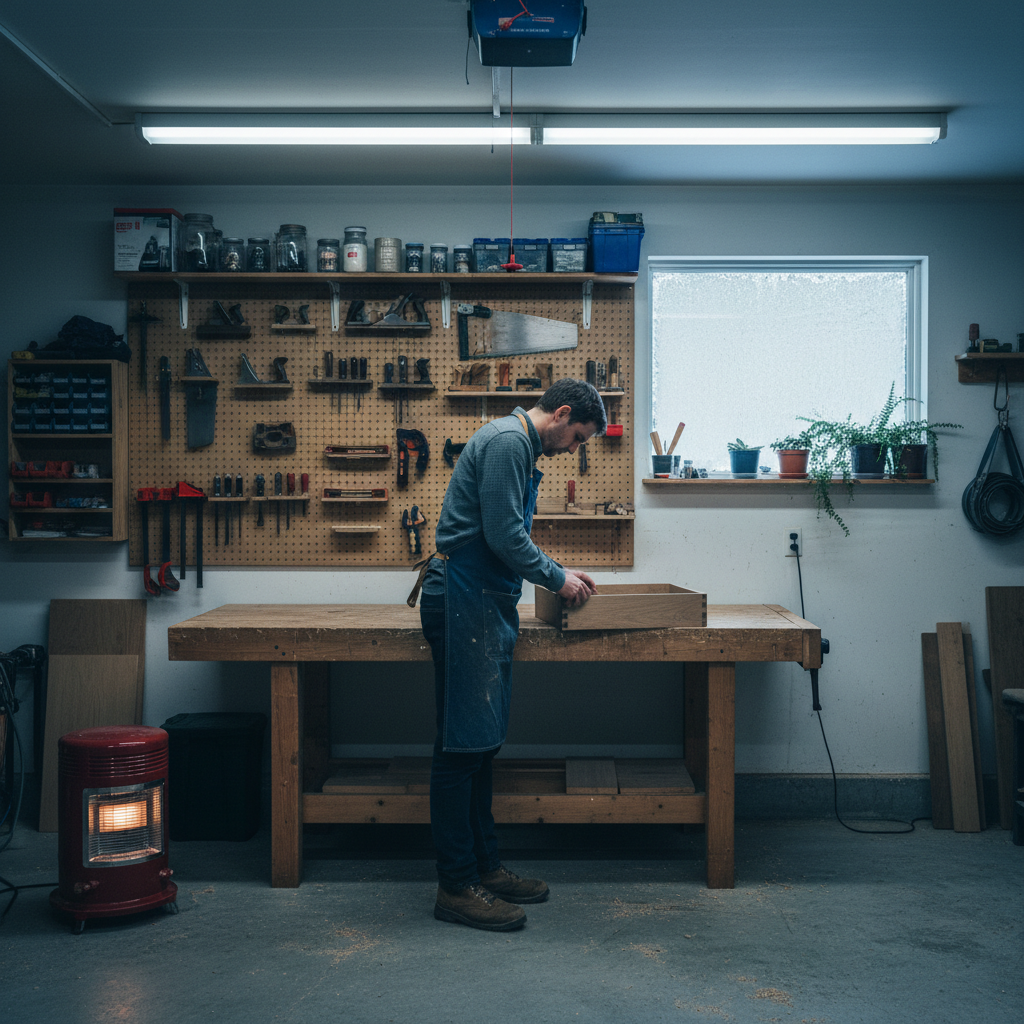
Infrared radiant heaters are genuinely different in how they work. They don't heat air, they heat objects and people directly through electromagnetic radiation, the same principle as sunlight warming your face on a cold day. A 1,500-watt infrared panel pointed at your workbench will keep you comfortable even when ambient air temperature in the garage is 40°F. For woodworkers who need consistent hand and body warmth without necessarily conditioning the entire space, this is often the best value. The limitation: radiant heat doesn't help paint or finish cure properly if the ambient temperature is too low, and it won't stop your compressor oil from thickening in single-digit temps.
Radiant tube heaters, the kind hung from ceiling joists and run on natural gas or propane, are the choice for larger dedicated shops (600+ sq ft) used frequently. They heat from above, which suits tall ceilings well, and they condition a space evenly over time. Installation requires a gas line and usually a permit. If you're going this route, factor in that cost upfront.
| Heater Type | Best For | Ventilation Required | Upfront Cost (approx.) | Speed to Warmth |
|---|---|---|---|---|
| Forced-air propane | Intermittent use, large spaces, fast warmth | Yes (CO risk) | $150 - $400 | Fast (20 - 40 min) |
| Electric baseboard | Well-insulated spaces, low local electric rates | No | $80 - $250 | Slow (1 - 2 hrs) |
| Infrared radiant (electric) | Spot comfort, woodworking, intermittent use | No | $100 - $350 | Immediate (person) |
| Radiant tube (gas) | Large dedicated shops, frequent use | Vented (professional install) | $800 - $2,500 installed | Moderate (45 - 90 min) |
The table above assumes a typical 400 - 600 sq ft detached garage. Upfront costs are approximate ranges based on common retail and contractor pricing and will vary by region and supplier. A forced-air propane unit looks cheapest to acquire, but if you're running it four days a week all winter, a properly installed radiant tube heater often delivers lower total-season cost once propane tank rental and delivery fees are folded in.
Temperature Targets: What 'Warm Enough' Actually Means
Fifty degrees Fahrenheit is the number most experienced woodworkers cite as the floor for comfortable hand tool work. Below that, your hands lose dexterity faster than most people expect, and glue joints stop curing reliably. Water-based finishes need at least 50°F to flow and dry correctly. Oil-based finishes prefer 60°F or warmer.
But if you're running power tools and moving around actively, 45°F is often workable with the right clothing layering. The trap is thinking that a comfortable core temperature means your extremities are fine. They're not. Cold fingers on a table saw are a safety issue, not just a comfort issue.
For automotive work or mechanical projects, 50°F is also a reasonable minimum. Below that, lubricants thicken, torque specs become harder to hit consistently, and your own reaction time degrades. A common guideline among mechanics is that if the shop is too cold to remove a glove for more than a few minutes, it's too cold to work safely on anything requiring fine motor control.
I'd start by targeting 55°F as a working minimum for most tasks. That gives you a buffer against cold spots and equipment variance. If you find that's more than your heating setup can sustain economically, drop to 50°F and invest in good insulated gloves for bench work rather than running a larger heater. The clothing solution is underrated.
What happens if you ignore this and just work in a cold garage? Beyond the comfort issue, you risk adhesive failures on joinery, cracked lumber from moisture differential, condensation on metal surfaces leading to rust, and genuinely elevated injury risk. A 2022 NIOSH guidance document on cold work environments notes that manual dexterity begins declining measurably below 59°F skin temperature, which in a 35°F garage can happen in under 20 minutes of stationary work. Don't tough it out when the fix is straightforward.
When Propane Is the Wrong Choice
Propane forced-air heaters are popular, widely available, and genuinely effective for warming a garage fast. But they're the wrong choice for a specific and important group of users: anyone doing spray finishing, working with flammable solvents, or running a wood dust-heavy environment without a serious dust collection system.
Forced-air propane heaters have open combustion and, in some models, an exposed ignition flame. Lacquer overspray, naphtha vapors, and fine sawdust all have explosive lower flammability limits that a garage workshop can realistically hit. This isn't a theoretical concern. The National Fire Protection Association's NFPA 33 standard for spray finishing explicitly restricts ignition sources in spray areas, and a propane heater is an ignition source. If you're finishing with any solvent-based product, the heater must be off and the space ventilated before you start spraying, full stop.
The alternative for finishers is an electric infrared heater positioned away from the spray zone, or better, doing finish work during warmer months and using the winter shop time for construction and joinery. Many serious furniture makers structure their year exactly this way. It's not a compromise, it's smart workflow planning.
And: if your garage has any propane-powered heater, run a UL-listed carbon monoxide detector at head height. This is not optional. CO is odorless, and CO poisoning in enclosed workshop spaces is documented frequently enough that treating this as a genuine risk rather than a remote one is the correct stance.
Estimating Your Heat Load Before You Buy
Buying a heater without calculating your heat load first is how you end up with a unit that either can't keep up or cycles so rarely it never runs efficiently. The calculation isn't complicated.
A basic heat load estimate for a garage uses square footage, ceiling height, insulation level, and your target delta T (the difference between your target indoor temperature and the coldest expected outdoor temperature in your area). For a 400 sq ft garage with 9-foot ceilings and R-13 walls, targeting 55°F in a climate where winter lows reach 15°F (a delta T of 40°F), a rough heuristic puts required output at around 15,000 - 20,000 BTU. Add 20 - 30% if insulation is poor or the overhead door is uninsulated. That puts most two-car workshops in the 30,000 - 60,000 BTU range under realistic conditions.
The Better question is not just what size heater, but what duty cycle makes sense economically. A 60,000 BTU propane unit running at full output for 30 minutes to heat a space, then cycling off for an hour, behaves very differently in operating cost than the same unit struggling to maintain temperature continuously against a leaky building envelope. Seal the building first, then size the heater.
Check square footage, ceiling height, and local design temperature before you shop. Your county's historical low temperature data is available through the National Weather Service. ASHRAE's design temperature tables, used by HVAC professionals, give you the 99th-percentile cold-hour figure for your location, which is the right number to design against. You don't need the coldest day ever recorded; you need the temperature exceeded only 1% of winter hours.
Making It Work This Winter
If your garage workshop is currently unusable in cold weather, here's the honest priority order.
If you have zero insulation and zero heating, start with the overhead door insulation kit and weatherstripping before buying any heater. A $100 door kit will do more for comfort than a $300 heater in an uninsulated shell. Then add R-13 batts to the stud walls if they're accessible. Then buy your heater sized to the improved envelope, not the original one.
If the space is already reasonably insulated and you need heat now, an electric infrared panel for personal spot warming costs $100 - $200 and requires no installation. It won't condition the whole space, but it will make bench work physically comfortable within minutes. A forced-air propane unit is the next step up for whole-space heating, just make sure CO detection is in place and combustibles are stored outside the main work area.
If you're running the shop more than 15 hours a week through a full winter, the math starts to favor a permanent solution: a wall-mounted electric heater on a thermostat, or a professionally installed radiant tube system. The upfront cost is higher, but you stop buying propane tanks and you get a space that holds temperature without intervention.
Don't spend the winter working in a coat and gloves and calling it fine. Cold hands make mistakes, cold adhesives fail, and cold solvents behave unpredictably. The fix is sequential and affordable if you address it in the right order.