Acoustic consultants will tell you that the weakest boundary in any room controls the whole noise problem, and there's a reason they say that before touching a product catalog. Soundproofing a garage workshop sounds straightforward until you realize a $400 wall treatment does almost nothing when your garage door is essentially a giant aluminum drum with a one-inch air gap at the bottom. The primary search concept here is straightforward: you want to work without driving your neighbors (or your household) to the edge of sanity. But the actual solution turns on three variables that most product guides leave vague: which frequencies your tools generate, how your garage connects to the structure of your house, and whether you're trying to contain impact noise, airborne noise, or both.
Angle grinders, table saws, and air compressors each produce noise in different frequency ranges, and low-frequency vibration below 200 Hz laughs at foam panels. That's the tension most people hit after their first round of improvements: they treat the walls and discover the floor is transmitting every hammer blow directly into the house foundation. The fix isn't always more material. Sometimes it's a different material in a completely different location.
This guide is written for homeowners with an attached or detached garage who want a practical, phased approach. It's not for commercial fabrication shops, recording studios, or anyone hoping to run an industrial CNC router at midnight without consequence. Those situations require a licensed acoustic engineer.
Why Your Garage Leaks Sound Differently Than You Expect
Sound escapes through the path of least resistance, always. In a typical American garage, that path has a clear pecking order: the door first, then the ceiling if it's attached to living space above, then the walls, then the floor. Most people install rockwool batts in the walls and stop there, which is roughly equivalent to patching one window in a leaky boat.
The physics worth understanding: airborne noise (the kind your saw generates in open air) and impact noise (vibration traveling through solid material) require different solutions. Mass stops airborne noise. Decoupling stops impact noise. Foam does neither particularly well at the frequencies power tools operate in. That's the first mechanism most guides skip entirely, and it's why foam panels marketed as "soundproofing" are mostly treating echo inside the garage rather than preventing noise from leaving it.
Or rather: foam does reduce echo, which makes the garage feel quieter to you. But your neighbor is hearing the sound that penetrated the wall, not the sound bouncing around inside. These are completely different problems. A garage that sounds dead inside can still be broadcasting low-frequency vibration into the house structure at full intensity.
The practical upshot: before you buy anything, identify your dominant noise type. If you're running a table saw or miter saw, airborne noise through walls and the door is your main issue. If you're using a planer, jointer, or any tool that sits directly on a concrete floor, impact transmission is likely sending vibration into every shared surface. Many workshop setups have both problems, which is why a layered approach almost always outperforms a single expensive intervention.
The Garage Door Problem (Treat It First)
The garage door is typically the largest single opening in the workshop, and standard sectional doors offer almost no meaningful acoustic resistance. A common industry guideline puts an untreated single-layer steel sectional door at around STC 18 to 20, which means most conversation-level sounds pass through with minimal reduction. A well-treated stud wall with insulation and drywall can reach STC 45 or higher. That gap is where your neighbor is living.
You have two realistic options here: treat the existing door or replace it.
Treating the existing door means adding mass-loaded vinyl (MLV) to the door panels and sealing every gap. MLV runs roughly $1 to $2 per square foot at most building supply retailers. For a standard two-car door at 16 × 7 feet, that's around $110 to $225 in material for full coverage. The gap at the bottom of the door matters as much as the panels themselves. A quality garage door bottom seal (bulb-style, not the thin rubber strips that come standard) and compression seals on the side jambs are non-negotiable. Without them, you've treated the drum and left all the windows open.
Replacing the door is the higher-cost option but produces substantially better results if you choose an insulated door with a high R-value core. Insulated steel doors with polyurethane foam cores are quieter than polystyrene (EPS) cores because polyurethane fills the cavity more completely. R-value here serves double duty: thermal insulation and some acoustic mass. But don't confuse R-value with STC rating. A door manufacturer's STC rating is the number you want, and it should appear on the product spec sheet. If it doesn't, ask before you buy.
And if you do nothing else in this entire project, seal the gaps. A 1/8-inch gap around a door transmits more sound than a well-treated wall panel. That's not an exaggeration.
Walls, Ceiling, and the Case for Mass Over Everything
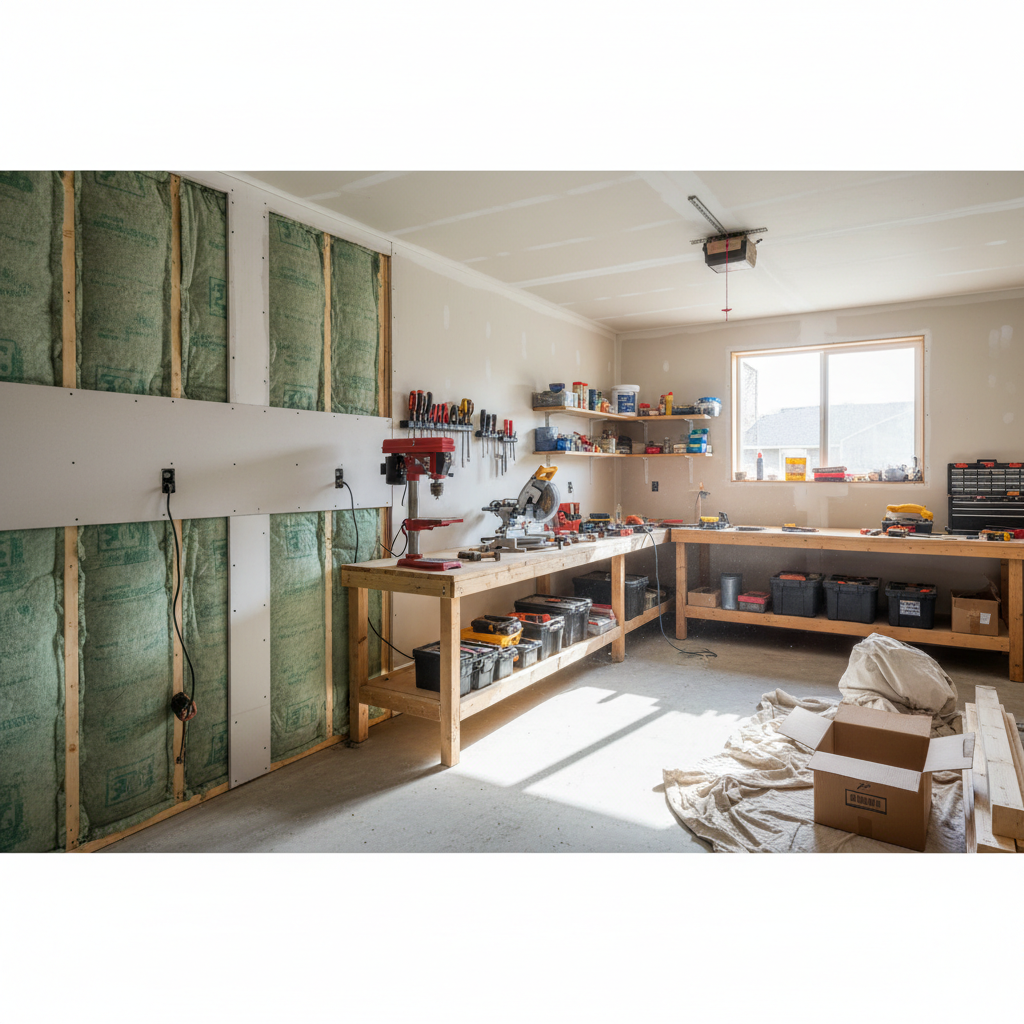
Once the door is handled, walls and ceiling are next. The principle is mass: heavier materials absorb and reflect more sound energy than light ones. For an unfinished garage with exposed studs, the standard approach is to fill the stud cavities with mineral wool (often sold under the Rockwool or Owens Corning QuietZone brands) and then add drywall. One layer of 5/8-inch Type X drywall is the starting point. Two layers with a damping compound between them (products like Green Glue are widely used for this purpose) meaningfully improve performance over a single layer.
The ceiling deserves particular attention in an attached garage where living space sits above. Sound traveling upward through an uninsulated drywall ceiling into a bedroom is one of the most common complaints in residential workshops. If the floor joists above are accessible from the garage side, filling those cavities with mineral wool before closing the ceiling is worth doing before anything else. It's the kind of step that's cheap when you're already working in the space and expensive to add later.
What you'll notice when you compare wall treatments side by side is that mass-loaded vinyl added to the stud cavity face (behind drywall) adds a meaningful layer of acoustic resistance without requiring you to rebuild the wall. It's not a magic fix, but in a garage where you're not rebuilding from scratch, it's a practical intermediate step. I'd start with MLV on the wall shared with the house or neighbors, add mineral wool in those cavities, and prioritize 5/8-inch drywall over 1/2-inch everywhere.
One thing this article won't cover: floating room-within-a-room construction. That technique, which involves completely decoupling interior walls from the garage structure using resilient channels or staggered studs, can push STC ratings into the 50s and 60s. But it requires significant structural planning, reduces usable floor area, and typically costs several thousand dollars in a garage context. It's the right answer for a dedicated recording studio. For a workshop where the goal is neighbor-friendly operation during reasonable hours, the layered mass approach gets most people where they need to be without that level of commitment.
Floor and Vibration Control: The Step Most Shops Skip
Concrete floors transmit vibration efficiently. A planer sitting directly on slab is essentially bolted to the building's foundation, and every cut sends vibration traveling through the concrete into shared walls and footings. Neighbors in adjacent rooms sometimes hear this as a low-frequency hum or thudding that no amount of wall treatment reduces, because the path bypasses the walls entirely.
The fix is anti-vibration pads or mounts under each tool. Rubber isolation feet designed for industrial equipment are the correct product here, not generic rubber matting. The distinction matters because thickness and durometer (rubber hardness) determine which frequency ranges get attenuated. A common guideline in workshop setup is to match pad stiffness to tool weight: heavier tools need stiffer pads to avoid bottoming out under load, which defeats the isolation. Manufacturer specifications for anti-vibration mounts typically include load ratings and natural frequency targets. Check those numbers before buying.
For tools you move around, an anti-fatigue mat with a rubberized base provides some isolation, but it's a supporting measure, not a primary one. The most common mistake I see in workshop setups is treating floor isolation as an afterthought, after the walls are done and the budget is mostly spent. Impact noise through the floor is often the last problem standing between a treated garage and one the neighbors stop noticing.
The better question is whether your compressor specifically needs its own isolation solution. Air compressors are notorious for broadcasting vibration through whatever surface they contact. A compressor sitting on a rubber isolation platform, positioned away from shared walls, produces dramatically less structural noise than the same unit sitting on bare concrete against an exterior wall. If you have an air-cooled compressor in the garage, this is the first floor intervention worth making.
| Noise Source | Primary Path | Recommended Treatment | Approx. Cost Range |
|---|---|---|---|
| Table saw, miter saw | Airborne through walls and door | MLV + mineral wool + 5/8" drywall; door sealing | $300 - $800 depending on area |
| Planer, jointer | Impact through floor/structure | Anti-vibration mounts under tool; mineral wool in shared-wall cavities | $50 - $200 per tool |
| Air compressor | Impact + airborne | Rubber isolation platform; locate away from shared walls | $30 - $100 |
| Angle grinder, router | Airborne, high-frequency | Door sealing; treated walls; schedule during daytime hours | Included in wall treatment |
The table above reflects practical heuristics from workshop setup guides and should be treated as a starting framework rather than engineered specifications. Every garage layout is different, and tools used simultaneously compound the noise load in ways a single-tool estimate won't capture.
When Soundproofing Alone Isn't Enough
There's a scenario where all of this work still doesn't fully resolve the neighbor problem, and it's worth naming directly: a detached garage located close to a property line, with a neighbor whose bedroom window faces the structure. No practical DIY soundproofing will reduce sound transmission enough to run a cyclone dust collector or a router table at 10 PM without impact. Physics has limits that common sense should accept.
In that situation, the more productive path is a combination of partial soundproofing and operating-hour discipline. Most local noise ordinances in US municipalities designate quiet hours starting between 9 PM and 11 PM, with morning restrictions often starting at 7 or 8 AM on weekdays and later on weekends. Check your local municipal code; these rules are enforced differently by jurisdiction and neighborhood type, and what's technically legal may still generate a legitimate complaint if your neighbor works night shifts.
Buyers who are planning a workshop in a new garage purchase sometimes skip this analysis entirely, which is a mistake. The cost of proper acoustic treatment for a poorly situated garage can easily exceed $2,000 to $3,000 for materials alone before any labor, and even that investment won't eliminate all tool noise at the property line. If you're in the planning phase rather than the remediation phase, tool selection and scheduling matter as much as wall treatment. A track saw with a good dust collection system is quieter than an equivalent table saw. A brushless router is quieter than a brush-motor equivalent. These aren't minor differences.
But if you ignore the soundproofing work entirely and rely on operating hours alone, you'll find that even midday use becomes a source of friction with neighbors who work from home or have young children. The combination of acoustic treatment and reasonable scheduling is what actually resolves the relationship problem, not either one alone.
A Practical Sequence for Getting This Done
Start with the garage door: seals, then mass if the door itself is single-skin. This is the single highest-leverage action in most garages, and it costs the least per unit of improvement. Next, address the wall or ceiling shared with living space or the neighbor's property. Fill stud cavities with mineral wool and add drywall. Don't skip the shared ceiling in an attached garage.
After the structure is treated, put anti-vibration mounts under every stationary tool. Order them by the tool's noise profile: compressor first, then planer or jointer, then router table. And test after each phase rather than doing everything at once. You may find that the door sealing and one treated wall gets you 80% of the way to your goal, which tells you something about where to stop spending.
The reframe worth keeping: soundproofing a workshop isn't about achieving silence. It's about reducing transmission enough that your neighbors don't hear your tools as their problem. Those are different thresholds, and the second one is achievable in most residential garages without a complete rebuild. Aim at the right target and you'll know when you've hit it.
Skip the treatment entirely and you're not just risking a neighbor complaint. You're risking a municipal noise violation, a damaged relationship that affects daily life, and eventually pressure to stop using the space at all. The upfront cost of a few hundred dollars in materials is a straightforward trade against that outcome.