Any contractor who has spent time in a poorly ventilated garage shop will tell you to deal with dust before you buy another tool, and there's a reason that advice comes first.
Garage woodworking dust control is where a lot of hobbyists hemorrhage money chasing horsepower ratings and filter specs they don't need yet. The real variable isn't how powerful your collector is. It's whether you've closed the gap between where dust is made and where it's captured, and that gap depends on three things most guides leave vague: your shop's square footage, which tools you actually run, and whether your garage has any meaningful cross-ventilation at all.
Here's the tension nobody talks about straight: a two-car garage with a table saw, a thickness planer, and a random orbit sander isn't one dust problem. It's three, and the fine airborne stuff from the sander is more dangerous than the shavings your planer throws across the floor. That distinction should drive every dollar you spend.
Why Dust Separation Matters More Than Collector CFM
The standard pitch is to buy the biggest shop vac or dust collector you can afford. For a hobbyist running one tool at a time in a 400-square-foot garage, that advice sends money in the wrong direction.
Dust particles fall into two practical categories. Chips and shavings above 10 microns settle quickly and are mostly a cleanup annoyance. Fine dust below 10 microns, and especially below 2.5 microns, stays suspended in air for hours after you've stopped cutting. According to the CDC's occupational health guidance, repeated inhalation of fine wood dust is associated with respiratory disease and, for certain hardwoods like oak and beech, is classified as a known human carcinogen. That's the particle class your lungs can't filter on their own.
The practical implication: a 5-gallon shop vac pulling 100 CFM directly at your router table is more effective at capturing fine dust than a 2 HP single-stage collector sitting in the corner with a 4-inch flex hose draped loosely near the blade. Proximity to the source beats raw suction volume every time. Or rather: CFM matters, but only after you've placed the inlet within a few inches of where dust is generated, because a 6-inch gap can let the majority of fine particles escape into room air before any collector can catch them.
This is the mechanism that unlocks the budget strategy. You don't need an expensive system. You need the right separation between coarse and fine particles, applied close to the tool.
The Two-Stage Approach on a Tight Budget
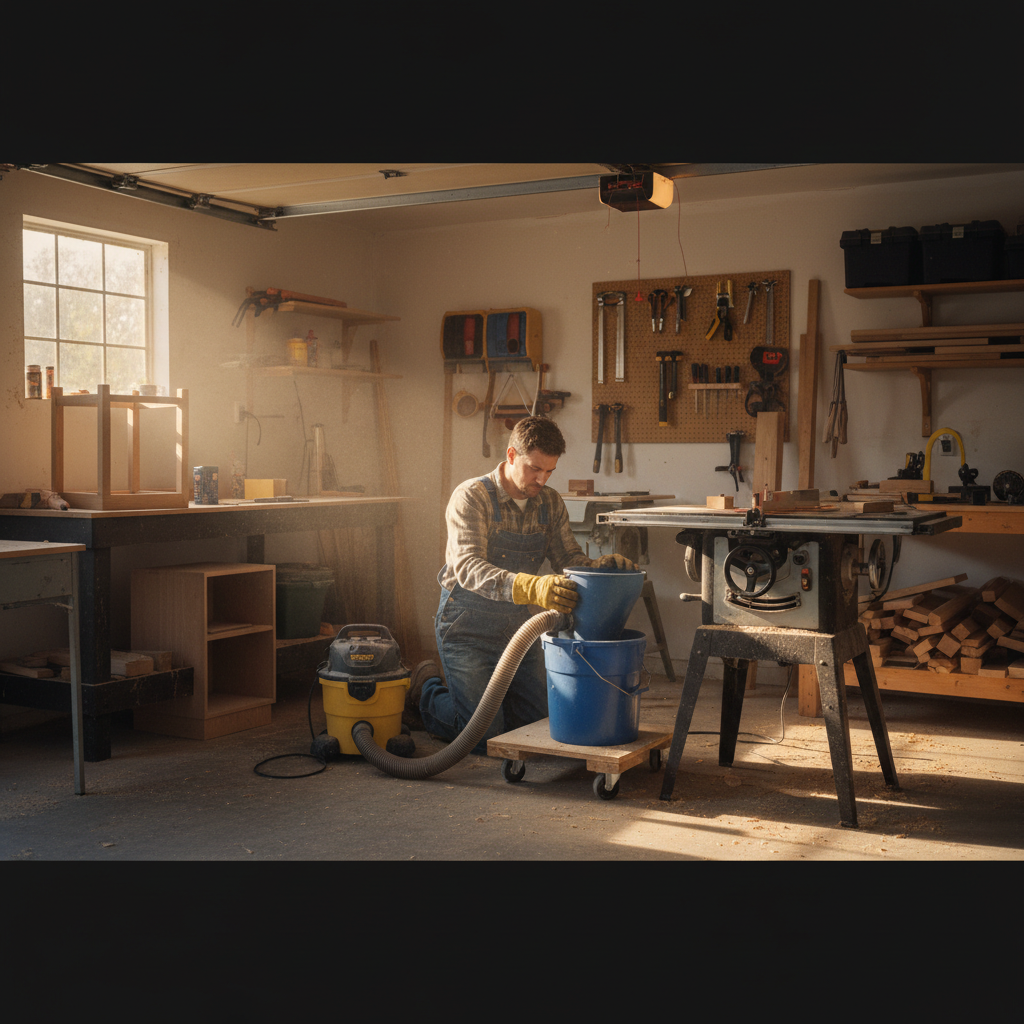
The most cost-effective starting point for a garage shop isn't a dedicated dust collector. It's a two-stage separator feeding an existing shop vac.
A cyclone separator, like the Oneida Dust Deputy or the generic knock-offs that run $30 to $50 on Amazon, sits between your hose and your shop vac bucket. Chips and coarse particles spin out into the lower bucket before they reach the vac's filter. This does two things: it extends filter life significantly, so your shop vac's filter isn't clogged after a single planing session, and it keeps the vac's suction from dropping as the canister fills with debris. A clogged filter on a shop vac can cut suction by more than half, which is a practical heuristic rather than a manufacturer-tested spec, but experienced woodworkers will recognize it as a real phenomenon.
For tools that generate mostly coarse chips (thickness planer, jointer), this two-stage shop-vac setup handles the job adequately. You're looking at around $150 to $200 total if you already own a decent 5-gallon or 6.5-gallon shop vac, less if you build a plywood lid separator yourself using a design from the Woodworking Talk or Sawmill Creek forums, which are good free resources for shop-built solutions.
The table saw and router table need a different inlet strategy. A zero-clearance insert and a shop-built dust hood below the blade capture far more than the standard blade guard port alone. You won't find this in a manufacturer's manual. But a plywood box around the lower cabinet opening, with a 4-inch port feeding your separator, can dramatically cut the airborne fraction.
Ambient Air Filtration: The Layer Most Builders Skip
Dust collection at the source doesn't catch everything. Sanding, in particular, generates so much fine dust that no practical hood can fully contain it. That's where an ambient air filtration unit earns its place.
A 1-HP ceiling-mounted ambient air cleaner with a 1-micron or finer filter runs between $200 and $350 for a unit sized to a two-car garage (Jet, WEN, and Shop Fox all make models in this range). Run it during and for at least 30 minutes after you finish working. The 30-minute runtime after you stop is the part most people skip, and it matters because fine particles that were airborne while you were cutting are still suspended when you pull off your hearing protection and reach for the broom.
If that budget is still too high right now, a box fan with a furnace filter taped to the intake side is a functional interim measure. Use a MERV 13 filter or higher (common in hardware stores, around $15 to $20 for a 20x20 size) rather than a standard fiberglass filter, which doesn't capture the particle sizes that matter. That framing misses something, though: a box fan and furnace filter has roughly 100 to 200 CFM of airflow, which is adequate for a small one-car space but marginal in a two-car garage with multiple tools running. It buys you time, not a permanent solution.
One more thing worth saying directly: a dust mask rated N95 or better is not optional. It's the last line of defense on days when your collection system is overwhelmed or you're doing a dusty task between setups. The CDC and NIOSH both publish guidance on respiratory protection for woodworkers. Read it.
When This Budget Strategy Breaks Down
The two-stage separator plus ambient filtration approach works well for a hobbyist running one or two tools in a session, in a space under roughly 600 square feet. Push beyond those conditions and the limitations become real.
If you run a thickness planer and a table saw simultaneously, or if you're in the shop four or more hours a day, a shop vac based system won't keep up. The motors on shop vacs aren't rated for continuous operation the way a dedicated dust collector is. Thermal overload protection will cycle the unit off, and in a longer session that interruption accumulates. A 1.5 HP or 2 HP single-stage collector (Grizzly and Powermatic both make reliable units in the $300 to $500 range) becomes the more honest recommendation at that usage level.
This article is not for professional cabinet shops or anyone running more than one tool simultaneously on a regular basis. Those environments need ducted collection systems with proper CFM calculations per the Wood Magazine or Fine Woodworking design guides, which are worth reading before you invest in fixed ductwork.
And if you don't address dust at all? The consequences aren't hypothetical. Accumulated fine dust on surfaces is a fire and explosion hazard, not just a nuisance. More immediately, chronic exposure without respiratory protection causes cumulative, often irreversible lung damage. There's no point at which your body repairs that accumulation the way it might recover from a cold.
A Practical Build Order for Getting Started
Start here, in this order, before buying anything else.
First, assess which tools generate the most dust in your sessions. If it's a thickness planer or jointer, the separator and shop vac combination is your first purchase. If sanding is your primary activity, ambient filtration moves up the priority list. Second, measure your garage: under 400 square feet allows a smaller ambient unit; over 500 square feet requires more airflow capacity or a window fan exhausting outward while you work. Third, buy a half-facepiece respirator with P100 cartridges rather than disposable N95 masks if you're in the shop more than once a week. The reusable respirator costs around $30 to $40 and is meaningfully more comfortable over longer sessions.
I'd start with the separator before the ambient cleaner, because capturing dust at the source is always more efficient than cleaning it from the air after the fact. Sequence matters here: source capture first, then ambient filtration, then ductwork only if your usage warrants it.
Two things to skip for now: rigid ductwork (unless you're certain where your tools will live permanently) and any collector marketed primarily on horsepower with a cheap bag filter. A 2 HP collector with a 30-micron bag filter captures coarse chips and vents fine particles right back into your shop. The filter rating matters more than the motor rating, and that's not a nuance most product listings make obvious.
Putting It Together
Buy the separator and a quality filter for your shop vac first. Add ambient air filtration before the end of the month if you're sanding regularly. Wear a P100 respirator every session, not just when it gets visibly dusty.
If your usage grows to daily sessions or multiple tools running together, move to a dedicated collector with a 1-micron filter bag. That's the point where the shop-vac approach stops keeping up, and you'll feel it before the math confirms it.
The goal isn't a perfect system. It's a system that captures the dangerous fine fraction close to the source, filters what escapes, and keeps your filter clean enough to maintain suction. Get those three right for under $300 and you've addressed the real problem. The expensive gear can wait.