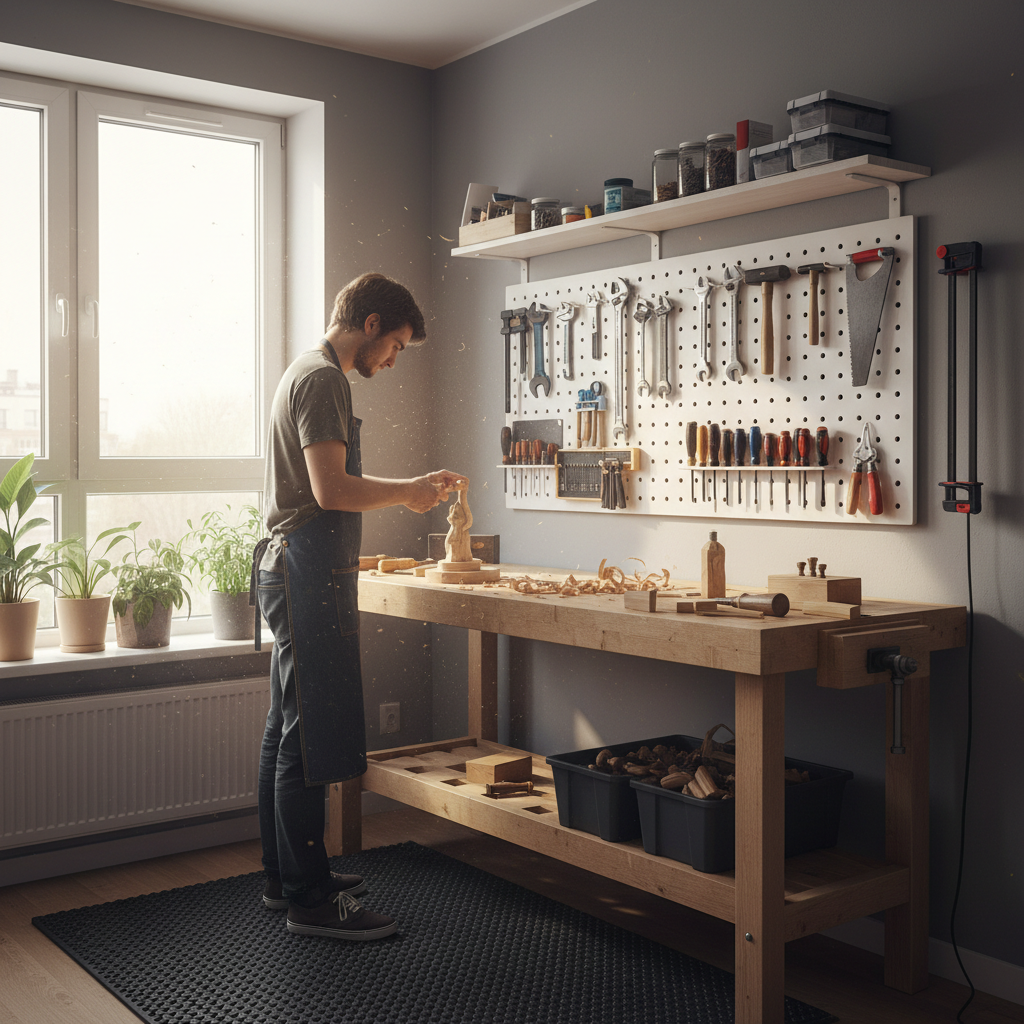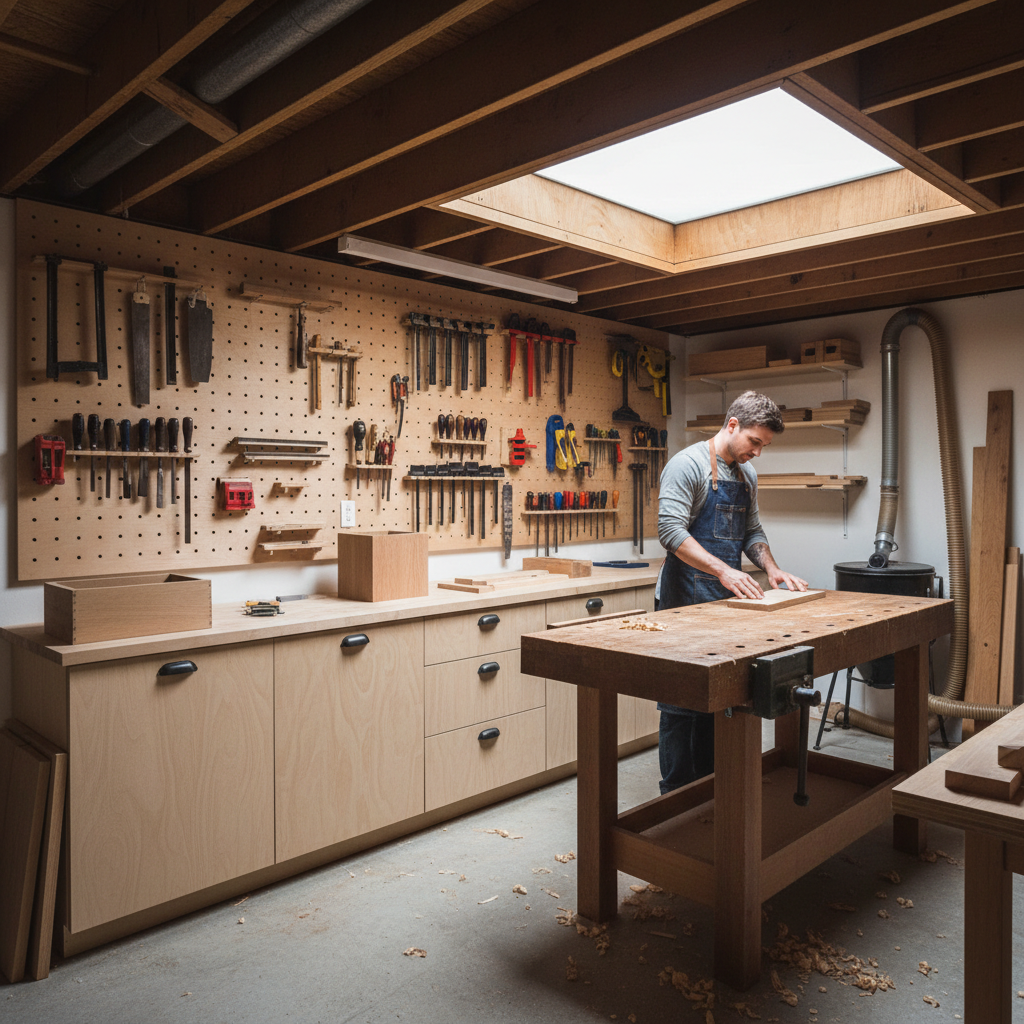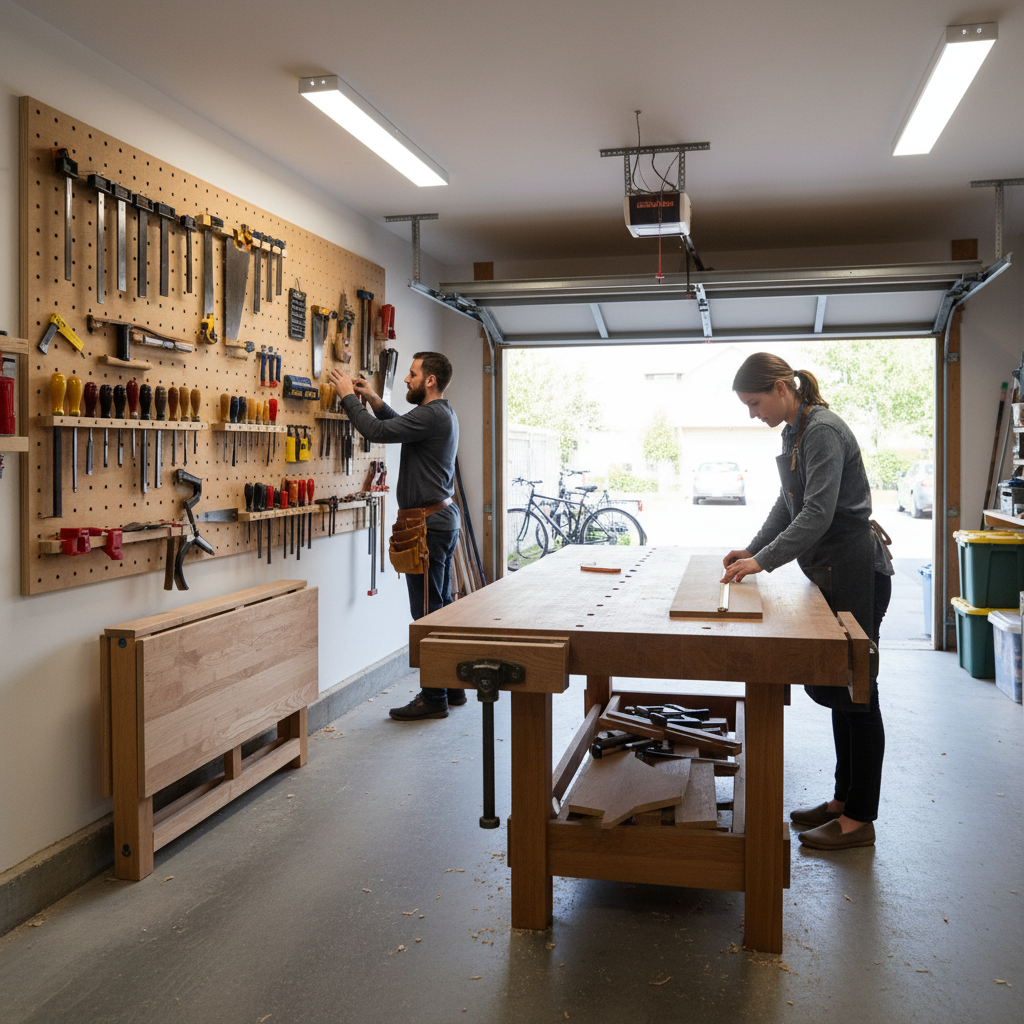
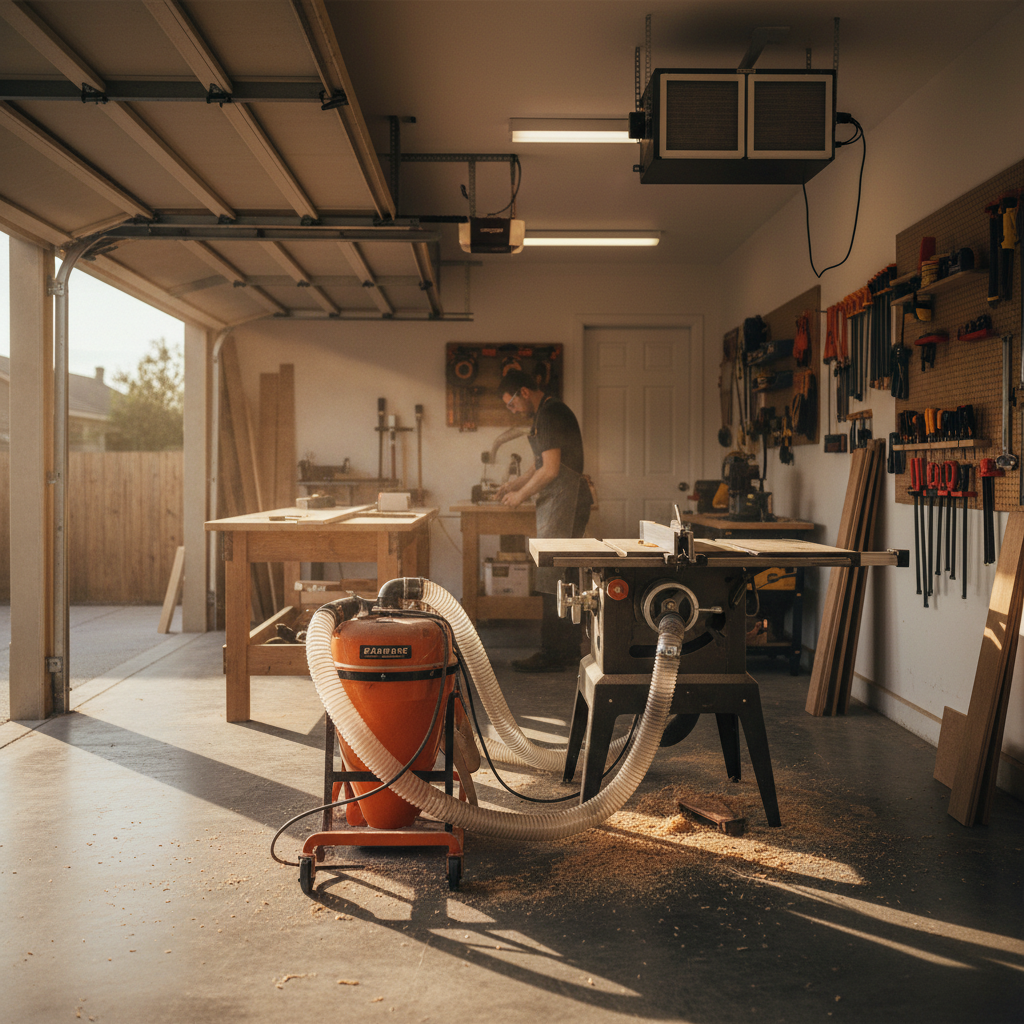
Woodworkers will tell you to sort out your dust collection before you buy your second tool, and there's a reason for that. Sawdust in a small shop doesn't just settle on flat surfaces. It migrates into motor housings, coats your lungs, and turns a 200-square-foot garage into a fire risk faster than most people expect.
Keeping sawdust under control in a home workshop comes down to three things: capture at the source, air filtration between you and the fine particles, and a realistic collection setup that fits the square footage. The tension is real: the machines that fit a small shop often have the weakest built-in dust ports, so you're fighting the physics of a tool designed for production environments and scaling it down to a one-car garage.
Your specific situation matters more than any single product recommendation. Shop footprint, which tools you run, whether you're in an attached garage or a detached shed, and how often you're actually cutting all change what the right answer looks like. This article won't tell you which brand of dust collector to buy. It will tell you how to think through the decision so you don't spend $400 on hardware that doesn't solve the problem.
Why Small Shops Have a Harder Dust Problem Than Big Ones
The instinct is to assume a bigger shop means more dust. Put more precisely: a bigger shop dilutes dust through sheer volume. At 200 square feet with an 8-foot ceiling, you have roughly 1,600 cubic feet of air. Run a table saw for 20 minutes and fine particles stay suspended for hours without active filtration. A 2,000-square-foot cabinet shop with the same saw has ten times the dilution volume before anything even reaches a filtration system.
That math changes what equipment you need. The standard guidance for home shops is a 1- to 1.5-horsepower single-stage dust collector. But single-stage collectors recirculate fine particles under 5 microns back into the room, which is exactly what you're trying to avoid. The real metric to watch is the filter's micron rating, not the motor's horsepower. A collector rated at 1 micron filtration in a 200-square-foot space does more useful work than a 2-HP machine with a 30-micron bag.
Fine dust under 10 microns is the category the EPA and NIOSH both flag as the respirable fraction, meaning it reaches your lung tissue rather than getting caught in nasal passages. A common guideline among woodworking safety educators is to target filtration at 1 micron or finer for any shop where you spend more than a few hours per week. That's not an official regulatory threshold for home shops, but it reflects the underlying physiology.
And if you skip filtration entirely? Fine particles accumulate in your shop air over weeks and months. Chronic low-level exposure to wood dust is classified as a known carcinogen for certain wood species by NIOSH. That's the consequence of treating this as a tidiness problem rather than a health one.
Capture First: Getting Dust Before It Reaches the Air
The most effective dust control happens at the cutting edge, not at a filter hanging on the wall. Source capture means connecting your tools directly to a collection system before the dust cloud forms. This is where most small-shop setups fail, and the failure is usually at the hose.
A 4-inch hose on a table saw port is the minimum for meaningful capture. Drop to 2.5 inches and you're reducing airflow to the point where fine particles escape around the fitting. A practical decision checklist before you buy any hose hardware: check your tool's port diameter, verify your collector's inlet size, confirm the CFM rating at the tool (not at the motor), and decide whether you need a wye fitting to run two tools off one line.
Buyers often skip Y-fittings until they're burned. A single 1.5-HP collector can realistically serve two light-duty tools simultaneously if the CFM is sufficient, but running a table saw and a planer at the same time through one collector is asking for trouble. Close the blast gate on the idle tool. Blast gates (the sliding valves that open and close individual hose runs) are a small-shop essential that gets treated as optional; it isn't.
Or rather: blast gates aren't just about preserving suction. They prevent recirculation. An open gate on an idle tool creates a low-resistance path that pulls already-filtered air backward through a dirty hose. Close every gate that isn't actively connected to a running tool.
For sanders and routers, which generate the finest particles, a shop vacuum with a HEPA-rated filter is genuinely better than routing those tools through a standard dust collector. HEPA filtration (rated to capture 99.97% of particles at 0.3 microns) is the correct tool for random-orbit sander output. A standard 30-micron bag collector on a random-orbit sander is not meaningfully better than no collection at all.
Ambient Air Filtration: The Layer Most Small Shops Skip
Source capture gets the bulk material. What it doesn't get is the fine dust that becomes airborne during cuts and lingers. This is where an ambient air filtration unit earns its place in a small shop.
An ambient air cleaner is a box fan with a rated filter that runs continuously while you work. For a shop under 400 square feet, a unit rated at 400 to 650 CFM will cycle the air roughly twice per hour, which is the minimum effective exchange rate for woodworking environments according to published guidance from air quality researchers. Units in this range cost $150 to $350, making them one of the higher-value purchases in a small shop.
Placement matters as much as CFM rating. Mount the unit at ceiling height on the wall opposite your primary cutting tool. Sawdust rises on thermal currents from the motor heat before settling, so ceiling-height filtration intercepts the particle cloud before it drops back into your breathing zone. A unit sitting on a shelf at waist height captures almost none of the fine suspension. Get it up high or don't bother.
I'd start with a 1-micron ambient filter before adding any other air quality hardware. The combination of source capture at your table saw and continuous ambient filtration handles the large majority of respirable dust exposure for a home woodworker running tools a few hours per week. Everything else is optimization.
What this article is not covering is commercial shop ventilation design, spray finishing booth exhaust systems, or HVAC integration. Those involve building permits and fire code compliance that vary by municipality and go well beyond what a small home shop requires.
The Downside: When Dust Collection Becomes a Noise and Space Problem
A 1.5-HP dust collector in a 200-square-foot shop runs at roughly 75 to 80 decibels. That's loud. In an attached garage with shared walls, that noise travels. Some woodworkers solve this by building a collector cabinet in an adjacent space or exterior closet and running ductwork through the wall, which is a real and workable solution. Others find the noise a genuine barrier to actually using the system.
A shop vacuum alternative deserves honest comparison here. A quality shop vac with a HEPA filter, such as the Festool CT series or comparable units from Ridgid and Fein, runs quieter, stores in less than 4 square feet, and provides better filtration at the fine end of the particle spectrum than most entry-level dust collectors. The tradeoff is capacity: a 5.5-gallon shop vac fills up fast when you're running a table saw, and stopping to empty it every 20 minutes is a real workflow interruption.
For a shop where the primary tool is a router table or random-orbit sander, a premium shop vac is probably the better choice than a dedicated dust collector. For a shop centered on a table saw and planer, the higher-capacity collector wins. Check sq footage, primary tool type, and whether the collector will sit inside or outside the work envelope before committing.
The woodworker who shouldn't follow the standard source-capture advice is someone running tools intermittently, one or two hours per month, in a large well-ventilated detached space. The exposure math is genuinely different. A good P100 respirator and a single-stage collector are probably sufficient. But if you're in an attached garage and you're in there weekly, the filtration investment is not optional.
Putting It Together: A Realistic Setup for Under $500
A functional dust control system for a small home shop doesn't require a custom-fabricated duct network. Three components do the actual work: a dust collector or shop vac matched to your primary tool, blast gates on every hose run, and an ambient air cleaner running at ceiling height.
What you'll notice when you price this out is that the entry-level dust collector market clusters around $200 to $350 for 1- to 1.5-HP units. Add $30 to $60 for a set of blast gates and fittings, and $150 to $250 for a ceiling-mount ambient filter, and you're inside $500 for a system that genuinely reduces exposure. The frustrating part is that most people buy the collector first and skip the ambient filter indefinitely, which leaves the fine-particle problem entirely unaddressed.
Skipping the ambient filter is the most common mistake I see in home shop setups. The collector handles chips and bulk material. The ambient filter handles the respirable fraction. Both are required for the system to function as intended. Running only one is like having a fire suppression system with no smoke alarm: you're handling the big emergency but missing the slow one.
So the honest version of the budget: if you can only do one thing, buy the ambient air cleaner first. Chips on the floor are inconvenient. Respirable dust is a health issue. Prioritize accordingly.