
Carpenters will tell you noise is the first problem before they mention any tool brand, and there's a reason for that. Apartment woodworking without a dedicated shop isn't primarily a space problem. It's a sound, dust, and vibration problem that happens to also have a space problem attached.
The compact tools for apartment woodworking that actually work share one trait: they let you control byproducts as precisely as the cut itself. A track saw with a shop vac connected directly at the blade guard is a fundamentally different machine than the same saw running free. Same kerf, radically different aftermath.
But here's where the tension sits: the tools that minimize dust and noise well enough for apartment use are rarely the ones woodworking YouTube recommends. The track saw crowd runs them in garages. The table saw crowd has a basement. If you're working in a 700-square-foot apartment with neighbors on three sides, their shortlist will get you evicted before your first project is finished.
Why Apartment Woodworking Demands a Different Tool Logic
The standard shop-tool hierarchy assumes you own the space you're working in and control the air inside it. Neither is true in an apartment. That changes almost every purchasing decision.
Consider what a random-orbit sander does in a sealed room with no dust collection. According to the EPA, wood dust from hardwoods like oak and walnut is classified as a potential human carcinogen, and fine particulate under 10 microns travels through standard HVAC systems, coating surfaces in adjacent rooms. A HEPA-filtered shop vac rated to capture particles at 0.3 microns isn't a luxury upgrade in this context. It's the tool that makes every other tool legal to use indoors.
Or rather: it's the tool that makes every other tool livable. Your landlord doesn't care about the EPA classification. Your lungs do, and so does the white ceiling you'll need to repaint before you move out.
This is why the differentiating insight for apartment woodworking isn't about which saw cuts cleanest. It's about which tools can be paired with direct-capture dust collection, run below 85 decibels at operator position, and break down small enough to store in a closet. The tool that wins on cut quality but fails two of those three criteria is the wrong tool for this context, full stop.
The buyers who ignore this logic and purchase a benchtop planer for their dining room typically discover the problem within a week: the neighbors complain, management issues a warning, and the planer sits in a corner unused. You're not buying tools for what they can do at their best. You're buying tools for what they don't do when they're running.
The Core Toolkit: Five Tools That Actually Belong in an Apartment
This list excludes jointers, planers, router tables, and benchtop band saws. Not because they're bad tools, but because none of them clear the noise and dust thresholds that make apartment use realistic. A lunchbox planer at full cut produces roughly 90 to 95 decibels at one meter. A jointer is similar. If your building has noise ordinances referencing 65 decibels in residential units (common in many US city codes), those tools aren't options.
What does work, with proper pairing:
- A track saw with a 55mm or deeper plunge capacity. The Festool TS 55 REQ and the Makita SP6000J are the two systems with the most mature guide rail ecosystems in the US market. Either will crosscut sheet goods and solid stock accurately enough to replace a table saw for most apartment-scale projects. Run one connected to a HEPA shop vac via the integrated dust port and you capture an estimated 90 percent or more of chips at the source, per Festool's published extraction efficiency data. The Makita runs quieter during freehand cuts. The Festool system offers more rail connector options. I'd start with the Makita if budget is tight, the Festool if you plan to expand the rail system over time.
- A domino joiner or pocket-hole jig. These are your joinery tools. The Festool Domino is the precision choice and connects to the same dust port system as the track saw. The Kreg Revo pocket-hole jig is the budget choice and produces almost no dust on its own. For furniture assembly in an apartment, either produces strong joints without a router or chisel work. Check sq footage of your workspace, the type of joints your projects require, and your budget before choosing between them.
- A random-orbit sander, 5-inch, variable speed. Variable speed matters because running an ROS at full speed on final grits produces more heat and more fine dust than running it at 60 percent speed. Slower on final passes is a practical heuristic, not a manufacturer specification, but it's one most finishers follow. Connect it directly to the same HEPA vac. Dewalt, Bosch, and Mirka all make solid options in the $80 to $160 range.
- A compact router. The Bosch Colt and the Makita RT0701C are the two that come up most often for good reason: both run under 7 amps, weigh under 4 pounds, and accept a wide range of collets. Use them with a router mat on a workbench surface rather than freehand, and you keep cuts controlled and quieter. These are not replacements for a router table. They're tools for edge profiling, dadoes, and rabbets done deliberately, one pass at a time.
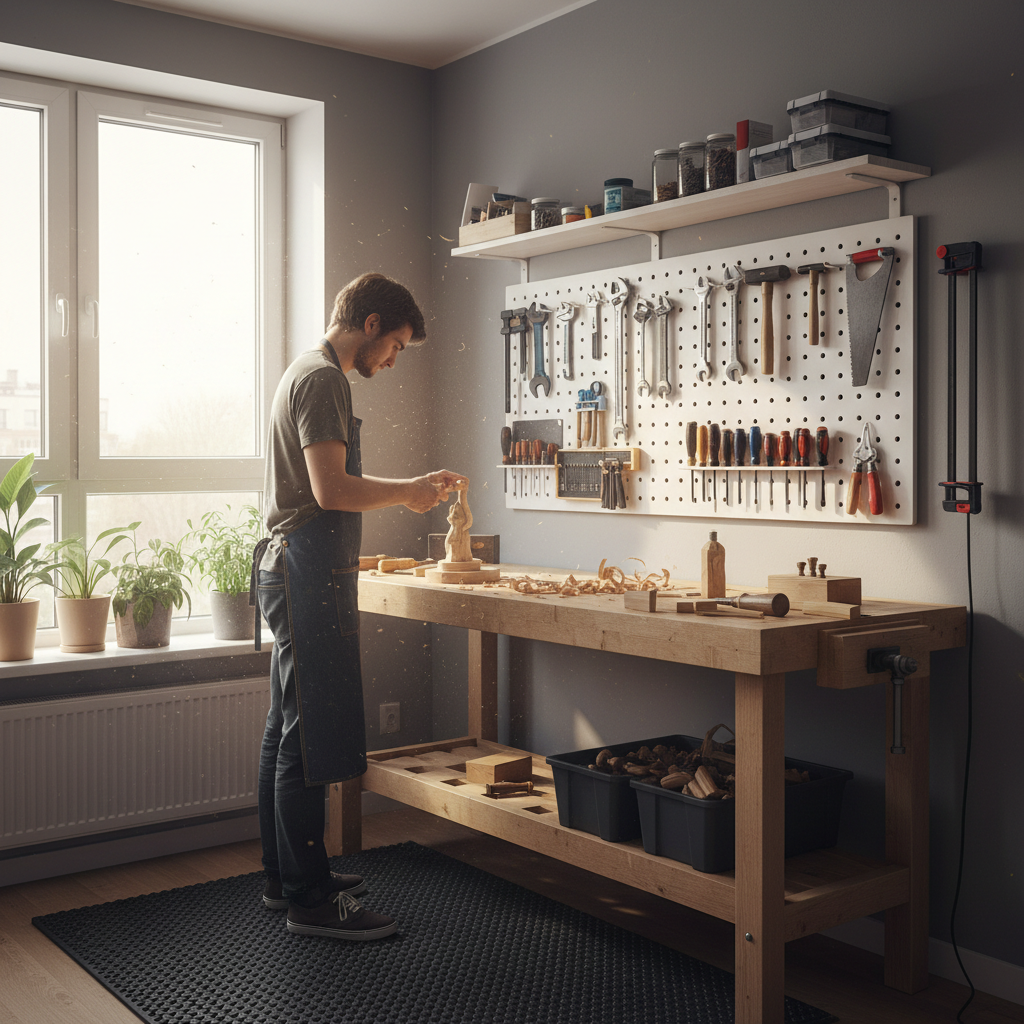
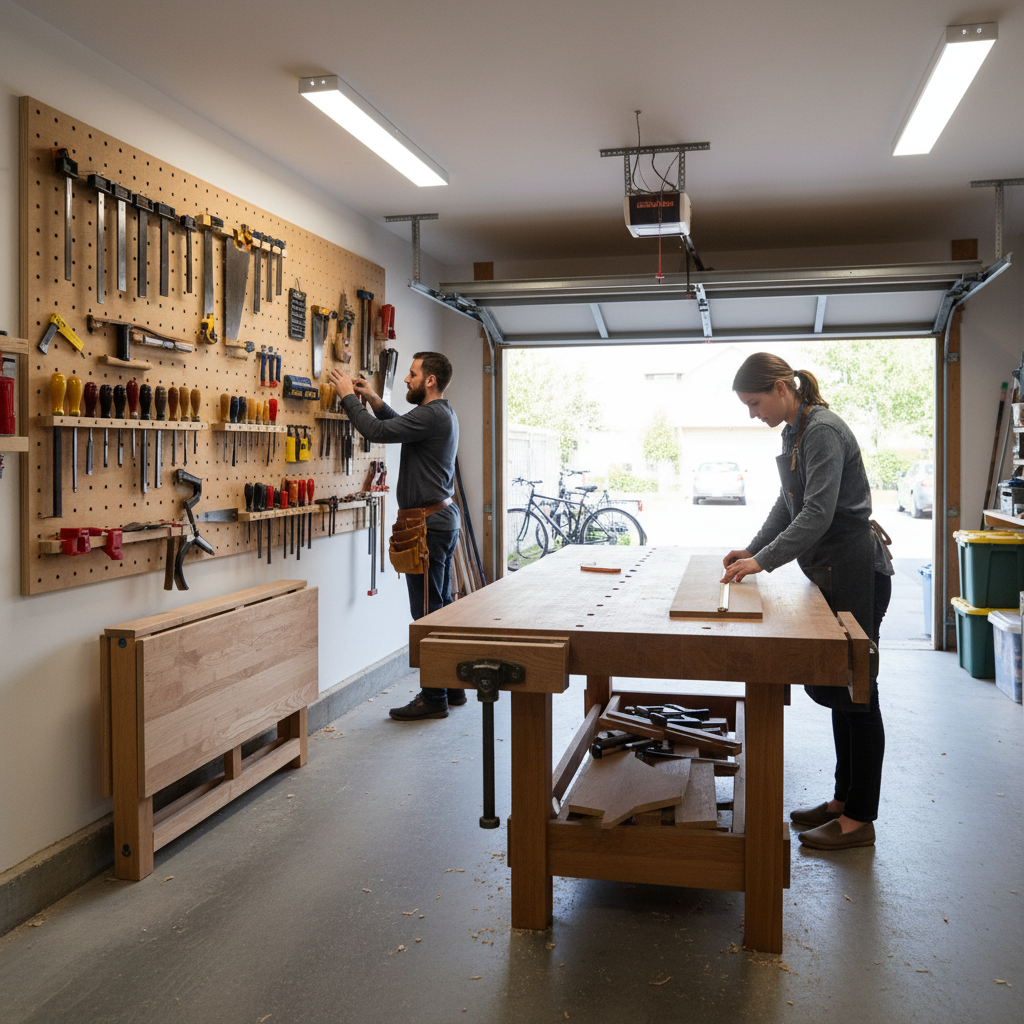
- A folding workbench. The Festool MFT/3 is the apartment woodworker's ideal surface: it folds flat, the dog-hole grid accepts clamps and stops for repeatable positioning, and it doubles as an outfeed support for the track saw. The price is substantial, around $600 to $700 new. The Kreg ACS System is a less expensive alternative that approximates some of the MFT's functionality. If neither fits your budget, a solid-core door on folding sawhorses works and stores flat against a wall.
That's the toolkit. Five categories, not fifteen.
Dust Collection: The Tool That Makes the Other Tools Possible
A HEPA shop vac is not optional equipment. It's the infrastructure every other tool in an apartment shop depends on.
The framing that catches people off guard: most shop vacs sold in home improvement stores are not HEPA-rated at the filter. They capture large chips effectively and release fine particulate back through the exhaust. The Festool CT Mini, the Bosch VAC090, and the Ridgid 4-gallon HEPA model are examples that genuinely filter at 0.3 microns. The price difference between a standard shop vac and a HEPA-rated model is typically $80 to $200. That's not a small gap, but the alternative is fine wood dust settling throughout your apartment every time you sand.
The better question is how you connect the vac to your tools. Most track saws, sanders, and routers accept standard 27mm or 35mm dust port adapters. Buy the adapter set for your vac brand when you buy the tool. Running a sander freehand and then vacuuming up after the fact collects a fraction of what direct-capture collects while running.
That framing misses something. The vac also controls noise indirectly. A sander running at 78 decibels with dust collection sounds like a sander. A sander running at 78 decibels in a dust cloud while you also run a separate vacuum sounds like a construction site. Centralized collection through one quiet vac running at the side of your bench is a different sensory experience for neighbors than two loud machines competing.
When This Setup Fails: Conditions That Change the Recommendation
The track saw and vac approach works well for softwoods, sheet goods, and dimensioned hardwood lumber from a supplier who pre-mills to rough thickness. It breaks down in two specific situations.
First: if you're milling rough-sawn lumber. Surfacing a rough board requires a planer or hand planes, and a lunchbox planer is not apartment-compatible for the noise reasons noted above. Hand planes are the apartment-compatible answer for milling, but they require skill that takes months to develop, and they're genuinely slow. If your projects require rough lumber milling and you haven't learned hand-plane technique, the apartment woodworking toolkit described here won't get you there. You'll need either pre-milled stock or a separate space for machine milling.
Second: if you're in a building with concrete subfloors and thin walls between units. Impact transmission through structural concrete is different from impact transmission through wood-frame construction. A track saw on a workbench sitting directly on a concrete floor can transmit vibration surprisingly far. Rubber anti-vibration feet under your workbench and a rubber mat under the bench legs are practical heuristics for reducing this, but they don't eliminate the problem. In particularly sound-sensitive buildings, some operations simply need to happen elsewhere.
And if you skip dust collection entirely and just open a window? The fine particulate that the window doesn't catch settles into your HVAC filter, your carpet, and eventually your lungs. Health consequences from chronic wood dust exposure accumulate over years, not a single session, which makes them easy to underestimate until they matter.
Making the Space Work: Storage and Workflow in Small Rooms
The tools matter less than the workflow once you have the right ones. Apartment woodworking in practice looks like setup, work, teardown, every session. There is no leaving things mid-project on the bench and returning tomorrow. Every tool stores somewhere specific after every use.
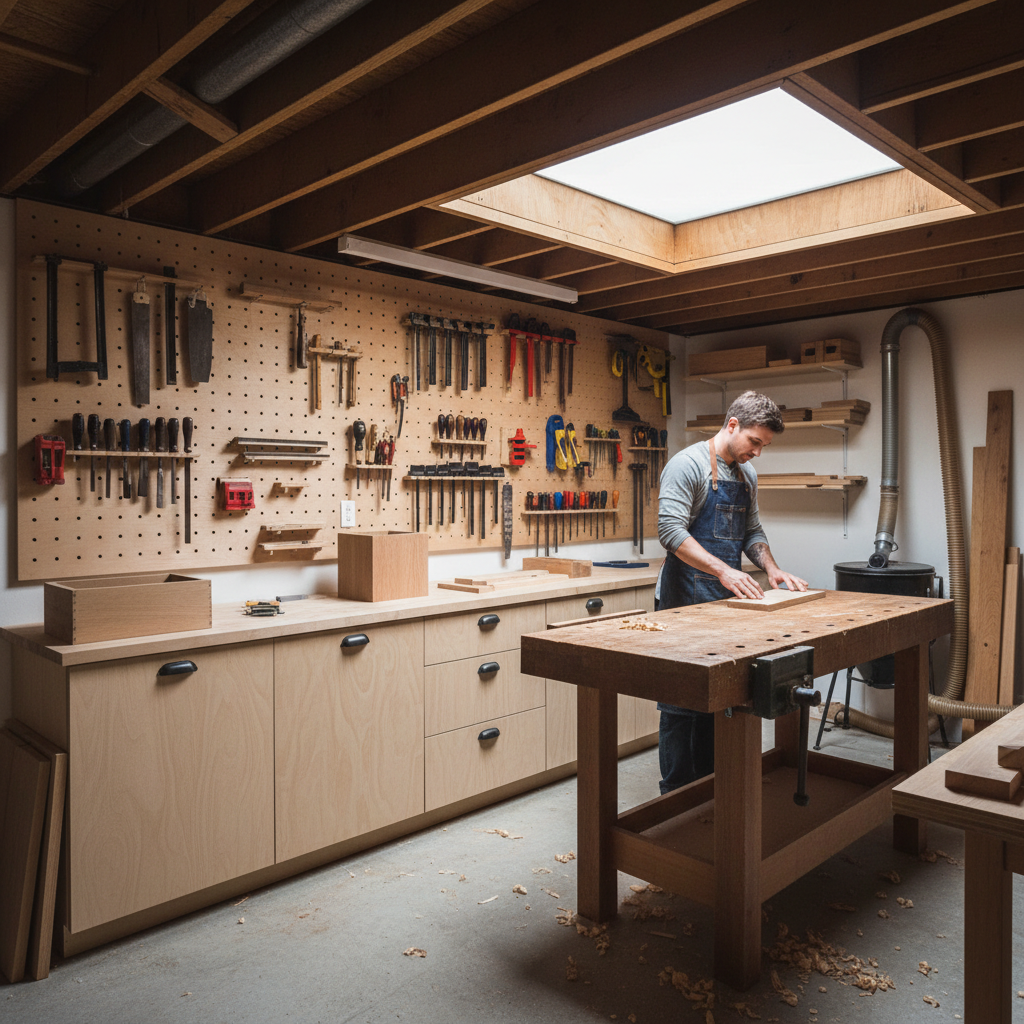
French cleat walls solve storage more efficiently than any cabinet system for a rented space. A sheet of 3/4-inch plywood ripped into 45-degree strips and screwed horizontally to a single wall stud creates a reconfigurable storage grid that holds everything from router bit cases to power tools to finish cans. The cleat strips themselves cost under $30 in material, come down cleanly when you move out, and leave only screw holes. Patching screw holes in drywall costs less than the security deposit penalty for permanent shelving modifications in most leases.
For lumber storage, vertical is almost always better than horizontal in small rooms. A freestanding vertical lumber rack, the kind with adjustable arms, holds eight-foot boards upright against a wall in roughly 12 inches of floor depth. Horizontal storage of any meaningful quantity of lumber will dominate a small room quickly.
Buyers who treat the apartment shop as a permanent open shop (tools always deployed, lumber stacked across the room) typically find the space becomes unlivable within a month. The discipline of teardown isn't a burden. It's what makes the whole thing sustainable.
Which Setup to Build First
If you're starting from zero, build the dust collection and workbench infrastructure before any power tool. A HEPA vac and a flat, stable work surface let you do an enormous amount with hand tools while you add powered tools over time. Trying to shortcut directly to a track saw with no bench and no collection is the sequence that leads to abandoned projects and a disciplinary letter from building management.
Start with: a HEPA shop vac (budget $200 to $350), a folding workbench or door-on-sawhorses setup (budget $50 to $700 depending on route), and one hand saw capable of crosscutting accurately. A quality Japanese-pattern pull saw (the Suizan or Gyokucho brands are reliable in the $25 to $60 range) will handle more cuts cleanly than most beginners expect. From that base, add the track saw when your first project demands sheet goods, the sander when you reach finishing, and the domino or pocket-hole jig when you need joinery beyond butt joints.
The alternative comparison here is renting time at a community makerspace. Most cities with active maker communities have one, and many have woodworking-specific shops with full tool access for $50 to $150 per month in membership fees. That's worth calculating against tool acquisition costs for your first year. If your project volume is low (one or two pieces per year), makerspace membership is almost certainly cheaper than buying the full toolkit. If you're building regularly, the math reverses within 12 to 18 months of consistent use, and you gain the flexibility of working on your own schedule.
The right answer depends on how often you actually build, which is the variable most people misestimate at the start.