A carpenter friend will size up your wall before asking about your tools, and there's a reason for that. The wall is where a fold-down workbench either holds or fails, and in a spare room or converted closet the structural picture is almost never what it looks like on the surface.
Building a fold-down workbench is genuinely achievable as a weekend project, and the result can turn sixty square feet of underused space into a capable work surface that disappears when you don't need it. But the decision tree branches early: the right design depends on whether you're hitting studs or masonry, how much weight the surface will carry, and whether the room is a true closet (where depth runs shallow) or a spare bedroom where you have options. Ignore those variables and you'll end up with a bench that sags, a wall anchor that pulls, or a folded surface that blocks the door.
This guide covers wood-framed interior walls with standard stud spacing, a hinged surface in the 24-to-30-inch depth range, and a load capacity suitable for hand tools and light hobby work. If you're planning to mount a vise and work with hardwood, that's a heavier build and a different article.
What the Wall Actually Tells You
Before you touch a saw, spend twenty minutes with a stud finder and a 1/4-inch drill bit. The two most common wall types you'll encounter in a US spare room are wood-framed drywall (studs typically at 16 or 24 inches on center) and, in older homes, plaster over wood lath. Both work. Concrete block or poured concrete, which shows up in basement spare rooms, requires masonry anchors and changes the hardware list entirely. This article assumes wood-framed drywall. If you're in a basement with block walls, stop here and look into sleeve anchors rated for masonry.
The hinge bracket is the load-transfer point. Every pound of bench weight and downward work force travels through those brackets into the wall fasteners. A single 2x4 stud can carry substantial shear load when fastened correctly, but the fastener has to bite into the stud, not just drywall. Drywall anchors, even heavy-duty toggle bolts, are not appropriate for a hinge mount that will see dynamic load. Find the studs and use 3-inch structural screws, minimum two per bracket per stud.
Or rather: two per stud is the floor, not the target. A wall-mounted ledger board spanning two studs and secured with four structural screws per stud is significantly stronger than individual bracket mounts, distributes load across a wider section of framing, and gives you a continuous mounting surface for piano hinge or European-style folding brackets. I'd start with the ledger approach for any bench deeper than 20 inches.
Measure the stud spacing before buying hardware. Most fold-down bench kits assume 16-inch centers. If your studs run 24 inches on center, a kit's pre-drilled bracket holes may not align, and you'll be drilling new ones.
Choosing the Right Folding Mechanism
There are three practical options for a DIY fold-down workbench: piano hinge with leg support, folding shelf brackets, and cable-and-hinge with no legs. Each has a different load ceiling and a different folded profile.
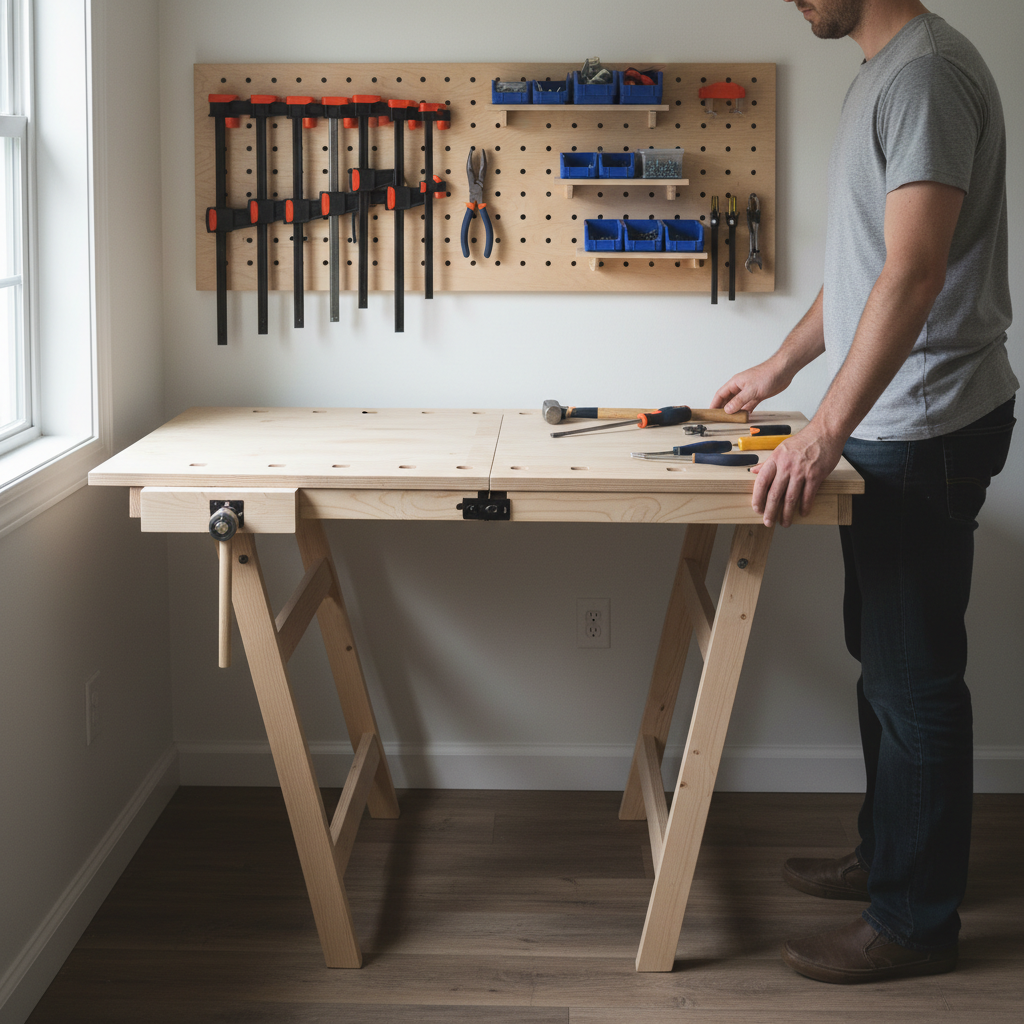
A piano hinge running the full width of the bench top is the most rigid connection, but the bench still needs support when open. The simplest support is a pair of folding legs that lock in the down position. Rockler, Woodpeckers, and several hardware suppliers sell folding leg hardware rated for bench use. Check the static load rating on whatever you buy. A good folding leg bracket will list a per-leg capacity; two legs at 250 lbs each give you 500 lbs of supported load, which is more than adequate for hand-tool work. The downside: legs add floor footprint, which matters in a closet conversion where you might be standing in the only available space.
Folding shelf brackets eliminate the legs. The bench pivots from the wall and is held horizontal by the brackets, which fold flat when the bench is down. The trade-off is load capacity. Folding shelf brackets sized for workbench use (as opposed to decorative shelf brackets) typically carry 100 to 200 lbs per pair when mounted into studs. That's enough for hobby work, light assembly, and hand tools. Put a bench vise on it and the math changes. Check the manufacturer's rated capacity, not the bracket gauge. Two identically sized brackets from different manufacturers can have meaningfully different ratings.
Cable suspension is the third route: the bench hinges from the ledger, and steel cables or chains attach to the underside at the outer corners, running up to wall anchors above. This works, and some builders prefer it because there's nothing under the bench to trip over. But cable hardware has to be sized carefully, the angles matter for load transfer, and it reads as noticeably less rigid under lateral force than either of the other two systems. Fine for a craft table; less ideal if you're doing anything that generates side-to-side force.
For a closet conversion where floor space is tight, folding brackets into a ledger board is the cleanest solution. For a spare room where you have room to stand back, piano hinge plus folding legs gives you more usable capacity and a more stable surface.
What happens if you skip the capacity check and just mount whatever you have on hand? A bracket that's undersized for the load deflects. Repeated deflection works the wall fasteners loose over time. You won't notice until one side drops.
Materials and Dimensions for a Closet Workbench
A standard US reach-in closet runs 24 inches deep. That's a workable bench depth but barely so. A 24-inch bench accommodates most hobby and craft work, light electronics, and small woodworking projects. Going shallower than 20 inches starts to feel frustrating. Going deeper than 30 inches in a closet creates a problem: you're leaning over the bench to reach the back, and your elbows have nowhere to rest on the front edge.
For the bench top, 3/4-inch cabinet-grade plywood is the standard choice. It's flat, stiff, stable, and takes a hardboard or tempered hardboard overlay if you want a sacrificial surface. A single sheet of 3/4-inch birch plywood cut to 24x48 inches weighs roughly 25 lbs. Add a poplar or maple hardwood edge band on the front and that's a bench that will last years. MDF is cheaper and flatter, but it's heavier for the same thickness and doesn't handle moisture or occasional liquid contact as well. In a spare room, either works. In a closet that shares a wall with a bathroom, use plywood.
The ledger board should be 2x4 or 2x6 lumber, straight-grained, kiln-dried. Run it horizontally across both studs at the height that puts the bench surface at elbow height when open. Standard workbench height is 34 to 36 inches from the floor for most adults, so measure from the floor up. The ledger attaches to the wall; the piano hinge or hinge hardware attaches the bench top to the ledger. A 2x6 ledger gives you more bearing surface for the hinge and a better fastener pattern.
Hardware list for a basic piano-hinge-and-folding-leg build: one full-width piano hinge (1.5 inches wide, length matched to bench width), two folding leg brackets, four leg blanks cut from 2x2 or 1.5-inch square stock, 3-inch structural screws for ledger-to-stud, 1.5-inch wood screws for hinge-to-wood, and a barrel bolt or hook latch to secure the bench flat against the wall when folded.
Budget for materials on a 48-inch-wide bench runs roughly $80 to $150 depending on wood choice and hardware quality. That assumes you're buying new lumber and basic hardware; reclaimed materials cut that considerably.
Building and Mounting Sequence
Cut the bench top to size first, before touching the wall. Sand the faces to 150 grit. If you're adding an edge band, glue and clamp it before mounting. Getting the bench top right on the bench is far easier than correcting it after it's on the wall.
Locate studs and mark them clearly with painter's tape. Cut the ledger board to match your bench width. Pre-drill the ledger for structural screws at stud locations. Two screws per stud, staggered vertically to avoid splitting the ledger. Hold the ledger at the correct height (account for the hinge barrel and bench thickness when calculating final surface height), level it, and drive the screws. Check level again after the first screw on each stud; wood moves slightly as you tighten.
Attach the piano hinge to the ledger face first, then to the bench top back edge. Piano hinges have a knuckle that projects forward; make sure the bench top, when folded up, clears any baseboard or outlet. Test the fold motion before driving all screws. It should swing up flat against the wall without binding.
Install the folding leg brackets on the underside of the bench top, positioned so the legs land flat on the floor when the bench is fully open. Measure twice. A leg that's 1/4-inch short will rock; a leg that's 1/4-inch long will tilt the surface. Cut and attach the leg blanks. Test the bench in the open position: legs flat, surface level, no side-to-side rock. If it rocks, shim the short leg with a thin hardwood pad glued to the bottom.
Add the wall latch last. When the bench folds up, a simple hook-and-eye or barrel bolt keeps it from swinging open accidentally. Don't skip this. A bench that swings open on its own in a small room is a genuine hazard.
- Pre-drill all screw holes to prevent splitting
- Check level at ledger, hinge, and open bench surface independently
- Test fold motion under no load before adding hardware weight
- Install latch before calling it done
The full build, from first cut to mounted bench, takes most people four to six hours on a first attempt. The mounting and alignment phase accounts for most of that time.
When a Fold-Down Bench Is the Wrong Solution
A fold-down bench works well in one specific scenario: a small room where you need the floor space back when the bench isn't in use, and where work sessions are bounded (you work, then you put things away). If your work style involves leaving a project mid-build and coming back two days later, a fold-down bench is a pain. You either clear the bench before folding, or you leave it open and lose the room. That's not a design flaw. It's a genuine use-case mismatch.
The other condition where this approach weakens: if the spare room or closet has no studs in the right location. An interior closet wall is sometimes a non-load-bearing partition with studs in awkward positions, or in older homes, a wall that's been modified and has blocking where you don't expect it. If you can't land the ledger on two studs with reasonable spacing, the whole system becomes a workaround. At that point, a freestanding folding workbench (Keter, Worx, and Black+Decker all make decent ones in the $100 to $200 range) is a better answer. Less satisfying as a build, but honest.
Anyone planning heavy metalwork, grinding, or work requiring a vise mounted for serious lateral force should not rely on this style of build. The physics of a hinged wall-mounted surface are fundamentally different from a four-legged freestanding bench bolted to the floor.
Finishing the Space
A workbench without storage is a surface that fills up in a week. If you're in a closet conversion, the walls above the bench are your storage. A simple French cleat system, which is a pair of opposing 45-degree beveled strips cut from 3/4-inch plywood, lets you hang tool holders, small shelves, and bins anywhere along the cleat run. The beauty of French cleats is that the weight of the hung object increases the clamping force. You don't need to pre-plan where every tool goes.
Run the cleat from wall stud to wall stud above the bench, starting about 6 inches above where the folded bench top will sit. Leave enough clearance that the bench can fold up without snagging the cleat or anything hung from it. In a standard 8-foot room with the bench surface at 35 inches, you'll have roughly 56 inches of wall above the bench, enough for two or three rows of cleats and meaningful storage.
Lighting matters more than most build guides acknowledge. A single overhead bulb in a closet creates shadows exactly where you're working. A plug-in LED strip mounted under a shelf or cleat, directed at the bench surface, solves this without any electrical work. Look for strips with a CRI (color rendering index) of 90 or above if you're doing any work where color accuracy matters, finishing, painting, fabric, electronics.
Buyers skip the surface finish until burned by it. A bare plywood bench absorbs oils, stains, and moisture. Two coats of water-based polyurethane on the top face take thirty minutes and make the surface cleanable for years.
Putting It Together
If you've confirmed you have accessible studs in the right location, cut your bench top to size this weekend. The ledger-and-piano-hinge build is the most forgiving for a first attempt, and the materials cost less than a commercial folding workbench that won't fit your space as well anyway.
If studs are in awkward positions or the wall is masonry, don't force the wall-mounted approach. A freestanding option is not a failure; it's just a different answer to the same space problem.
The reframe here is worth holding onto: a fold-down workbench isn't really about saving space. It's about making a room do two things at once without making either function feel compromised. That only works when the build is solid enough that you trust it, and trust comes from the ledger connection, not the bench top.