Carpenters will tell you to pick your joinery method before you buy a single board, and there's a reason for that. The coffee table you build this weekend will either stand solid for fifteen years or rack sideways within six months, and that outcome is decided at the hardware store, not in the garage. Most first-time builders focus on dimensions and wood species. Those matter. But the connection points between apron and leg determine whether your build survives the first year of daily use.
Three variables define every DIY coffee table project: the wood species and its dimensional stability, the joinery approach you're capable of executing cleanly, and the surface finish that will take daily abuse. Get any one of these wrong and you'll feel it fast, either as a wobbling table, raised grain under your coffee mug, or legs that twist out of square within a season.
Here's the tension nobody flags upfront: beginner-friendly plans almost always specify pocket-hole joinery, which is fast and forgiving, but pocket screws alone can't resist the lateral racking that happens when someone sits on the edge of a low table or a dog clips a leg at speed. You need to know that going in, because the fix is simple and cheap if you plan for it, but nearly impossible to retrofit once the table is assembled and finished.
Choosing Your Lumber: Species, Dimensions, and What to Expect at the Lumber Yard
The single best beginner species for a coffee table in the US is poplar, not pine. That framing misses something. Poplar is often dismissed as a secondary hardwood because it's soft for a hardwood, but its dimensional stability is genuinely superior to most construction-grade pine, it takes paint flawlessly, and a 1x4 select poplar board at a big-box store typically runs $1.50 to $2.50 per linear foot, which keeps a weekend project under $80 in material cost before hardware.
If you want a stained natural look instead of paint, step up to red oak. It's the most widely available hardwood at Home Depot and Lowe's, it holds stain predictably, and 4/4 rough-sawn oak (about 13/16 inch after surfacing) gives you enough thickness for a leg blank without laminating boards together. Expect to pay roughly $4 to $6 per board foot for select red oak. For a table with four legs at 1.5 inches square and four apron pieces, budget around 10 to 12 board feet total.
Avoid construction-grade pine labeled "#2 common" for anything structural. The knots are load-bearing weaknesses and the boards cup unpredictably as moisture content changes in a heated home. If pine is your preference, pay for "premium" or "select" grade, which runs clear or near-clear and behaves far more predictably. Buy your lumber a day early, stack it flat in the space where the finished table will live, and let it acclimate for 24 hours before milling.
Standard coffee table dimensions in the US run 48 inches long, 24 inches wide, and 16 to 18 inches tall. Sixteen inches pairs well with low sofas; 18 inches works better with standard-height seating. Commit to your height before cutting legs, because that dimension cannot be corrected after assembly without a full disassembly.
Joinery Methods: What Pocket Screws Can and Cannot Do
Pocket-hole joinery, using a Kreg jig or equivalent, is the right call for most weekend builders. It requires no mortise-and-tenon skill, the jig costs around $20 to $40 for the basic version, and the joint is genuinely strong in withdrawal (pulling apart lengthwise). The problem is racking resistance: a pocket-screw joint resists side-to-side movement poorly unless you add a diagonal brace, a stretcher between legs, or a lower shelf.
For a coffee table specifically, add a lower shelf. It's not just decorative storage. A shelf connecting the bottom of all four leg pairs with dadoed or pocket-screwed rails turns what would be a rackable frame into a rigid box. Without it, the table will flex noticeably under lateral load within 12 months of normal use, regardless of how tight your screws are on day one.
The three joinery configurations worth considering for a beginner build are these: pocket screws with a lower shelf (fast, tools already in most garages), dowel joinery (stronger alignment, requires a doweling jig at around $25 to $35), or loose tenons with a Festool Domino (overkill for a weekend project unless you already own one). Check board footage, device count, and jig availability first.
If you're working with pocket screws, use 1.5-inch coarse-thread screws for 3/4-inch stock connections and 2.5-inch screws where you're joining thicker leg blanks. Apply glue to every joint before driving screws. The glue does most of the long-term work; the screw holds alignment while the glue cures. Skipping glue is the most common mistake on first builds, and the table will tell you about it within a year.
Assembly Sequence and the One Step Beginners Always Skip
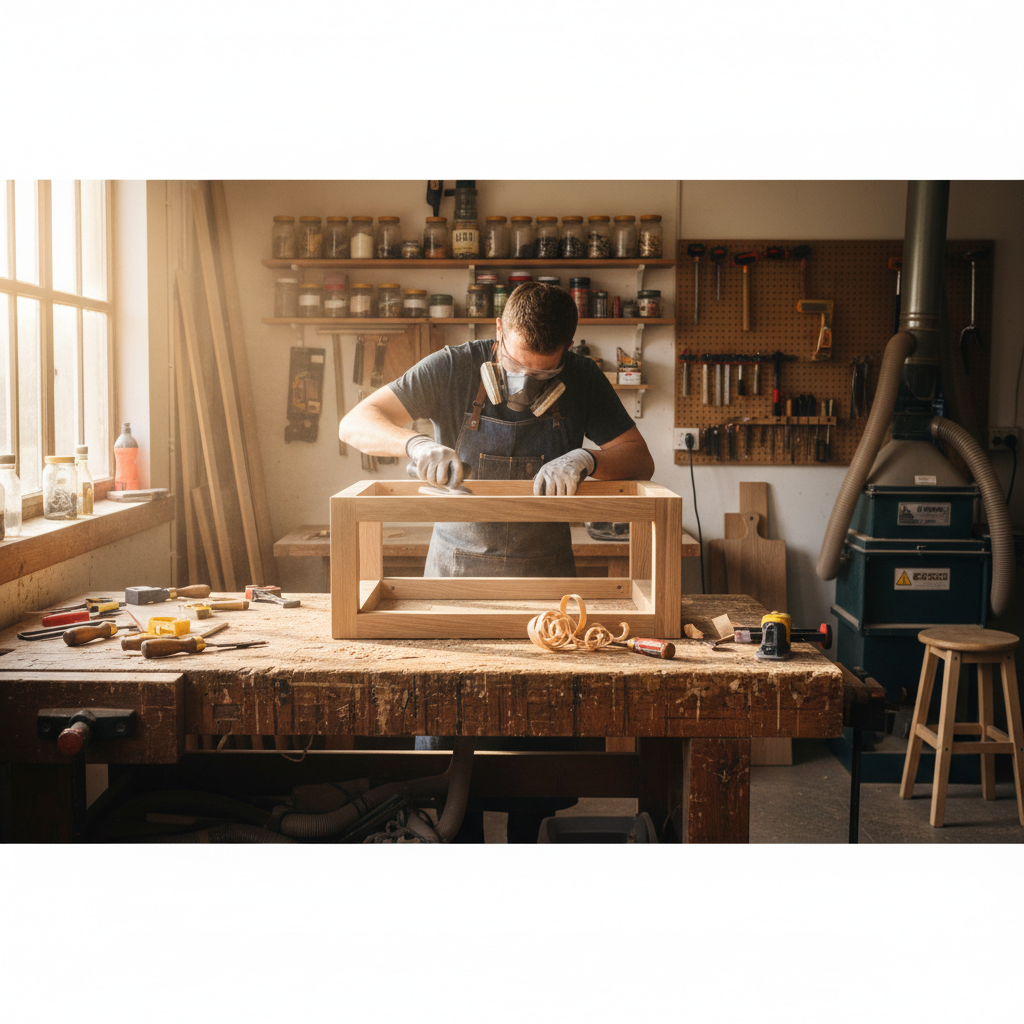
Assemble in sub-units, not all at once. Build two end frames first, each consisting of two legs and one short apron piece. Let those dry completely, ideally overnight, before connecting them with the long apron rails. This sequence keeps everything square because you're only managing two dimensions at a time, not four legs simultaneously trying to drift.
The step most first-time builders skip is clamping to a flat reference surface during assembly. Your workbench top, a sheet of 3/4-inch melamine, or even a verified-flat section of concrete floor will do. If you assemble on a surface that has any bow or twist, you will build that bow or twist into the table permanently. Use winding sticks (two identical straight pieces of scrap laid across opposite ends) to check for twist before the glue sets. If they aren't parallel, adjust clamp pressure until they are.
Before the glue fully cures, measure diagonals corner to corner. Both measurements must match within 1/16 inch. If they don't, apply clamp pressure across the longer diagonal to pull the frame into square. A frame that dries out of square cannot be corrected by sanding or shimming later.
And once everything is square and clamped, leave it alone. A common impulse is to check the joint tightness by flexing the frame while it's still in clamps. Don't. You're breaking the glue bond before it reaches working strength. Most wood glues reach handling strength in one hour but full strength in 24. Plan assembly for the evening of day one, finishing work for day two.
Finishing: What Actually Protects a Coffee Table Surface
A coffee table takes more abuse per square foot than almost any other piece of furniture in the house. Water rings from cold glasses, coffee mug heat, remote controls dragged across the surface, and the occasional foot. The finish needs to be hard, not just pretty.
For a painted finish on poplar, use a water-based alkyd paint, not a standard latex wall paint. Water-based alkyds cure to a harder film than latex and sand between coats without gumming. Apply two coats of shellac-based primer first (Zinsser BIN is the standard choice), then two to three coats of finish paint, scuff-sanding with 320-grit between coats. The primer step is not optional on poplar; without it, tannins and mill glaze will cause adhesion failure within a year.
For a natural wood look on oak, an oil-based polyurethane in satin sheen gives the best durability-to-effort ratio for a beginner. Apply three coats, sanding with 220-grit between the first and second coat, then 320-grit between second and third. Wipe-on poly formulas are more forgiving for beginners because drips and brush marks are nearly impossible, but they require five to six coats instead of three to build equivalent film thickness.
Water-based polyurethane is faster-drying and lower-odor, but it raises the grain on open-pored woods like oak unless you seal first with a coat of dewaxed shellac. If you skip the sealer coat on oak with water-based poly, the first coat will feel rough like sandpaper and you'll spend time correcting a problem that cost ten minutes to prevent.
The finish also determines your sanding schedule. Sand the entire tabletop through 150-grit, then 180-grit, before any finish goes on. Do not jump from 80-grit to 180; the deeper scratches from coarse paper show through most clear finishes, especially when light rakes across the surface at a low angle.
When This Approach Doesn't Work: Limits and Alternatives
This build sequence assumes you have access to a miter saw or circular saw, a drill, and basic clamps. If you're working from a toolbox that tops out at a jigsaw and a cordless drill, this is harder but not impossible: buy pre-dimensioned lumber (S4S, meaning surfaced on all four sides) and use a hand miter box for cuts, which adds time but keeps the project achievable without a stationary saw.
The pocket-screw-plus-shelf approach described here is also not the right call if you're building for a commercial space, a rental property with heavy use, or for a child's room where the table will be climbed on. In those contexts, step up to mortise-and-tenon or breadboard construction with full-length wood screws through the apron. The time investment doubles, but so does the load rating.
If your weekend is genuinely one full day rather than two, don't attempt this build with a finish that requires overnight dry time between coats. Substitute a hardwax oil like Rubio Monocoat (one coat, penetrating finish, no film buildup) or an aerosol lacquer, both of which allow recoating in two to four hours. You give up some long-term durability compared to three-coat polyurethane, but you end the weekend with a usable, protected table rather than one still curing in the garage.
Your Two-Day Build Schedule
Day one is material and structure. Buy and acclimate lumber in the morning. Mill to final dimensions in the afternoon (crosscuts, rips if needed, leg blanks). Cut all pocket holes. Dry-fit the entire table without glue, check square and height. If everything checks out, glue and assemble end frames in the evening and leave them clamped overnight.
Day two is assembly and finish. Connect end frames with long aprons in the morning, check diagonals, clamp to flat surface, and let cure until midday. Sand the top through 180-grit after lunch. Apply first finish coat by mid-afternoon. If using oil-based poly, that's your day done. If using wipe-on poly or hardwax oil, you may get a second coat in by early evening.
I'd start with the pocket-hole jig and a lower shelf, poplar if you're painting, red oak if you're staining. That combination gives a first-time builder the highest probability of a table that looks intentional and stays square through its first winter of indoor heating cycles.
If you skip the lower shelf and trust pocket screws alone, you'll have a table that looks fine on day one and feels loose by spring. Build the shelf.