
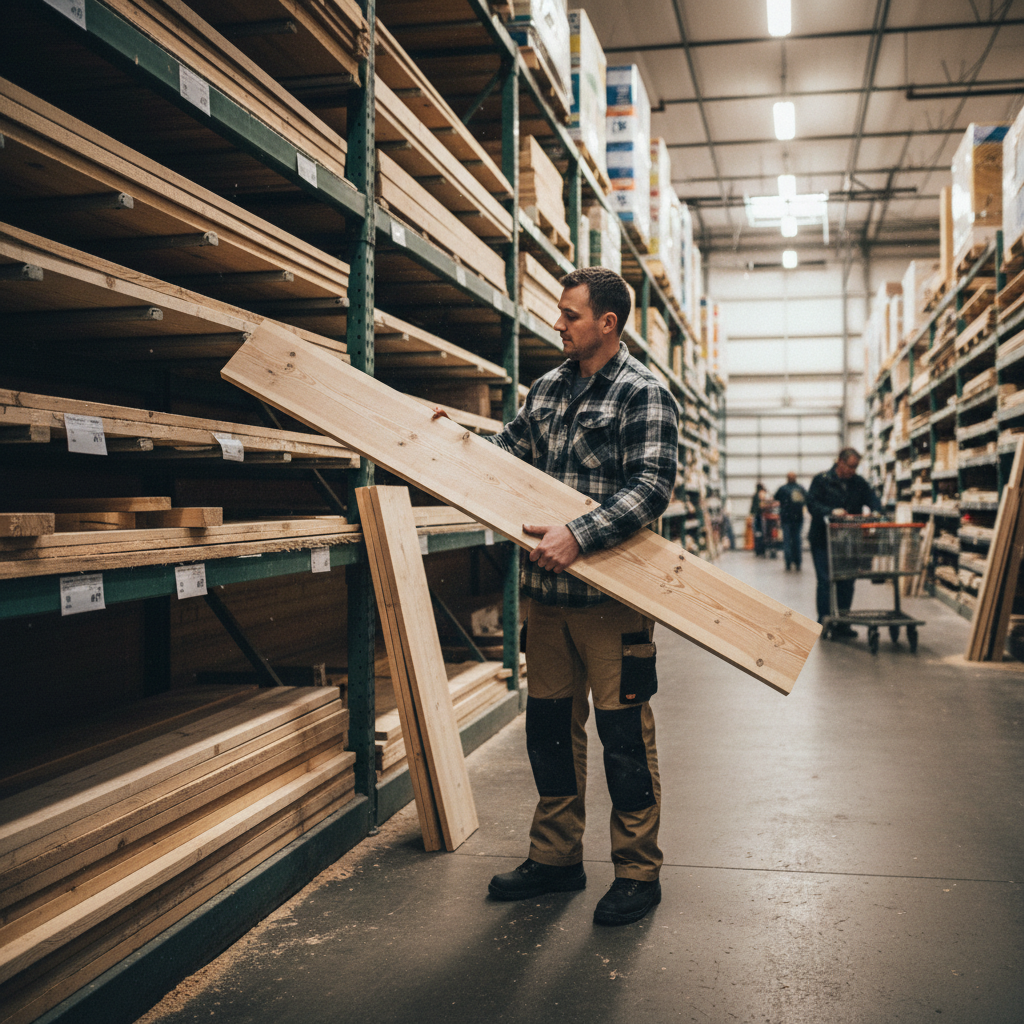
Carpenters will tell you to read the grade stamp before you touch the board, and there is a reason for that. The stamp is a compressed argument: it tells you who graded the wood, what species it is, how dry it is, and whether it belongs in a wall or on a shelf. Skip it and you are making a structural decision blind.
Lumber grades in the US fall under two mostly separate systems, one for dimension lumber used in framing and one for boards used in appearance work, and the two systems share almost no logic. A No. 2 in framing is perfectly acceptable for most walls and floors. A No. 2 in hardwood boards is a different animal entirely, graded by the National Hardwood Lumber Association under rules that prioritize clear-face yield, not strength. Confusing them is the single most common expensive mistake at the lumber rack.
Here is the real problem, though: hardware stores stock both systems on adjacent racks, label them inconsistently, and rarely explain which applies to what you are building. You can walk out with boards that are technically graded correctly and still be completely wrong for your project.
The Two Grading Systems and Why They Don't Overlap
Softwood dimension lumber, the SPF (spruce-pine-fir) and Doug fir studs that frame nearly every house in America, is graded under rules published by agencies like the Western Wood Products Association (WWPA) and the Southern Pine Inspection Bureau (SPIB). These agencies are certified by the American Lumber Standard Committee, which operates under a memorandum of understanding with the US Department of Commerce. Strength is the organizing principle. Grades like Select Structural, No. 1, No. 2, and No. 3 reflect how knots, slope of grain, and wane affect load capacity.
Hardwood boards follow NHLA rules. The NHLA system grades by how much defect-free surface you can cut from a board, measured in board feet of clear cuttings. FAS (Firsts and Seconds) is the top grade, requiring at least 83.3 percent clear-face yield. Select and No. 1 Common step down from there. Strength barely enters the conversation because hardwood boards go into furniture, cabinetry, and trim, not load-bearing walls.
The practical upshot: if you are framing a deck or interior wall, you are buying softwood dimension lumber and reading a strength grade. If you are building a dining table, you are buying hardwood boards and reading a yield grade. The rack location and board thickness are your first clues about which world you are in. Dimension lumber comes in nominal 2-inch thickness (actual 1.5 inches). Hardwood boards are sold in actual thickness, often listed in quarters of an inch, so 4/4 is one inch, 8/4 is two inches.
Or rather: thickness alone does not always tell you. Some home centers stock 1x hardwood boards labeled only by species with no grade stamp visible. In that case, look for the NHLA grade stenciled on the end grain. If there is nothing there, you are probably looking at a box-store proprietary selection that skips formal grading entirely, which means you should inspect every board individually rather than trusting a category label.
Decoding the Softwood Grade Stamp
Every piece of graded softwood carries a stamp with five pieces of information. Once you know what to look for, reading it takes about three seconds.
- Mill number: Identifies the sawmill. Not useful at the rack, but it matters if you ever need to file a warranty claim with the grading agency.
- Grading agency: WWPA, SPIB, WCLIB, NELMA, and others. Each certifies mills in its region. The agency name or logo confirms the grade is third-party verified.
- Grade: Select Structural, No. 1, No. 2, No. 3, Stud, or Construction/Standard/Utility for light framing. No. 2 is the workhorse grade for most residential framing because building codes in most jurisdictions accept it for wall studs, floor joists, and rafters under typical spans.
- Species or species group: Hem-Fir, SPF, Southern Yellow Pine. Species affects Fb (fiber bending stress) values, which engineers use when sizing members. SYP is notably stiffer and denser than SPF, so a No. 2 SYP joist can span farther than a No. 2 SPF joist of the same dimensions.
- Moisture content: S-DRY means kiln-dried to 19 percent or less. S-GRN means green, above 19 percent. MC15 means dried to 15 percent or less, the tighter standard preferred for interior finish work where shrinkage is a concern.
The grade designation is the one most people already look at. The moisture content marking is the one most people ignore, and that is a mistake that shows up six months later as warped baseboards or squeaky floors. Buy S-DRY or MC15 for anything that will be enclosed or finished. Green lumber belongs on rough framing that has time and airflow to dry in place, not on interior trim or flooring.
Species group is the other overlooked field. A contractor framing a floor system in the Southeast will often specify No. 2 SYP because its higher design values allow longer spans without doubling up joists. That same decision in the Pacific Northwest typically calls for No. 2 Doug Fir-Larch. Both are labeled No. 2. They are not interchangeable if your spans are pushing the design limits of the grade.
Appearance Grades: When Strength Doesn't Matter
For shelving, trim, paneling, and furniture built from softwood, the structural grading system gives way to appearance grades. The dominant categories you will see at a home center are C and Better (sometimes labeled C Select) and D Select, plus shop-grade boards often sold as No. 2 Common or No. 3 Common.
C and Better boards have tight, small knots and minimal surface defects. They paint and stain cleanly. D Select allows slightly larger knots but still presents a face suitable for clear finishes if you orient the better face outward. No. 2 Common has larger, sound knots throughout, which is exactly what you want for a rustic-look shelf or a knotty pine accent wall. No. 3 Common has loose knots that may fall out and is mainly useful for crates, rough shelving, or projects where appearance is irrelevant.
The appearance grade system runs parallel to structural grading and appears on the same stamp format. A board labeled 1 COM is not structurally equivalent to a framing-grade No. 1. It is simply a No. 1 Common appearance-grade board. Home center staff often use the terms interchangeably, which is not their fault, but it is a real source of confusion. Read the stamp, not the bin label.
If you are buying hardwood at a specialty lumber dealer rather than a big-box store, the NHLA grades apply. FAS gives you the longest, clearest cuttings and commands a significant price premium. For most furniture projects, No. 1 Common is a better value because the shorter clear sections still yield enough material for most parts, and the price per board foot is substantially lower. A common guideline among woodworkers is that No. 1 Common costs roughly 30 to 40 percent less than FAS in the same species, though this varies by species and market conditions and should be verified with your supplier before budgeting a project.
Matching Grade to Project: The Decisions That Actually Matter
The framing-versus-appearance distinction handles most decisions. But within those categories, a few specific choices separate projects that go smoothly from ones that come back to haunt you.
For load-bearing walls and floor systems: No. 2 or better. Most residential building codes, including those based on the International Residential Code (IRC), list acceptable grades and species for specific applications in span tables. If you are framing to code, check those tables rather than assuming No. 2 is always sufficient, because span, spacing, and load all affect the minimum acceptable grade.
For interior trim and painted millwork: C and Better or finger-jointed primed boards. Finger-jointed boards are short clear pieces glued end-to-end and work well under paint, but they telegraph joints under stain or clear finish. Buyers skip this distinction until the finish coat goes on, and then it is too late.
For exterior applications: Grade matters, but so does species and treatment. Look for lumber rated for ground contact or above-ground use as appropriate. Pressure-treated lumber carries a separate retention-level stamp (UC3B, UC4A, UC4B) that indicates where it can be safely installed, and that stamp governs more than the grade stamp for rot resistance.
I'd start any project by writing down three things before I go to the store: the application (structural or appearance), the moisture environment (interior dry, exterior, or ground contact), and the longest clear length I need from a single piece. Those three answers eliminate roughly 80 percent of the options at the rack before I have touched a single board.
What happens if you buy the wrong grade? For structural applications, using under-grade material in a floor or wall is a code violation and a safety issue. For appearance work, you will either over-spend on grade you don't need or spend hours routing around defects in material that was too low a grade for the finish you wanted. Neither is recoverable without tearing it out.
This article covers grading of solid sawn lumber at retail. It does not cover engineered lumber products like LVL, LSL, or I-joists, which carry manufacturer-specific performance ratings rather than grade stamps and require separate evaluation.
Common Defects and What They Signal
Grade stamps tell you what the worst board in that grade category can look like. They don't tell you what the specific board in your hands looks like. Visual inspection is still mandatory.
Here is a quick reference for the defects that matter most at the rack:
The table below covers the defects you are most likely to encounter and what to do with each one.
| Defect | What It Means | Action |
|---|---|---|
| Loose knots | Knot not structurally connected to surrounding wood; will fall out | Reject for finish work; only acceptable for rough boxing or crating |
| Tight knots | Firmly intergrown; reduce bending strength but often acceptable | Check grade for allowable knot size; orient away from tension edge in joists |
| Cup | Board curved across its width | Mild cup flattens under fasteners; severe cup on wide boards does not |
| Bow | Board curved along its length | Acceptable for short spans; reject bowed studs, they create wavy walls |
| Twist | Opposite corners not in the same plane | Reject. Twist does not come out under fasteners and causes racking problems |
| Wane | Missing wood at corner, often bark edge remaining | Allowed in structural grades within limits; unacceptable for appearance work |
| Checks | Cracks along the grain, usually at ends | Normal in dried lumber; trim past checks before measurement, typically 2 to 4 inches |
Twist is the defect most worth rejecting outright. A bowed board can often be forced into place; a twisted board fights every fastener and still ends up wrong. Pick up one end and sight down the length. Any visible corkscrew means put it back.
The most common mistake is buying by grade alone and skipping the sighting step. Grade guarantees a floor, not a ceiling. A No. 2 board can be the straightest piece on the rack or the most contorted, both within spec. You are allowed to pick through the pile.
Before You Leave the Store
Run through this mentally before you load the cart: application type (structural or appearance), moisture content marking (S-DRY for enclosed work), species match (if span or stain color matters), and defect check by eye (twist first, then bow, then cup). That framing covers the decisions that actually cost money when they go wrong.
If you are buying more than a few boards, count out extras. A practical guideline in the trades is to add 10 to 15 percent to your calculated board count to account for defects you will cut around, mis-cuts, and the occasional board that passes the stamp but fails the eye test once you get it into good light. That buffer is cheaper than a second trip.
One more thing: if a bin of boards is priced noticeably below the surrounding options with no explanation, check the end stamp. Stores sometimes mix MSR (machine stress-rated) lumber, which carries a different stamp format showing a design value like 1650f-1.5E, in with visually graded material. MSR lumber isn't inferior, it's just graded differently, by a machine measuring stiffness rather than by a human reading defects. But if you were expecting a visual grade and got an MSR stamp, you want to know that before you frame a floor with it, not after.