Finishing suppliers will tell you surface prep matters more than product choice before they discuss anything else, and there's a real reason for that. But when you're standing in the finishing aisle at your local home center staring at forty-plus options, product choice is exactly the decision you need to make first. Picking the wrong finish for a beginner wood finishing project doesn't just look bad. It can turn a solid first build into something you're ashamed to show anyone.
The finish you choose controls how visible your application errors will be. Lap marks, brush strokes, drips, blotchy grain absorption: some products punish every mistake at full volume, while others absorb those errors into the final look. That gap between forgiving and unforgiving finishes is what most product comparison guides skip over entirely.
Three factors separate a genuinely forgiving finish from one that just sounds easy on the label: dry time (slower often means more workable), application method (wipe-on nearly always outperforms brush-on for beginners), and build rate (thin, multiple coats hide errors that thick single coats expose). None of that is obvious from the can. And here's the tension that most beginner guides never address: the finishes marketed as easiest to apply are often the ones with the least margin for error if you rush them.
Why Some Finishes Punish Beginners and Others Don't
The core problem with oil-based polyurethane, the product most people reach for first, is its combination of high viscosity and fast surface tack. Brush it on and you have roughly ten minutes before the surface starts to set. Any re-brushing after that point drags partially cured finish and leaves visible ridges. That's not a beginner failing. That's physics working against you.
Wipe-on finishes work differently at the molecular level. Because they're heavily thinned (wipe-on poly is typically standard poly diluted to around 50% solids), each coat goes on extremely thin. Thin coats level themselves. They also dry slowly enough that wet edges stay open longer, which means overlapping passes don't leave hard lines. Or rather: they do leave lines initially, but those lines flow out before the coat skins over. That self-leveling behavior is what creates the forgiveness.
Gel stains and gel topcoats extend this principle further. Their thickened, non-penetrating formula sits on the wood surface rather than soaking in unevenly. On blotch-prone woods like pine, cherry, and alder, this matters enormously. A liquid stain on pine will absorb three times deeper in soft earlywood than in dense latewood, producing a striped, unintentional look. Gel stain deposits color uniformly because it can't soak in fast enough to track grain variation. That's not just a cosmetic benefit. It's the difference between a finish that looks intentional and one that looks like a mistake.
Buyers sometimes skip gel products because they cost slightly more per can than liquid equivalents. That calculation ignores what you'd spend in time and materials redoing a blotched panel.
The Three Finishes Worth Considering for a First Project
These aren't the only products on the market. This article isn't covering lacquer (requires spray equipment), two-part epoxy (too unforgiving for learning), or raw oil finishes like tung oil (takes days between coats and offers minimal protection). The focus here is wipe-on products that a first-time builder can apply with a lint-free cloth and get acceptable results on the first try.
Wipe-on polyurethane is the most accessible starting point. Minwax Wipe-On Poly is widely available at Home Depot and Lowe's across the US, costs around $15 to $20 for a pint, and requires no brushes. You fold a clean cloth, apply a thin coat in long passes with the grain, and let it dry. Three to four coats builds a durable surface with a low-sheen satin or semi-gloss finish. The main drawback is build time: each coat adds only a thin layer, so you'll need more coats than with brush-on poly to reach the same film thickness.
Gel stain plus a wipe-on topcoat is the combination I'd recommend for anyone working with pine, poplar, or any wood with uneven grain absorption. Apply gel stain first for uniform color, let it cure fully (usually 24 hours), then apply wipe-on poly over the top. It adds one step but eliminates the blotching problem that ruins more first projects than any application error.
Waterlox Original Tung Oil Finish occupies a middle ground: it penetrates like an oil finish but builds a harder, more protective surface than pure tung oil. It's slower and slightly more expensive (around $30 to $40 per quart), but it's genuinely difficult to mess up. Thin coats, wiped on, wiped off. The self-leveling behavior is excellent.
Here's how they compare on the factors that matter most to a beginner:
The table below shows how these three options perform across the five criteria that most affect first-project outcomes.
| Finish | Blotch Resistance | Application Margin | Dry Time Between Coats | Durability | Approx. Cost (pint/quart) |
|---|---|---|---|---|---|
| Wipe-On Poly (e.g., Minwax) | Low | High | 2-4 hours | Good | $15-$20 / pint |
| Gel Stain + Wipe-On Poly | High | High | 24 hrs (stain) + 2-4 hrs (poly) | Good | $20-$30 combined |
| Waterlox Original | Medium | Very High | 24 hours | Very Good | $30-$40 / quart |
Waterlox wins on application margin, but the longer dry time and higher cost make wipe-on poly the more practical default for most first projects. If you're working with a blotch-prone species, the gel stain combination isn't optional. It's just what you use.
The One Mistake That Overrides Finish Choice
Choosing a forgiving finish doesn't save you if you skip the sanding step properly. Sand to 180-grit before finishing. Not 120, not 150. At 120-grit, you leave scratches visible enough that any finish will telegraph them. At 150, you're close but still leaving surface roughness that drinks finish unevenly. 180-grit closes the wood surface just enough that finish absorbs at a consistent rate.
Put more precisely: the grit number tells you the scratch depth the abrasive leaves behind, and finish clarity depends on those scratches being finer than the finish film is thick. Wipe-on poly coats are so thin that 150-grit scratches can show through, especially under a raking light. 180-grit scratches are below the threshold where a three-coat wipe-on finish becomes optically flat.
After sanding, wipe the surface with a tack cloth or a lint-free cloth dampened with mineral spirits. Dust left on the surface embeds in your first coat and shows as grit bumps. Sand those bumps away between coats with 320-grit sandpaper. Check grain raise, device count (if applying finish with a foam applicator), and ventilation before you open the can.
If you skip surface prep and rely on a forgiving finish to compensate, you'll get a mediocre result. A forgiving finish still requires a clean, properly sanded surface. What it forgives is application technique, not substrate quality.
When Wipe-On Products Aren't the Right Answer
Wipe-on finishes are the wrong choice for projects that need hard-use durability fast. A dining table that will see daily use needs a full film-build finish, and wipe-on poly simply takes too many coats to get there in a reasonable time. Brush-on oil-based poly, applied carefully with a high-quality China bristle brush, builds the film thickness in two coats that wipe-on needs five or six to match.
For outdoor projects, none of these three options work. Exterior wood requires UV-stable finishes with specific weatherproofing chemistry. Waterlox makes an exterior version, but standard Waterlox Original and wipe-on poly are interior products. Using them outside is a waste of money and time.
Beginners who skip this distinction often discover the problem when their porch furniture finish fails in under a year. That's not a forgiving-finish issue. That's a product-selection issue.
And if you ignore finish entirely on an indoor project, here's what happens: bare wood oxidizes, absorbs oils from handling, and raises grain every time it gets wet. Within a few months, an unfinished pine shelf looks gray and dirty. Unfinished hardwood takes longer to degrade visually, but it offers zero protection against the moisture cycles that cause wood to expand, contract, and eventually crack along the grain.
How to Apply Wipe-On Finish Without Wrecking It
Work in a clean, dust-free space. A garage with the door open on a windy day introduces enough airborne particles to ruin a coat. Garages work fine with the door closed and a few minutes to let disturbed dust settle.
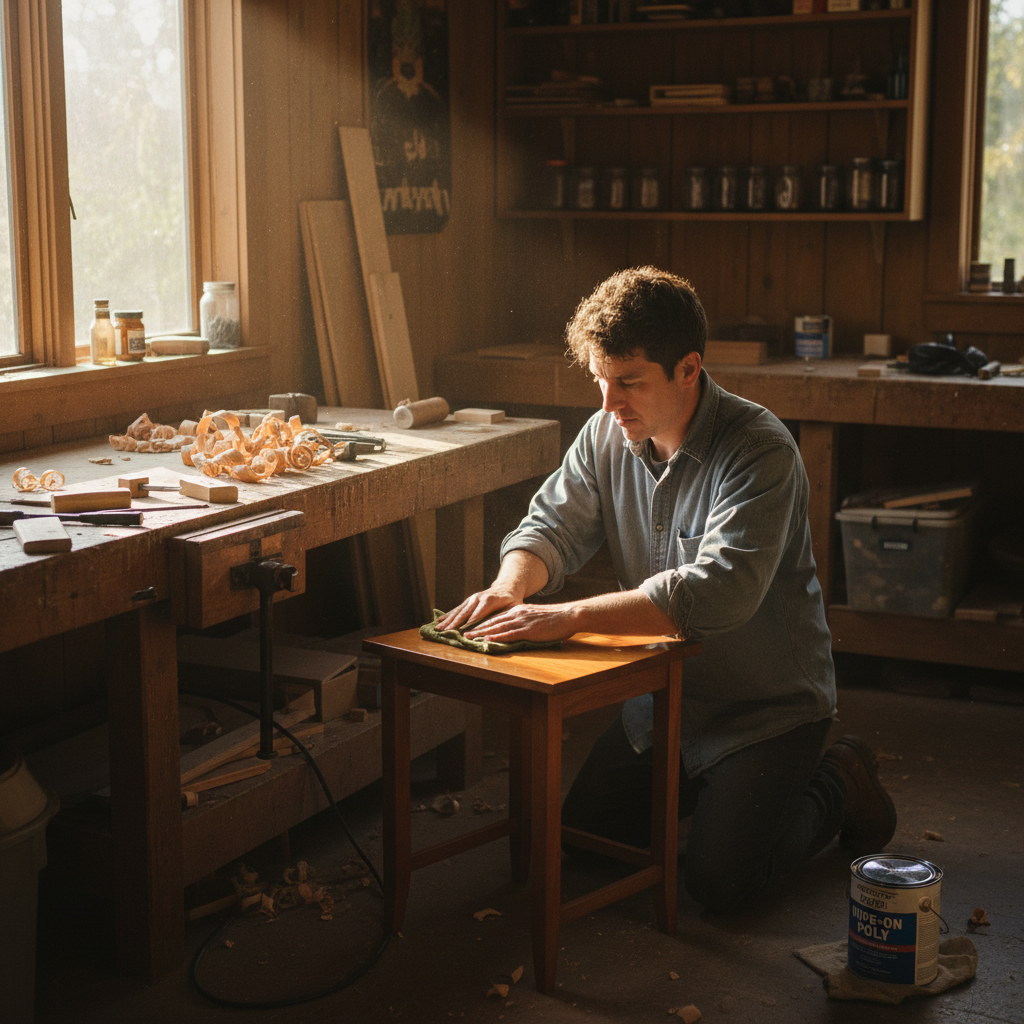
Fold a clean lint-free cloth (cut-up old T-shirts are genuinely fine) into a pad. Pour a small amount of finish onto the pad rather than directly onto the wood. Apply in long, overlapping strokes parallel to the grain. The overlaps need to happen while both the new and old wet edges are still open, which is easier with wipe-on products because their extended open time means you're not racing the clock.
Let each coat dry fully before adding the next. Rushing this step is the most common mistake. Touch the surface gently. If it feels even slightly tacky, wait another hour. Between coats two and three, scuff-sand lightly with 320-grit to knock down any dust nibs. Wipe clean before applying the next coat.
Three coats is a practical minimum for functional protection. Four coats gives you a more durable surface that handles light cleaning and normal handling without issue. Five coats starts getting into diminishing returns for most interior furniture.