Finish carpenters will tell you the dilution ratio before they discuss anything else about whitewashing wood, and there's a reason for that. A whitewash that looks intentional and warm is almost always the product of a 1:1 or 2:1 water-to-paint ratio applied to properly prepped, open-grain wood. Get those two variables wrong and you don't get a subtle, beachy tone. You get a chalky streak that looks like someone started painting and gave up.
White-washed wood finishes work by allowing the grain to show through a translucent layer of diluted paint. That transparency is both the appeal and the vulnerability. Wood species matters enormously here: oak, ash, and pine absorb diluted paint differently, and the grain depth on each produces a different visual result. A tight-grained wood like maple will barely register the wash at all.
The tension most guides skip is this: the same technique that produces a gorgeous driftwood effect on raw oak can look flat and patchy on sanded pine unless you adjust both the dilution and the sealing approach. Knowing which wood you're working with before you mix a single drop changes every decision that follows.
Why Wood Species Is the First Decision, Not an Afterthought
Open-grain hardwoods are the workhorses of whitewashing. Red oak is the most forgiving species for beginners because its pronounced grain channels hold diluted paint predictably, pulling the wash into the lines and leaving the surface wood lighter. The result has depth without effort. White oak behaves similarly but reads slightly cooler, which pairs well with the gray-white palette popular in farmhouse and coastal interiors.
Pine is trickier. It's cheap and widely available, and it whitewashes reasonably well on rough-sawn or lightly sanded surfaces. But heavily sanded pine closes the grain enough that diluted paint skims the surface rather than absorbing into it. If you're working with pine, stop sanding at 80-grit rather than going all the way to 120 or 150. That's a practical heuristic, not a hard rule, but the difference in absorption is visible.
Maple, cherry, and other tight-grained species are genuinely poor candidates for a traditional whitewash. Or rather: you can apply diluted paint to maple, but the wash sits on top rather than penetrating, and the finish looks more like a thin coat of paint than a genuine whitewash effect. If you're committed to a light finish on tight-grained wood, a gel stain in white or off-white will give you more control than a diluted latex wash ever will.
Reclaimed wood deserves its own mention. Old barn wood whitewashes beautifully because decades of weathering open the grain and create natural variation that diluted paint settles into. The downside: reclaimed wood often has residual oils, waxes, or old finishes that prevent absorption entirely. Clean it with a degreaser and test a small section before committing to a full project.
Prep Work That Actually Changes the Outcome
Sanding direction matters more than most tutorials admit. Always sand with the grain, never across it. Cross-grain scratches catch diluted paint and create visible horizontal marks that survive the wash and show through the final finish, especially on lighter wood tones. For new dimensional lumber, 80-grit followed by a single pass at 100-grit is usually enough. For furniture with an existing finish, strip it completely first. Whitewashing over varnish, polyurethane, or lacquer produces uneven absorption and the wash will peel within months.
Raise the grain before you apply the wash. Wipe the sanded wood with a damp cloth and let it dry fully, then do a final light pass with 120-grit. This prevents the water in your diluted paint from raising the grain after application, which causes a rough, fuzzy texture under the dried wash. One extra step, significant difference in the final feel.
If you're working on bare wood that has knots, seal them with a shellac-based primer (Zinsser BIN is the commonly available option at US hardware stores) before washing. Knots bleed resin over time, and that resin will yellow a white wash within a year or two on untreated wood. This is the prep step that cheap guides miss entirely, and it's the reason whitewashed pine furniture sometimes looks dingy after eighteen months.
Mixing and Applying the Wash: Where the Result Is Actually Decided
The standard starting ratio is 1 part flat white latex paint to 1 part water. That's the baseline, not the target. The better question is what opacity level serves your specific wood and design intent, and that depends on species, grain depth, and the look you're after.
For oak with deep grain, a 1:1 ratio produces a moderately heavy wash that reads clearly white with visible grain. A 1:2 ratio (one part paint, two parts water) on the same wood gives a thinner, more transparent effect closer to a lime-wax look. For pine, a 1:1 ratio is often too heavy; start at 1:2 and add paint if you need more coverage. Always test on scrap from the same board before applying to the project surface. Not similar wood. The same board.
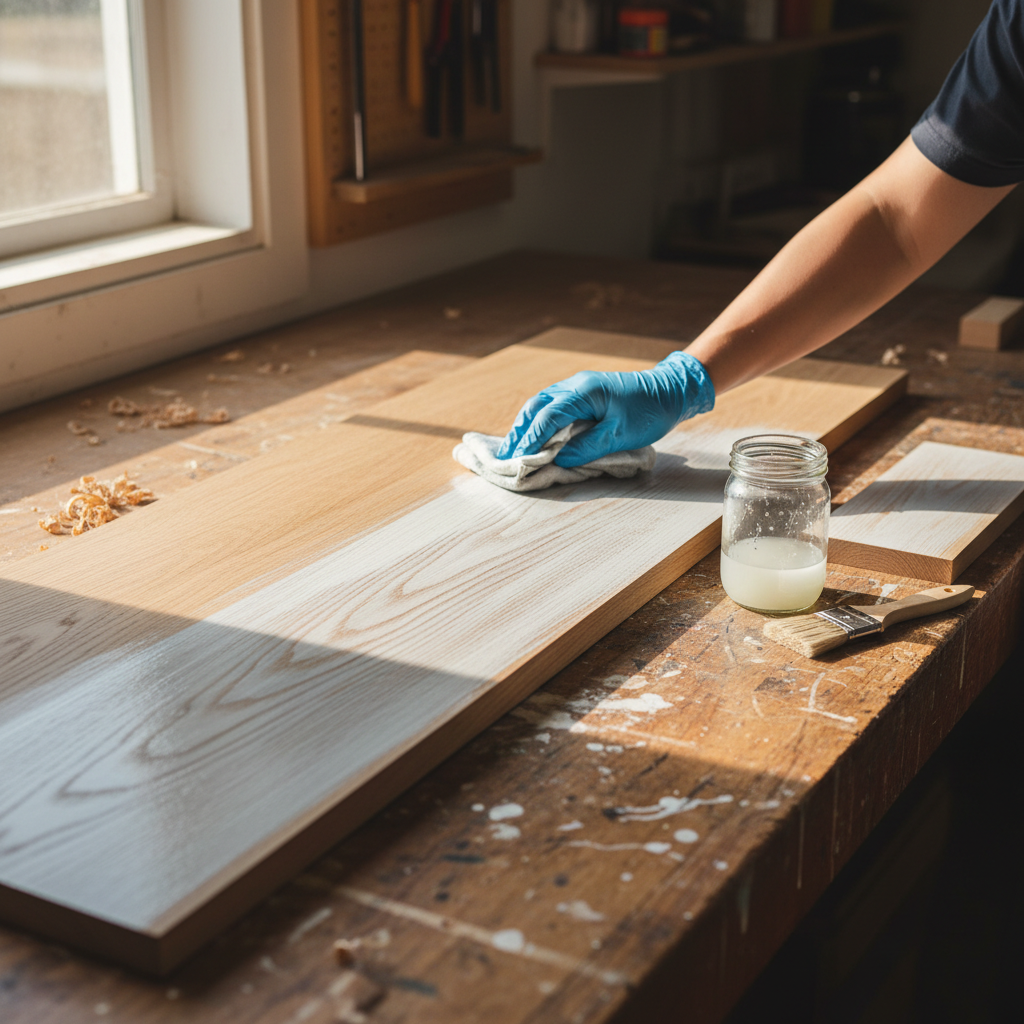
Apply with a natural-bristle brush, working in the direction of the grain. Work in small sections of roughly two to three square feet at a time. Let the wash sit for thirty to sixty seconds, then wipe back with a lint-free cotton cloth, again following the grain. The wipe-back step is what separates a whitewash from a thin coat of paint. How much you wipe determines the final opacity. Wipe more for a subtle effect, wipe less for a bolder statement. You're in control of that variable in real time, which is the actual advantage of this technique over stains or paints.
Let each section dry completely before moving to an adjacent area. Wet edges blend differently than dry ones, and if you're working on a large surface like a floor or a dining table, lapping wet sections produces visible lines. On floors specifically, work board-by-board rather than in patches.
If you skip the test board and go straight to the project surface, you're gambling on a result you can't easily undo. Whitewash that's dried into raw wood can be difficult to remove without re-sanding the entire surface. That's not a hypothetical; it's the most common reason whitewashing projects get abandoned halfway through.
Sealing: The Step That Determines How Long It Lasts
An unsealed whitewash finish will not last. On furniture or flooring, an unprotected wash starts showing wear within weeks of regular use. The diluted paint layer is fragile, and it needs a topcoat to survive contact.
The choice of sealer matters because some finishes yellow over time and will change the color of a white wash. Oil-based polyurethane is durable but adds a warm amber tone that will noticeably shift a bright white wash toward cream or yellow over one to two years. For a white or near-white finish, a water-based polyurethane or a water-based polycrylic is the better choice. Both dry clear and stay clear. Minwax Polycrylic in a matte or satin sheen is a widely available US option that works well over whitewash without adding color.
Apply sealer in thin coats. Two thin coats outperform one heavy coat every time, partly because a heavy coat is more likely to trap air bubbles and partly because thick topcoats on a whitewash can look plasticky, flattening the grain effect you worked to create. Lightly sand between coats with 220-grit, wipe clean, and apply the second coat. For floors or high-traffic table surfaces, three coats is a practical minimum.
That framing misses something. The sheen level of your topcoat affects the visual character of the finished whitewash more than most people expect. A high-gloss topcoat over a whitewash tends to look wrong, amplifying imperfections and making the grain lines look painted rather than natural. Matte or satin sheens preserve the organic quality of the wash. This is one of those details that distinguishes a whitewash that looks considered from one that looks accidental.
One author preference: I'd start every whitewash project with a satin polycrylic topcoat rather than matte, because satin offers slightly better protection and still reads as low-sheen in real-world lighting. Matte topcoats on floors in particular show scuffs faster.
When Whitewashing Is the Wrong Choice
Whitewashing is a poor fit for exterior wood without significant modification to the finish system. Standard diluted latex paint over exterior wood, even sealed, won't hold up to UV exposure, temperature cycling, or moisture penetration the way a proper exterior stain or paint system will. If the goal is a whitewashed look on exterior siding or a porch, use a dedicated exterior solid-color stain in white or off-white rather than a DIY latex wash. The visual effect is similar; the durability is not comparable.
Skip whitewashing on wood that will be exposed to standing water or sustained humidity, such as a bathroom vanity base or a mudroom bench that gets wet daily. Even with a water-based topcoat, the wash layer underneath can eventually soften and separate. Painted wood with a proper primer and topcoat system handles those environments better.
This article is also not covering faux-whitewash effects on non-wood surfaces, whitewash over painted furniture, or lime-washing masonry. Those are different processes with different materials, and the techniques don't transfer.