
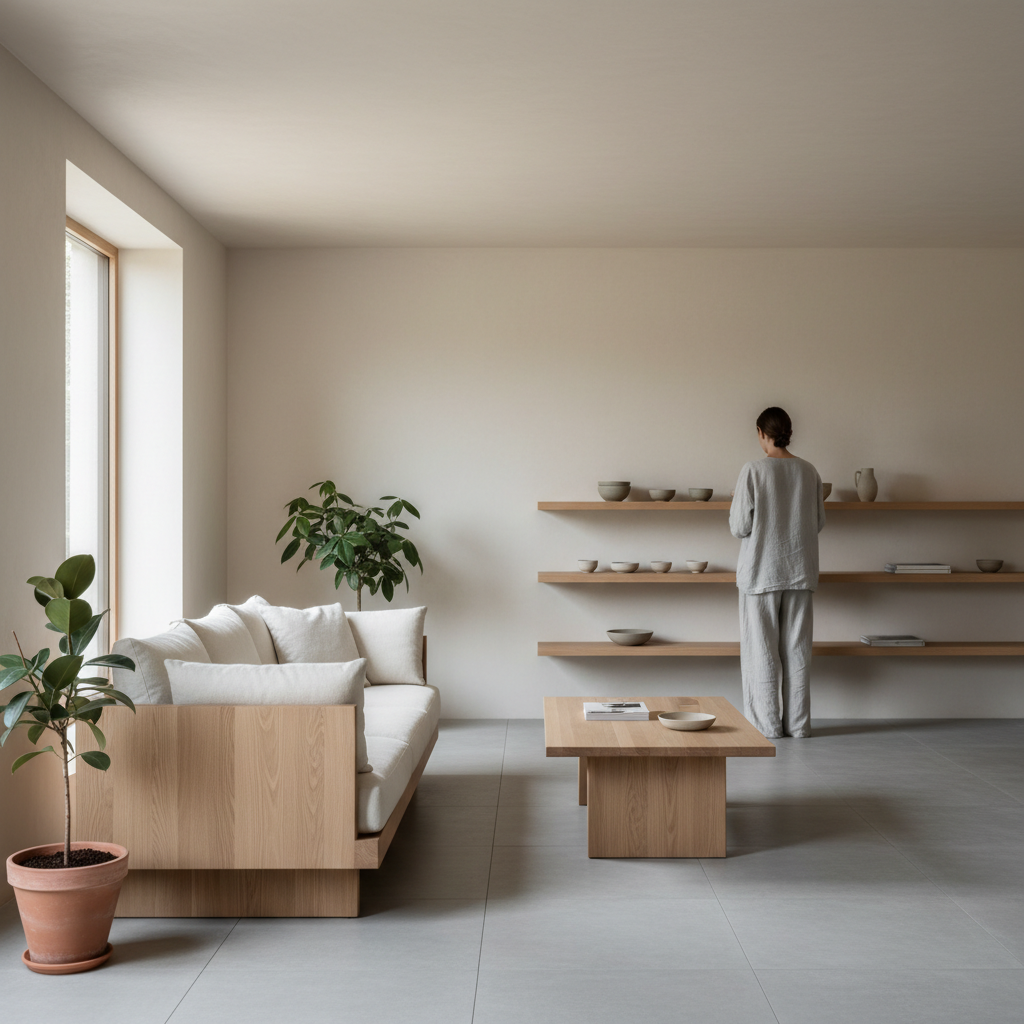
Woodworkers who specialize in Scandinavian and Japanese furniture will name grain restraint before they name a species, and there's a reason for that. The Japandi aesthetic isn't about a particular tree. It's about how wood behaves at rest, and most species fail that test not because of their color but because of how loudly they announce themselves.
The woods that fit Japandi best share three qualities: fine, even grain that recedes rather than dominates, a natural tone that sits in the warm-ash-to-pale-honey range without needing heavy stain, and a surface character that looks better with age rather than worse. White oak, ash, and birch all qualify. Pine mostly doesn't, despite how often it appears in Scandinavian-adjacent content.
Here's the tension worth sitting with: Japandi asks wood to do two contradictory things simultaneously. It should feel natural and present, connecting the room to something organic. But it should also be quiet enough that it doesn't compete with the negative space around it. Getting that balance wrong is easier than getting it right, and the species you choose is the first decision that tilts you one way or the other.
Why Grain Character Matters More Than Color
The single most important property in wood selection for this aesthetic is grain figure, not species. A flat-sawn piece of white oak with a wild ray fleck pattern will read as decorative in a way that undermines Japandi restraint, even though white oak is one of the two or three best species for the style. The same board quarter-sawn, with tight parallel grain lines, disappears into the design the way it should.
That distinction matters practically when you're sourcing lumber or specifying furniture. Quarter-sawn and rift-sawn cuts reduce medullary ray flare and produce straighter grain lines. They also tend to be more dimensionally stable, which matters for solid-wood joinery in furniture pieces. The trade-off is cost: rift and quarter-sawn boards typically run 20 to 40 percent more than flat-sawn equivalents from the same species, and not every lumber yard stocks them in standard widths. Or rather: the premium varies sharply by region and species. In the US, rift-sawn white oak is more consistently available in the mid-Atlantic and upper Midwest, where woodworking supply chains are stronger, than in the South or Mountain West where flat-sawn pine and poplar dominate dealer inventory.
Ash behaves similarly. Its grain is slightly more open than white oak, which gives it a little more visual presence at close range, but in the light-toned, low-saturation Japandi palette that presence reads as texture rather than noise. Ash also responds exceptionally well to wire-brushing, a finishing technique that lifts the soft grain fibers and produces a subtle relief that amplifies the hand-crafted quality Japandi interiors are built around.
Birch is the third reliable option, and it's the most accessible. It's quieter than both oak and ash, with a fine, almost uniform grain that can look flat in larger pieces but works beautifully for smaller furniture, shelving, and millwork details where grain subtlety is an asset rather than a liability.
The Species That Actually Work (and One That Usually Doesn't)
A quick-reference guide to species suitability:
The table below compares the four most-discussed options across the criteria that actually determine Japandi fit. Read it alongside the grain character section above; species suitability changes depending on how the wood is cut and finished.
| Species | Grain Character | Natural Tone | Japandi Fit | Best Use |
|---|---|---|---|---|
| White Oak (rift/quarter-sawn) | Fine, controlled | Warm pale tan | Excellent | Furniture, flooring, cabinetry |
| Ash | Open, slightly bold | Creamy blonde | Good with wire-brush finish | Furniture frames, accent pieces |
| Birch | Fine, quiet | Pale neutral | Good for smaller pieces | Millwork, shelving, plywood panels |
| Pine (knotty or clear) | Variable, often loud | Yellow-orange | Poor in most applications | Not recommended for focal pieces |
The pine question comes up constantly in Japandi forums and YouTube tutorials, and the honest answer is that it rarely works. Clear pine can be finished down to a cooler tone, but its grain often has a faint yellow-orange undertone that fights the greige and cool-white palette Japandi interiors rely on. Knotty pine is worse: the knot patterns are too visually active, the opposite of what the aesthetic requires. If budget is the constraint driving you toward pine, birch plywood is the stronger choice. It holds finish more predictably, costs comparably, and reads as calm in a way pine seldom manages.
Japanese cedar (sugi) deserves a note for anyone with access to a specialty importer. It's historically central to Japanese interior architecture, light, warm, and beautifully quiet in grain. It's not a standard US lumber yard item, but a handful of specialty hardwood dealers on the West Coast stock it, and the distinctive soft-wood smell is a genuine sensory addition to a room in a way that milled oak can't replicate. But this article isn't for the reader sourcing sugi from an importer in Portland. If you're building your first Japandi piece or finishing a room on a working budget, white oak or birch will serve you better with far fewer sourcing complications.
Finish Choices That Preserve Natural Wood Character
Species selection and finish selection are inseparable decisions. A hardwax oil finish on white oak produces a fundamentally different result than a water-based polyurethane on the same board, and the Japandi aesthetic strongly favors the former category of finish.
Hardwax oil and pure oil finishes (brands like Rubio Monocoat and Osmo are widely available in the US) penetrate the wood fiber rather than sitting on top as a film. The result is a matte, close-to-the-wood surface that shows grain texture rather than laminating it under plastic. Film finishes, including most polyurethanes and conversion varnishes, tend to create a surface sheen that reads as industrial, the opposite of the organic warmth that Japandi interiors are organized around.
I'd start with a single-component hardwax oil in a clear or very lightly tinted gray-white tone. The gray-white tint is where the Scandi influence enters: it cools the natural yellow of ash and white oak slightly, pushing the tone toward the warm neutral range that bridges Japanese interior palettes and Nordic ones. Too much tint and you lose the wood entirely. A single coat of lightly tinted oil is enough to shift the undertone without obscuring the grain.
One thing buyers skip until they've already made the mistake: test your finish on an offcut before committing to a full piece. Hardwax oils vary considerably by brand in their sheen level and tone shift, and the variation matters more on light-toned species like ash and birch than on darker ones where the finish effect is more forgiving.
When Natural Wood Grain Works Against You
The main recommendation here, orienting your project around quarter-sawn white oak or ash with a penetrating oil finish, weakens in a specific set of circumstances worth naming directly.
If your existing interior has warm, high-contrast elements (dark walnut floors, terracotta tile, or brick wall mass), the pale warm tone of white oak or ash won't anchor the Japandi palette the way it would in a neutral or cool-toned room. In that context, you're better off looking at bamboo or a darker-toned oak with a gray wash, which can bridge the existing warmth without competing with it. The Japandi palette is internally coherent; it doesn't adapt gracefully to warm-dominant existing interiors without significant material intervention elsewhere in the room.
High-humidity spaces are a separate problem. White oak and ash are relatively stable hardwoods, but solid-wood furniture and millwork in bathrooms or poorly ventilated kitchens will move seasonally in ways that stress joints and finishes. In those applications, engineered oak (a veneer over a dimensionally stable core) performs better over time, and the visual result is identical. If you ignore this and install solid ash in a steamy bathroom, you'll be re-finishing within two or three years.
The reader building with reclaimed wood should also consider this advice with some caution. Reclaimed boards can be excellent, genuinely beautiful, and the right choice for a Japandi project that values provenance and material history. But reclaimed grain character is unpredictable. You may find quarter-sawn reclaimed white oak with flawless quiet grain, or you may find flat-sawn boards with bold figure. Buy what you see, not by species name alone.
Bringing It Together in a Real Project
Before you buy lumber or specify furniture, check three things: the existing floor tone, the dominant light source, and whether you're building furniture or millwork. Those three factors determine which species and finish combination will actually work in your specific room.
For a furniture piece in a neutral or cool-toned room with good natural light, quarter-sawn white oak with a clear or lightly tinted hardwax oil is the closest thing to a reliable default. It's well-stocked at hardwood dealers in most US metro areas, it machines and joins cleanly, and it ages toward a richer honey tone over time rather than yellowing or graying unpredictably.
For millwork, shelving, and cabinetry where you're working with sheet goods, birch plywood is the practical choice. It's available at most home centers in cabinet-grade form, holds paint and oil finish predictably, and the edge grain on exposed ends can be left visible in a way that adds quiet texture without demanding attention.
If you decide the species question is secondary and go straight for a look based on finish tone alone, you'll get a result that photographs well but feels off in the room. The grain restraint, the natural aging behavior, the way the surface responds to raking light: those are properties that only come from the right species cut the right way. The finish amplifies them. It doesn't replace them.
The Wood Decision You're Actually Making
Quarter-sawn white oak with a penetrating hardwax oil finish is the right starting point for Japandi woodwork in most US homes. That framing misses something, though: the real decision isn't which species to buy. It's how much of the Japandi aesthetic lives in the wood itself versus in the restraint of everything around it.
Wood in this aesthetic is meant to be the warmth in a room that is otherwise spare. It earns that role by being quiet, consistent, and honest about what it is. A heavily figured flat-sawn board with a glossy urethane finish can be beautiful, but it's doing the opposite job. And if the wood is doing the opposite job, the rest of the room has to work harder to compensate, which usually means the composition never fully resolves.
If you choose ash over oak because that's what your local dealer stocks in the right cut, you've made a fine decision. If you choose pine because it's cheaper and plan to compensate with paint or stain, you'll spend more time and money than the savings were worth. Buy the quieter wood. Finish it simply. Let the grain do exactly as much as it needs to, and no more.