A hobbyist walking into Home Depot for the first time to buy lumber for woodworking leaves either overpaying by 40 percent or hauling home wood that won't hold a joint. Neither outcome is inevitable, but avoiding both requires knowing something the store's lumber aisle won't tell you: big-box retailers optimize their inventory for contractors buying dimensional softwood in volume, not for someone building a walnut end table on a Saturday afternoon.
Affordable lumber for hobby woodworking is out there in the US, but it's scattered across sources with very different strengths. The right answer depends on three things that almost no guide specifies clearly: the species you actually need, the quantity you're buying per project, and your local market's density of independent suppliers. A woodworker in rural Tennessee has genuinely different options than one in the Chicago metro area.
Here's the tension worth sitting with before you read further: the cheapest source by board-foot price is often the most expensive by time and waste. You can find walnut offcuts on Facebook Marketplace for next to nothing, then spend an hour driving and come home with boards too twisted to use. The sources that feel premium sometimes deliver the most economical result once you factor in usable yield.
Why Your Source Choice Depends on Species First
Softwoods and hardwoods are not interchangeable categories when you're shopping. Pine, poplar, and cedar are stocked at Home Depot and Lowe's in dimensional sizes because the construction trade needs them. Hardwoods like oak, maple, walnut, and cherry are a different supply chain entirely, and treating them as the same shopping trip is the first mistake hobby woodworkers make.
For softwood projects, dimensional lumber from a big-box store is genuinely fine and often the right call. The lumber is graded, it's dry, and the price is stable. A 1x6x8 pine board runs roughly $8 to $12 depending on region and grade. You won't find better pricing in small quantities anywhere else for species that grow fast and get cut in massive volume. But buy a sheet of walnut there and you'll pay a premium that an independent hardwood dealer would find embarrassing.
Or rather: it's not just that big-box hardwood is expensive. It's that the selection is thin, the drying is sometimes inconsistent, and the boards are often face-planed to a finished thickness that removes your ability to flatten and true the surface yourself. You're paying more for wood that gives you less control.
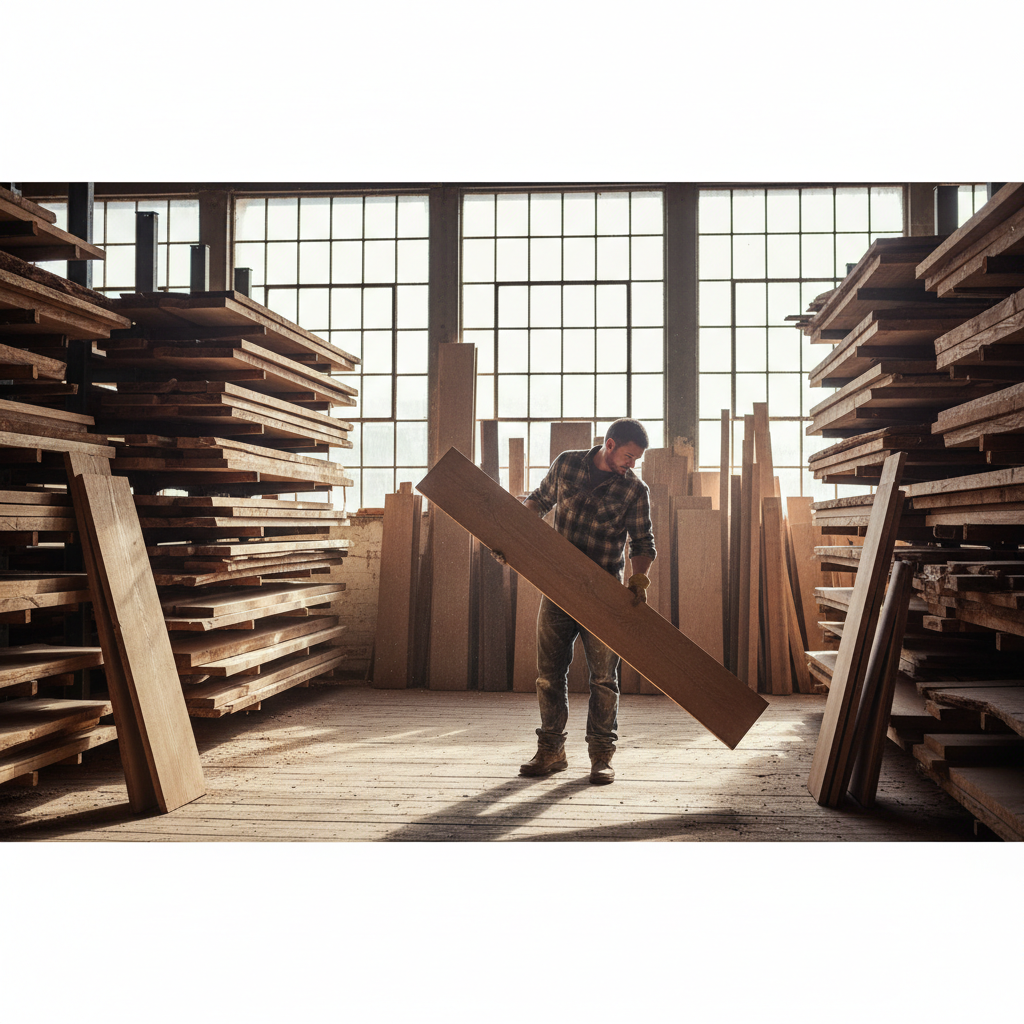
Independent hardwood dealers are the correct default for hobby woodworkers buying anything other than pine or poplar. They stock rough-sawn lumber in multiple thicknesses (4/4, 5/4, 6/4, 8/4 are standard), sell by the board foot rather than by the piece, and their staff can actually help you select for grain and figure. A hobbyist who visits one for the first time almost always says they wished they'd found it sooner.
The Source Landscape: Where to Actually Shop
Before you commit to any single source, check species, quantity, and distance against each option. Those three inputs change the math every time.
Independent hardwood dealers and lumber yards are the backbone of affordable hobby woodworking in the US. Woodcraft stores carry hardwood but their pricing reflects retail convenience. The real dealers, the ones supplying small furniture shops and cabinetmakers, often sell to hobbyists at the same board-foot rates they charge professionals. A common guideline among woodworkers is to look for dealers who have a rough-sawn rack visible from the front, not just pre-surfaced boards behind glass. Rockler Woodworking and Hardware has retail locations across the country and reliable stock, but pricing sits above dealer-direct.
Buyers skip local sawmills until they get burned by shipping costs from online retailers. A regional sawmill that cuts to order, or sells green lumber you'll dry yourself, can bring the price per board foot well below what any retailer charges. The tradeoff is lead time and the skill to work with wood that isn't kiln-dried yet. If you're building anything with joinery that requires tight tolerances, freshly sawn green lumber is a genuine liability until it reaches equilibrium moisture content, which can take months depending on thickness.
Online hardwood retailers including Bell Forest Products, Woodworkers Source, and Wood-Mizer's retail arm ship nationwide and publish board-foot pricing you can compare directly. Shipping adds cost, but their selection depth often justifies it for specialty species. I'd start with local options and move to online shipping only for species your region doesn't carry. Paying $30 to ship $80 of walnut makes sense. Paying $30 to ship $20 of poplar does not.
Facebook Marketplace and Craigslist are real sources that belong in this conversation, not afterthoughts. Estate sales, shop closures, and hobbyists clearing out their stock regularly list hardwood lumber at 30 to 60 percent below retail. The variability in quality is high and you need to know what you're looking at, but for someone who can identify twist, check, and end-checking on sight, this channel delivers genuine value. The most common mistake here is buying more than you can store properly, then watching the stack degrade.
Habitat for Humanity ReStores and salvage yards stock reclaimed lumber: old-growth pine, Douglas fir, heart pine, and occasionally hardwoods pulled from demolished structures. This wood is often denser and more stable than new-growth equivalents. Pricing is inconsistent, the boards are almost always rough and may contain embedded metal, and you'll need a metal detector before running anything through a planer. But for the right project, particularly anything with a rustic or heritage aesthetic, the material quality is exceptional.
| Source Type | Best For | Price Range (per board foot) | Minimum Quantity |
|---|---|---|---|
| Big-box retail | Softwood, dimensional lumber | $0.80 to $2.00 (softwood) | Single board |
| Independent hardwood dealer | Hardwood species, rough-sawn | $3.00 to $9.00 (species-dependent) | Usually 10+ board feet |
| Online hardwood retailer | Specialty species, nationwide access | $4.00 to $12.00 plus shipping | Varies by seller |
| Local sawmill | Bulk purchase, regional species | $1.50 to $5.00 | Often half-log or more |
| Facebook Marketplace / Craigslist | Opportunistic deals, local pickup | $0.50 to $4.00 | Seller-determined |
| Habitat ReStore / salvage | Reclaimed, old-growth character | $1.00 to $6.00 | Single board |
These price ranges are approximate and vary by region, species, and market conditions. They reflect common reported ranges from hobbyist forums and dealer listings, not published official data. Treat them as orientation, not guarantees.
When the Cheap Source Costs More
The cheapest board-foot price is not the cheapest project. That framing misses the actual cost calculation a hobby woodworker should be running.
Usable yield is the number that matters. A rough-sawn walnut board at $5 per board foot with 15 percent waste from twist, warp, and sapwood removal actually costs more per usable board foot than a $6.50 board that's been properly dried and is flat. If you don't have a jointer and planer in your shop, you're dependent on getting lumber that's already close to true, which narrows your options considerably.
The species-quantity calculation: for a small project under 10 board feet, the convenience premium of a retail store is often worth it. For anything over 20 board feet in a single species, driving to an independent dealer almost always saves money even after accounting for the trip. That threshold isn't a rule from any official body; it's a practical heuristic based on how dealer minimums and per-board-foot discounts typically stack against retail pricing.
What happens if you ignore this and just default to the nearest Home Depot every time? The cumulative cost adds up fast. A hobbyist building two or three projects per year in hardwoods will overspend by hundreds of dollars annually compared to someone who established a relationship with one local dealer. That's not a warning about single purchases; it's a pattern that compounds quietly until you finally price out a project and realize the lumber alone is eating half your discretionary hobby budget.
Who Should Not Follow the Standard Advice
This article is aimed at hobbyists buying lumber for finished projects: furniture, boxes, frames, small items. It's not addressing timber framing, deck construction, or anyone buying in volumes where a contractor account at a lumber yard changes the math entirely.
If your shop lacks milling equipment (jointer, thickness planer, or both), the recommendation to buy rough-sawn lumber from an independent dealer weakens significantly. Rough-sawn stock requires flattening and surfacing before it's usable for joinery. Without that equipment, you either pay a dealer to surface it for you (sometimes an option, worth asking), buy S2S or S4S stock that's already surfaced, or stick with the pre-surfaced boards that retail stores stock. The economics of rough-sawn lumber assume you can process it yourself.
Similarly, if you're in a rural area without a local hardwood dealer within a reasonable drive, the online retailer path becomes your primary channel, not a secondary one. That shifts the species-quantity calculation. Shipping costs mean smaller orders are relatively expensive; ordering in larger batches to amortize shipping makes more sense even if it means more lumber storage at home. And storing lumber correctly, stickered and covered in a space with reasonable humidity control, is its own consideration that some hobbyists haven't factored in when they decide how much to order.
Finding Dealers Near You and Building the Relationship
Open a browser and search for hardwood lumber dealers within 50 miles of your zip code. The National Hardwood Lumber Association (NHLA) does not maintain a public consumer dealer locator, but woodworking forums including Sawmill Creek and The Wood Whisperer community regularly compile regional dealer lists that members keep current. Local woodworking clubs, which exist in most mid-size and larger US cities, almost always know who the regional suppliers are and often have negotiated member discounts.
When you visit a dealer for the first time, bring the species, thickness, and approximate footage for your current project. Ask to walk the rough-sawn rack yourself rather than having boards pulled for you. Dealers who are serious about serving hobbyists and small shops expect this and won't rush you. The ones who treat small buyers as an inconvenience will make that obvious quickly, and that tells you something useful about whether the relationship is worth building.
A few things worth checking before you buy anywhere: ask whether the lumber is air-dried or kiln-dried, and what the current moisture content is. For interior furniture, you're targeting 6 to 8 percent moisture content in most US climate zones. A dealer who can tell you this has actually been managing their stock. One who looks at you blankly has not.
Cheap guides miss the value of becoming a known customer at one dealer. Dealers who recognize you start setting aside figured boards, calling when unusual species come in, and occasionally offering offcuts at no charge. None of that shows up in a board-foot price comparison, but it matters to hobbyists who care about interesting material.
Making the Decision for Your Next Project
If you need softwood or dimensional construction lumber, go to the closest big-box store. No further analysis needed.
If you need hardwood and you have milling equipment, find your nearest independent hardwood dealer first. Call ahead, tell them you're a hobbyist, and ask if they sell to individuals. Compare their board-foot price against an online retailer for your specific species. Factor in drive time and shipping honestly. Most of the time, local wins on cost and wins decisively on the ability to hand-select boards.
If you're buying hardwood without milling equipment, your realistic options are: an independent dealer who will surface for you, a retailer like Rockler or Woodcraft that stocks S4S hardwood, or online retailers that ship surfaced stock. Budget roughly 20 to 30 percent more per board foot for the surfacing, whether you pay a dealer or buy it pre-surfaced. That's not waste; it's the cost of not having the equipment to do it yourself, and it's still usually cheaper than the big-box equivalent for the same species.
For opportunistic buying: check Facebook Marketplace monthly for your area. Set a search alert for species you use regularly. Be selective; only buy boards you've seen in person and can assess for defects before loading them in your car.
Find your local hardwood dealer this week. One visit will tell you more about your actual options than any online guide.