
Experienced woodworkers will tell you the layout comes before the tools every time, and there's a reason for that. Your first workshop doesn't fail because you bought the wrong saw. It fails because nothing has a permanent home, so you spend twenty minutes hunting for a square before every cut.
Organizing a beginner workshop is really a problem of workflow sequencing: where raw material enters, where it gets processed, and where finished pieces land. Get that sequence wrong and your shop fights you. Get it right and the space almost runs itself. The specific tension here is that most beginners treat storage as something to figure out later, after the tools accumulate, which is exactly backward.
The variables that actually drive your layout decisions are floor square footage, the number of stationary versus handheld tools you own, and whether your shop shares space with a car or laundry. None of those resolve the same way twice, so this guide won't pretend there's one universal floor plan.
Map Your Workflow Before You Move a Single Tool
The standard advice is to organize by tool category: hang all the chisels together, group the measuring gear, store clamps near the bench. For a beginner shop under 200 square feet, that advice creates a shop that looks tidy in a photo and slows you down in practice.
Organize by workflow stage instead. Every project moves through roughly the same steps: rough material storage, breakdown cuts, milling or shaping, assembly, and finishing. Each stage should have a dedicated zone, even if that zone is only three feet wide. When you reach for a tool, it should be in the zone where you use it, not in the zone where it belongs taxonomically.
Or rather: the goal isn't for tools to live near other tools in the same family. The goal is for each tool to live at the point in the workflow where you reach for it. A tape measure belongs at the breakdown station, not in a drawer with other measuring tools across the shop.
Label every zone before you store anything. Painter's tape and a marker cost almost nothing and force a real commitment. If you can't name a zone, you don't have a zone; you have a pile with aspirations. The labeling step is where most beginner shops stall, because naming zones means deciding what the shop is actually for, which means confronting limitations in square footage or budget. Do it anyway. A shop built around honest constraints outperforms one built around optimistic assumptions every time.
The Five Zones Every Small Shop Needs
Five zones handle the full workflow in any shop smaller than a two-car garage. You don't need more than five to start, and adding zones before you've used all five is a reliable way to create dead space.
The zones are: raw material storage, the primary workbench, a dedicated cut zone, an assembly surface, and a finishing area. Each has one non-negotiable location rule.
Raw material storage goes farthest from the main door. Lumber and sheet goods are heavy and awkward, but you only move them once per project. The workbench goes under the best natural light, full stop. The cut zone needs clearance on both the infeed and outfeed sides of any stationary saw; a common guideline is at least the length of your longest board on each side, which in a small shop often means the saw sits near the center of the room rather than against a wall. Assembly and finishing share the floor near the door, because you'll be moving completed pieces out and that short trip matters more than it sounds when you're carrying something fragile or wet with finish.
That framing misses something. The finishing area specifically needs ventilation, and in many attached garages or basement shops, that means it's constrained by window or exhaust fan placement regardless of workflow logic. If ventilation and workflow pull the finishing zone in different directions, ventilation wins. Finishing with inadequate airflow is a health and fire risk that no organizational preference justifies.
If you do nothing else, do these three things before adding a single shelf: mark your five zones on the floor with tape, identify your ventilation point and build the finishing zone around it, and confirm your workbench placement under natural light. Everything else is adjustable. These three aren't.
Storage That Scales Without Wasting Money
A new woodworker once told me the most expensive mistake in his first shop was buying matching wall-mounted tool cabinets before he knew which tools he actually used most. Six months later, half the cabinet space held tools he'd touched twice. The cabinets weren't wrong; the sequence was.
Buy storage reactively for the first six months. Use what you have, note what annoys you, then build or buy storage that solves the specific friction. A five-gallon bucket with a foam insert handles most handheld tools while you figure out your real workflow. It costs almost nothing and it's honest about where you are.
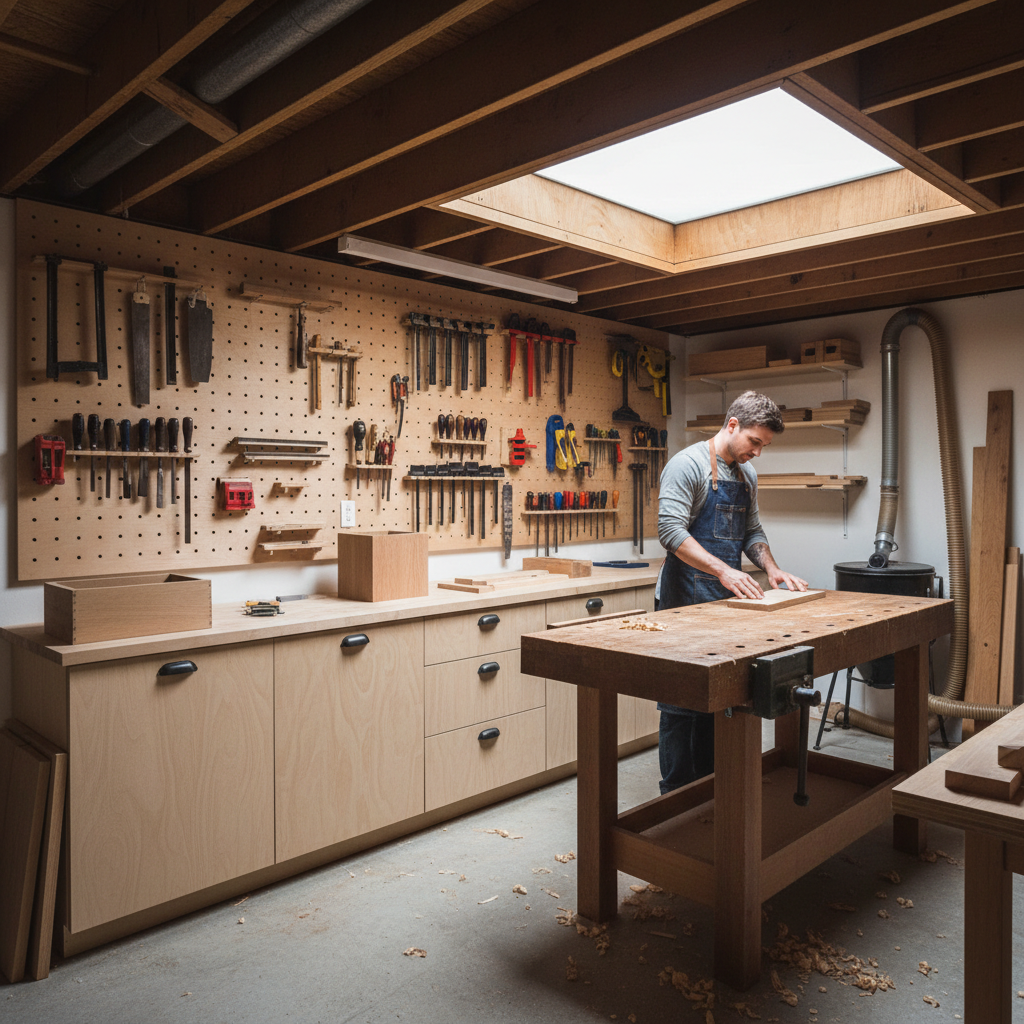
When you do invest in permanent storage, pegboard on a French cleat wall is the most forgiving system for a beginner shop. French cleats (horizontal strips of wood or aluminum cut at 45 degrees, mounted to studs at regular intervals) let you reposition every holder, shelf, and bin without drilling new holes. That flexibility matters because your tool collection will change faster in the first two years than at any other point. A rigid cabinet system built around your current tools is likely to fight your future self.
A practical heuristic worth knowing: reserve roughly 30 percent of your wall storage capacity for tools you don't own yet. That sounds wasteful until you realize how quickly a beginner shop grows. Leaving planned empty space prevents the creeping disorder that comes from adding tools with nowhere logical to go.
And keep consumables in a separate location from tools. Sandpaper, finish, tape, and screws stored with tools creates a category confusion that costs time every session. A single plastic bin on a low shelf handles consumables for most beginner shops. Cheap and completely adequate.
When Good Organization Fails
Workshop organization works well when your tool count, floor plan, and project type are reasonably stable. Add a major tool like a bandsaw or drill press without replanning your zones and the whole layout can collapse. One large stationary tool repositioned without updating the workflow map creates a chain reaction: the cut zone moves, which pushes the assembly surface, which puts finishing too close to the bench. It happens fast and it's genuinely tedious to fix mid-project.
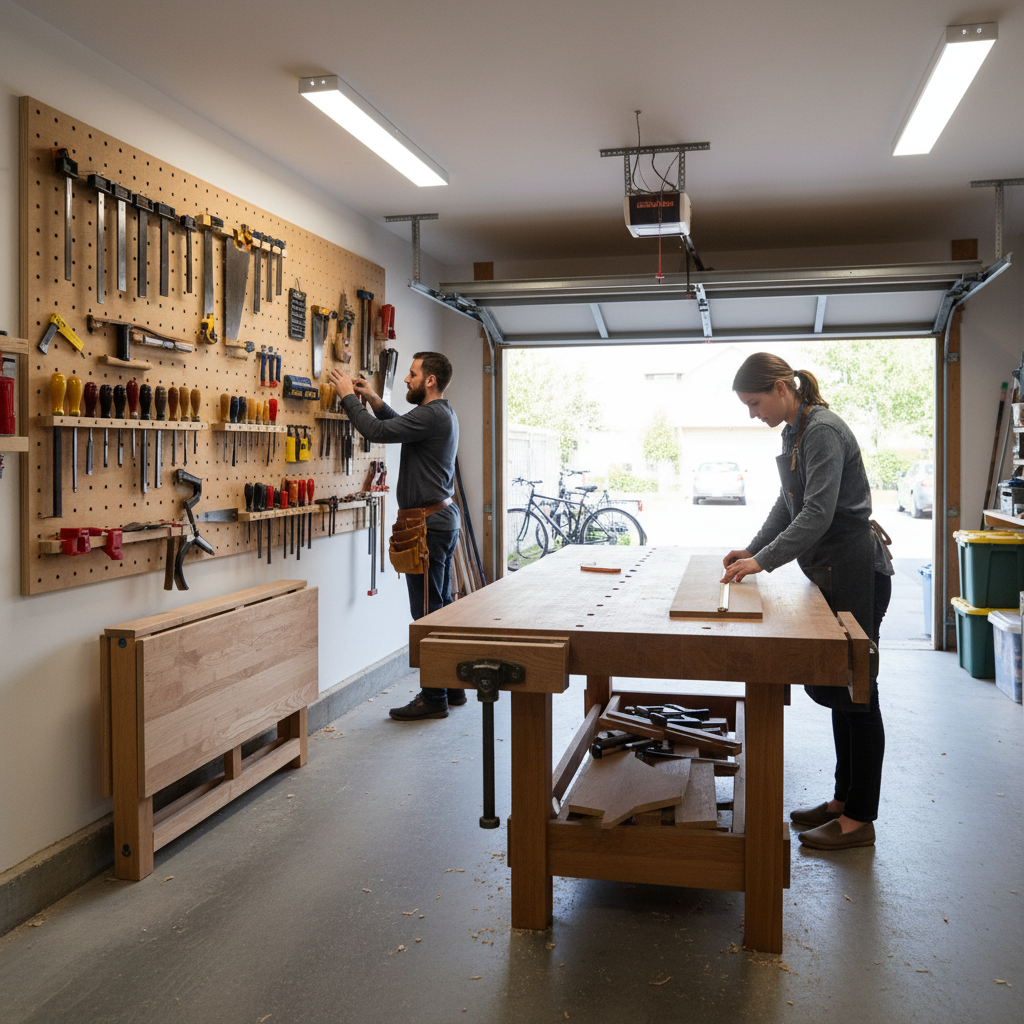
Beginners who share a shop with another person face a specific failure mode: dual-user shops organized around one person's workflow. If two people use the space, zone placement needs to accommodate both reach preferences and both dominant hands. A left-handed user at a bench configured for a right-handed workflow isn't a small inconvenience; it's a fatigue and safety issue that compounds over long sessions.
This guide is also not written for shops where vehicle storage is the primary use. In a single-car garage where the car must come in each night, every zone gets compressed and the workflow logic changes substantially. The five-zone model still applies, but everything needs to fold, roll, or store vertically. That's a separate planning problem requiring different storage hardware.
Skip the organization step entirely and here's what actually happens: tools migrate to wherever they were last used, which means no tool is reliably where you expect it. Projects stall not from skill gaps but from setup friction. A shop without defined zones trains you to tolerate disorder, which is a habit that compounds. The shop you work in shapes how you work. An organized shop makes you more deliberate; a chaotic one makes you reactive.
Getting the Layout Right on Day One
Start your first session in the new shop without unpacking anything. Walk the empty space and physically stand in each of the five zone positions. Notice where the light falls, where the electrical outlets are, and where the door swing limits placement. That ten-minute walk costs nothing and prevents the most common beginner error: committing to a layout based on a sketch rather than the actual room.
I'd start with the workbench position, because every other zone orients around it. Once the bench is fixed, zone boundaries become much easier to place, and storage decisions follow naturally from zone assignments rather than from guesswork.
The real question in a beginner workshop isn't which storage products to buy. It's whether you've committed to a workflow before the tools arrive. Shops that get organized from day one stay organized, not because their owners are tidier, but because the organization was designed into the space rather than retrofitted around accumulated chaos.
Place the tape on the floor today. Commit to zone names. Let the storage decisions wait until the workflow is real.