
A first-time woodworker standing in the lumber aisle at Home Depot or Lowe's has somewhere between eight and twelve nominal sizes staring back at them, and the gap between what those labels say and what the boards actually measure is enough to wreck a project before the first cut.
Pre-dimensioned lumber, the kind already milled to a standard cross-section and sold in set lengths, is the default starting point for most beginner DIY builds in the US. It's widely available, relatively cheap, and skips the need for a planer or jointer. But whether it's actually worth it depends on three things that most buying guides skip: your specific project type, what's sitting in that store's rack on a given day, and how much dimensional variation you can tolerate before your joints stop fitting.
That last variable is the one beginners consistently underestimate. A 2x4 sold as "dimensional lumber" is actually 1.5 inches by 3.5 inches, a fact codified in the American Softwood Lumber Standard (PS 20), published by the National Institute of Standards and Technology. The nominal size is a historical artifact from when lumber was sold rough-sawn. Knowing that gap exists is fine. Not knowing it will cost you, usually in the form of a bookshelf that wobbles or a frame that won't square up.
What Pre-Dimensioned Lumber Actually Gives You
The honest case for big box dimensional lumber is straightforward: for structural framing, utility shelving, and beginner practice builds, it's hard to beat. The boards are already surfaced on four sides (S4S), cut to predictable cross-sections, and priced well below hardwood alternatives. A standard 8-foot 2x4 at either Home Depot or Lowe's typically runs in the $4 to $6 range for construction-grade SPF (spruce-pine-fir), which is the most common species blend you'll find on those racks.
SPF is soft, easy to work with hand tools, and forgiving on beginner edges. That's its biggest practical advantage. You're not fighting the wood while you're also fighting your technique.
Or rather: the real value isn't just the low price per board. It's the elimination of milling steps that beginners have no equipment for. Without a jointer and planer, starting from rough lumber means your reference faces are never truly flat, and every measurement cascades off that error. Pre-dimensioned boards give you a flat face and a square edge out of the rack, which is genuinely useful when you're still learning to measure and mark accurately.
That framing misses something, though. "Pre-dimensioned" doesn't mean "consistent." Construction-grade boards (the cheapest tier, stamped #2 or lower) are graded for structural use, not appearance or dimensional uniformity. Bow, twist, cup, and crook are all acceptable within grade. Pull ten 2x4s off the rack and you may find three or four with enough warp to make furniture joinery frustrating. I'd start with pulling boards individually and sighting down the length before you put anything in your cart, not after.
Where Big Box Lumber Fits and Where It Doesn't
Pre-dimensioned softwood from a big box store is the right call for framing walls, building workbenches, constructing outdoor raised beds, making shop fixtures, and practice cuts where you're learning a new joint. The wood is expendable, the cost of mistakes is low, and dimensional consistency matters less when fasteners are doing structural work.
It is not the right call for furniture with visible faces, projects requiring glue joints with tight mating surfaces, or anything where wood movement matters over time. SPF has relatively high moisture content variability at retail. Boards sold at Home Depot or Lowe's are not kiln-dried to furniture standards. The Forest Products Laboratory (a USDA research facility) notes that softwood sold for construction use typically targets around 19% moisture content at time of grading, which is too wet for fine furniture work without a drying period. Build a coffee table from fresh construction 2x4s and there's a real chance the top cups or the joints open as it dries in your shop.
This article isn't for someone building heirloom furniture or finish carpentry. If that's your project, dimensional softwood from a big box store is the wrong material category, full stop. The comparison here is between big box pre-dimensioned lumber and the realistic alternatives a beginner actually has: rough-sawn lumber from a local sawmill, S4S hardwood from a specialty retailer, or sheet goods like plywood and MDF.
Rough-sawn lumber from a local mill is cheaper per board foot but requires milling equipment or accepts more variability. S4S hardwood from a specialty retailer (Woodcraft and Rockler both carry it nationally) is dimensionally consistent and furniture-grade, but costs three to five times more per linear foot. For a beginner building their first box or bookshelf, that cost difference is genuinely hard to justify before you know whether woodworking will stick.
Reading the Rack: How to Pick Good Boards
Big box lumber quality varies more by individual board than by store or region. The grading system exists, but it sets a floor, not a standard. Your job at the rack is triage.
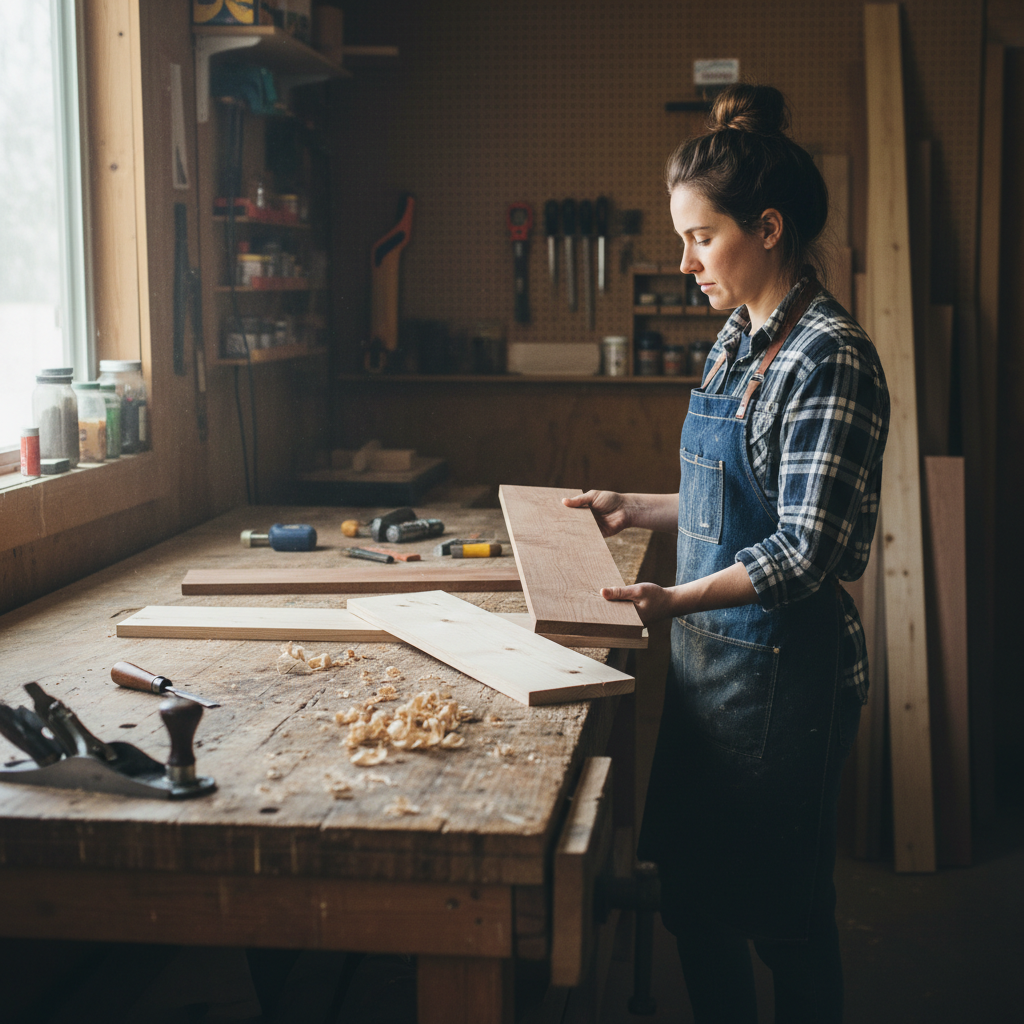
Check four things before you pull a board: sight down the length for bow and crook, hold one end flat and look for twist across the face, check for cup across the width, and scan for large knots within 6 inches of where you plan to cut a joint. Knots themselves aren't always a problem in utility work, but a loose or dead knot near a joinery location can blow out under stress.
The grade stamp tells you species, moisture content designation, and structural grade. "S-DRY" or "KD-19" means the board was kiln-dried to 19% or below at time of grading, which is construction-standard but not furniture-standard. "S-GRN" means it was sold green and will move more as it dries. For utility builds, either is workable. For anything requiring tight joints, S-DRY is the minimum and an acclimation period of a week in your workspace is worth the wait.
And yes, it's fine to dig through the rack. The boards at the back are often flatter than the ones on top, which have been handling more humidity swings from people opening and closing the store's lumber bay doors all day. (Most of the regulars at the lumber aisle already know this. Now you do too.)
The Cost Math and When It Breaks Down
Pre-dimensioned lumber from a big box store wins on cost for utility projects. For a simple 4-foot by 8-foot workbench top built from 2x6 SPF, you're looking at roughly $30 to $45 in material at current retail pricing, a practical heuristic based on typical SPF board prices in 2024. The equivalent surface in S4S hard maple from a specialty retailer would run $120 to $180 or more depending on your region.
That gap is decisive at the beginner stage. If you're spending $35 on a bench top and it ends up slightly cupped, you've lost $35 and learned something. If you've spent $150, the stakes of every mistake change your willingness to experiment.
The math breaks down in two situations. First, if your project requires multiple boards edge-glued into a panel (like a tabletop), construction-grade softwood introduces enough variability that you'll spend significant time flattening and correcting before glue-up. The time cost often exceeds the material savings. Second, if you need a specific species for its hardness, grain, or appearance, big box stores carry almost nothing beyond SPF, Douglas fir, and occasionally whitewood (a marketing term for whatever soft species is locally available). You won't find ash, cherry, or white oak on those racks.
Put more precisely: the cost advantage of big box lumber is real but front-loaded. It applies to the purchase price, not necessarily to total project time. Beginners who skip the rack-triage step and grab the first boards they see often end up spending an hour correcting twist and bow that a three-minute inspection would have avoided.
Should Beginners Start Here?
For most first builds, yes. But the recommendation comes with a boundary.
If your first project is a simple box, a set of utility shelves, or a garden bed, pre-dimensioned construction lumber from a big box store is the right starting material. The price is low, the dimensions are predictable enough for fastener-based construction, and the learning curve is about joinery and measurement, not material handling. Starting on expensive hardwood before you've dialed in your technique is a waste of money.
If you skip the quality check at the rack, you will end up fighting warped boards mid-project. That's not a hypothetical. It's the single most common frustration among new woodworkers who buy construction lumber without inspecting it first. The fix is simple: check sq footage needed, board count, and twist before loading your cart.
The alternative worth knowing about is the "select" or "appearance" grade boards that both Home Depot and Lowe's carry alongside construction grade. These are the same species, same dimensions, but graded for fewer defects and straighter grain. They cost roughly 30 to 50 percent more per board, but for a beginner's first furniture-adjacent project, the reduced defect rate can meaningfully cut prep time. They're not hardwood, but they're a real upgrade over #2 construction grade for visible work.
If you do nothing else before your next lumber run, learn to read the grade stamp and sight down the board. Those two habits will save you more frustration than any tool upgrade in your first year.