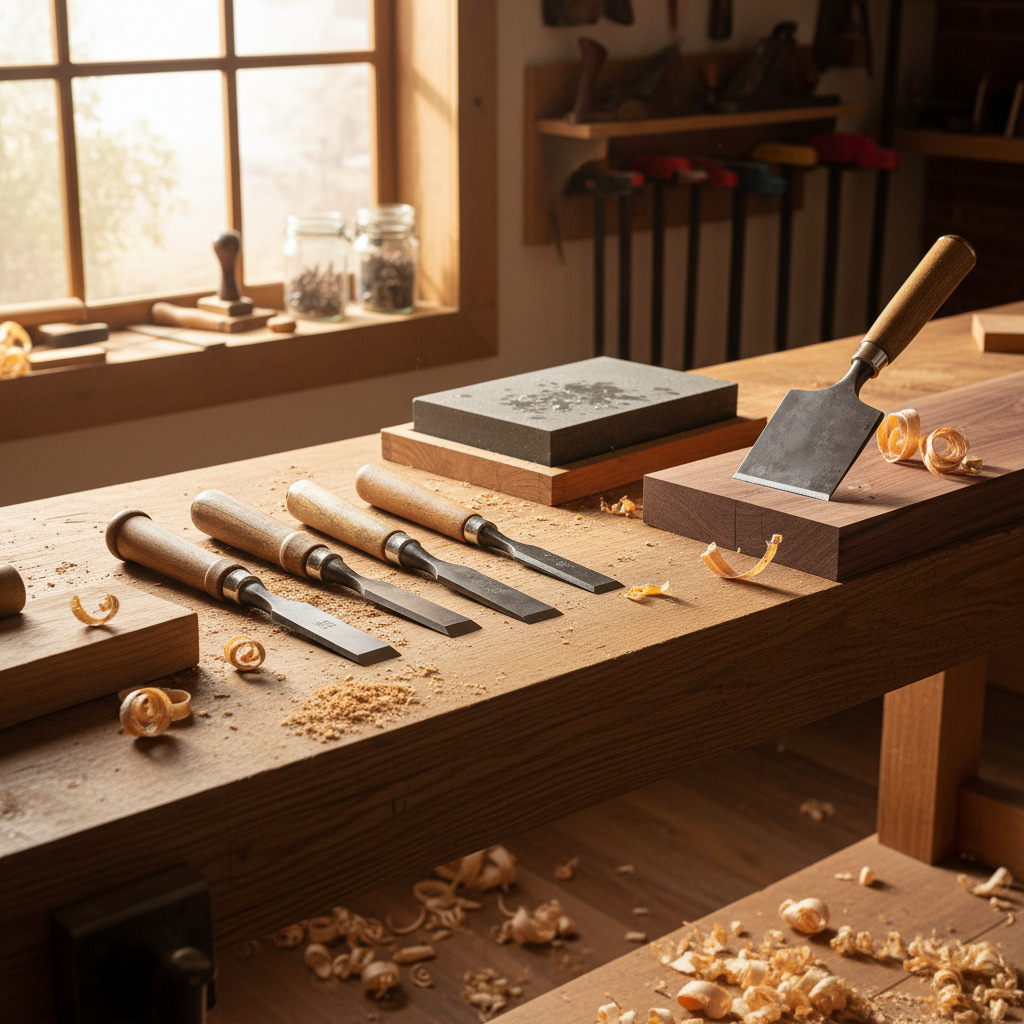

Any woodworker will tell you to sharpen your tools before you use them, and there's a reason that advice comes first. A dull chisel doesn't just make work harder; it teaches you the wrong thing about what wood feels like when it's properly worked. Chisels for beginner woodworkers sit at the intersection of three variables that most buying guides flatten into a single star rating: steel hardness, handle geometry, and factory edge quality. Get two of three right and you'll be sharpening and cutting within the hour. Get them wrong and you'll be fighting the tool instead of learning a skill.
That tension matters more than price. A $30 set from a recognizable brand can outperform a $90 set if the factory grind is closer to ready and the steel holds an edge through the learning curve. But there's a real cost to getting it backwards: if your first chisels are too soft, every mallet blow mushes the edge instead of driving the cut, and you'll spend more time at the honing guide than at the bench. Plenty of beginners quit because they assumed they lacked skill when they actually lacked a serviceable tool.
This guide doesn't cover carving gouges, mortise chisels for timber framing, or specialty Japanese bench chisels. If you're setting up a general-purpose bench for joinery and furniture work, read on.
What Actually Makes a Chisel Work for a Beginner
Steel hardness is measured on the Rockwell C scale (HRC). For bench chisels, the practical window for beginners is roughly HRC 58 to 62. Below that range, the edge rolls under mallet work and requires constant touching up. Above HRC 63 or so, the steel becomes brittle enough that a beginner's technique, which typically involves lateral torquing and prying, risks chipping the edge rather than dulling it. That framing misses something: hardness alone doesn't determine how a chisel performs, because grind geometry matters just as much. A chisel ground to a hollow bevel needs less metal removed to reach a sharp apex, which means a beginner gets a working edge faster. A flat-ground chisel from the factory often has a convex face behind the edge, which must be lapped flat before sharpening makes any difference at all.
Handle fit is the overlooked variable. A handle that's too thin causes the hand to squeeze, which creates lateral wobble on the cut. Octagonal handles, like those on most traditional English-pattern bench chisels, register against the palm and resist rolling on the bench. Round handles are faster to manufacture and cheaper, but they're also more likely to roll off the bench and chip an edge you just spent twenty minutes putting on. A shovel-style handle with a bolster, where the metal collar meets the wood right at the shoulder, transfers mallet force cleanly without splitting the handle after a few months of use.
The last variable is the one nobody wants to talk about: factory edge quality. Some budget chisels ship with a ground edge that's close to flat on the back and angled near 25 degrees on the bevel. Those can be sharpened to a working edge in under ten minutes. Other budget chisels ship with a back that's slightly concave or twisted, which means you'll lap for half an hour before you can even begin bevel work. I'd start with any chisel that ships with a stated bevel angle and a clear grind; that's the manufacturer telling you they finished the edge on purpose rather than by accident.
The Sets Worth Buying and Why
Three sets consistently appear at the top of beginner recommendations for good reasons, not marketing: the Narex 8111 series, the Two Cherries 1508 series, and the Wood Is Good-adjacent Stanley 16-150 series. Each sits in a different price band and makes a different trade-off.
Narex bench chisels (Czech-made, around $10 to $14 per chisel individually, or $40 to $60 for a four-piece set) arrive at approximately HRC 59 with a beech handle and a chrome-manganese steel blade. The factory back is flat enough that most beginners can lap to a working surface in 10 to 15 minutes on 220-grit sandpaper on glass. That's a practical heuristic based on widely reported user experience, not a manufacturer specification, but it's consistent enough to be useful. The bevel arrives at roughly 25 degrees, which is appropriate for general bench work. Narex chisels are frequently cited in Fine Woodworking magazine's tool reviews as the entry point where quality and price intersect most practically for new woodworkers.
Two Cherries (German-made, around $20 to $30 per chisel) are noticeably harder, closer to HRC 62, and arrive with a hornbeam handle that's denser than the Narex beech. The back preparation is better out of the box, meaning less lapping time. They're not a beginner's first chisel if money is tight, but they're the set you won't outgrow. If you're buying once and don't want to upgrade in 18 months, the price difference is defensible.
The Stanley 16-150 set (around $30 to $40 for four chisels) is the answer to a different question. Stanley's consumer-grade chisels are softer than either option above, which some beginners actually prefer because a soft steel edge is more forgiving when prying out waste or being used without a mallet. The trade-off is clear: you'll be honing more frequently, sometimes every 15 to 20 minutes of active cutting. If you're still deciding whether woodworking is your thing and want a low-cost entry, Stanley works. If you're committed, skip them.
Check square footage, device count, Thread support first. For chisels: check handle material (hornbeam or beech outperform plastic), steel origin (European or Japanese shops publish HRC, many imports don't), and factory bevel angle (25 degrees for bench work, 30 for harder use).
What to Skip and Why It Matters
The category to avoid is what the tool trade calls "imported bench chisels with no stated specification." These are typically sold in 10- or 12-piece sets at hardware chains or on Amazon for $20 to $35 for the entire set. The price signals the problem: at those quantities and that price point, the steel specification is usually not published because it doesn't hold up to scrutiny. Some testers in the woodworking community, including reviews published on Wood Magazine's tool review section, have found these chisels testing below HRC 55, which means the edge deforms rather than cuts under mallet work.
The specific failure mode is this: soft steel doesn't take a wire edge cleanly during sharpening, so even after proper lapping and bevel work, the edge folds rather than fractures. Beginners experience this as "the chisel never really gets sharp" when the real problem is that the steel can't hold the geometry you put on it. And if you quit at that point, you've blamed your technique for a materials failure.
Plastic-handled chisels are a separate skip for most beginners. Plastic handles can be struck with a mallet, but they don't telegraph the cut the way a wood handle does. The feedback, the slight give you feel when the chisel is biting cleanly versus skating off grain, is reduced. That feedback is how you learn. Or rather: it's not that plastic handles are unusable, it's that they remove one of the few tactile signals that helps a beginner understand what's happening at the edge.
When the Standard Advice Weakens
The recommendation above assumes you're doing bench joinery: cutting dovetails, fitting mortises, paring tenon cheeks. If you're primarily doing green woodworking, splitting chair legs from fresh stock, or working with very hard exotics like hard maple or purpleheart, the beginner-friendly HRC 58 to 60 range becomes a liability. Harder exotics are abrasive enough that a softer chisel dulls noticeably within a single session. In that context, a Two Cherries or a premium Japanese chisel at HRC 63 to 65 is worth the added fragility risk because the alternative is constant interruption to resharpen.
The other real exception: if you have any tremor, grip weakness, or reduced hand strength from a condition like arthritis, the standard recommendation to prioritize handle feedback over comfort becomes less relevant. In that situation, a larger-diameter handle, even a plastic one, may be the right call regardless of what it costs in tactile signal. That's a genuine boundary condition. It doesn't come up in most beginner guides because most beginner guides aren't written for that reader.
Buyers who skip a good set entirely and start with whatever's in a family member's garage often run into this: old chisels that have been resharpened unevenly for decades can have a bevel angle that's crept up to 35 or even 40 degrees. They'll cut, but slowly, and learning to sharpen on a deeply convex bevel is harder than starting fresh. Inherited tools are not automatically a good deal.
The Starter Set You Actually Need
Four chisels cover most of what a beginner will cut: 1/4 inch, 1/2 inch, 3/4 inch, and 1 inch. That's it. The 1/4 inch handles narrow mortise cleanup and dovetail corners. The 1/2 inch is the most-used size in general furniture work. The 3/4 inch is fast at removing waste. The 1 inch pairs with a card scraper for final surface work. Buying a six- or eight-piece set adds widths you won't use for months and spends money you could put toward a decent honing guide and a piece of float glass for lapping.
A comparison of the three recommended sets:
All three sets can produce sharp, working chisels. The column that matters most for a beginner is out-of-box prep time, because that's the barrier between opening the box and making your first cut.
| Set | Steel (approx. HRC) | Handle Material | Out-of-Box Prep Time | 4-Piece Price (USD) |
|---|---|---|---|---|
| Narex 8111 Series | ~59 | Beech | 10-15 min | $40-$60 |
| Two Cherries 1508 | ~62 | Hornbeam | 5-10 min | $80-$120 |
| Stanley 16-150 | ~55-57 | Plastic/composite | 20-30 min | $30-$40 |
The prep time difference is more significant than it looks. Forty-five minutes lapping a back that should have shipped flat is a frustrating first experience that has nothing to do with your skill. The Narex set hits the crossover point where the price is low enough to be a reasonable first purchase and the steel is hard enough that the edge you put on it will still cut after an hour of work.
Reframe what you're buying: a starter chisel set isn't a permanent collection, it's a sharpening practice platform. The chisels exist to teach you what a sharp edge feels and cuts like so you can recognize when you've lost it.
Before You Use Them: The One Step Most Beginners Skip
Flat-back preparation is not optional. Every bench chisel, regardless of price, needs the back lapped flat before you sharpen the bevel. The back is one of the two surfaces that form the cutting edge, and if it's not flat, a sharp bevel still produces a rounded apex. You can do this with 220-grit wet-dry sandpaper on a piece of float glass or a cheap granite tile, both of which are flat to a tolerance that's more than adequate for hand tools.
The process: hold the chisel flat on the abrasive, bevel-side up, and push forward with moderate pressure. Check the scratch pattern. Early on, only the high spots catch. You're done when the scratch pattern runs evenly across the full width of the back, right up to the edge. On a Narex, that typically takes less than 15 minutes. On a Stanley 16-150, budget 25 to 30.
But don't over-lap. The goal is a flat back immediately behind the edge, not a mirror-polished surface all the way up the blade. Two inches behind the edge is plenty. The woodworking community has an occasionally unproductive obsession with perfectly flat backs extending six inches up the blade, which is time spent on a surface that never contacts the wood. Focus on the first two inches and move on.
Once the back is flat, set the bevel to 25 degrees on a honing guide. Free-hand sharpening comes later, after you understand what a sharp edge feels like. Honing guides aren't a crutch; they're a consistency tool. Use one until you can reliably reproduce a sharp edge without it.