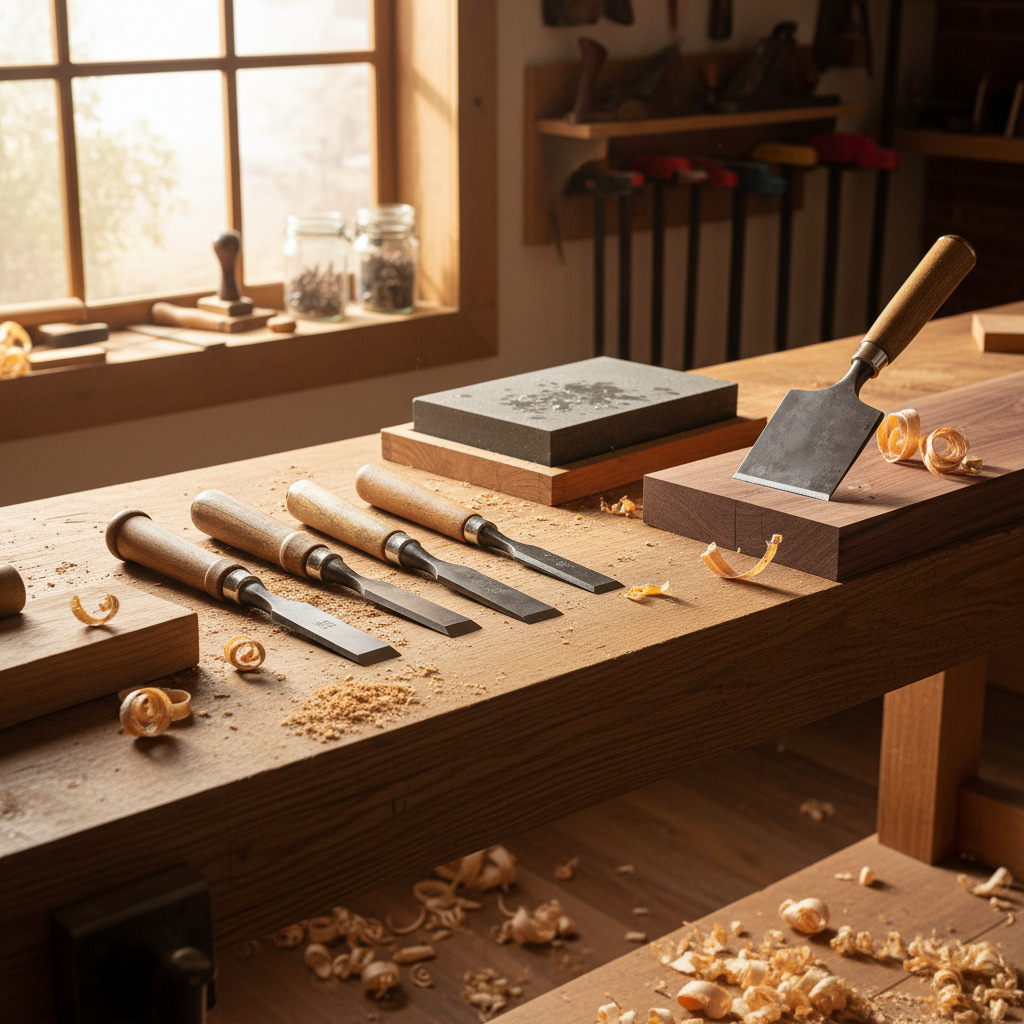

Woodworkers will tell you the bevel angle before they discuss anything else, and there is a reason for that. A chisel sharpened at the wrong angle will feel sharp for about ten minutes and then behave like a butter knife. The angle is not a preference. It determines how the geometry of the edge holds up under lateral pressure, and getting it wrong by even five degrees changes how quickly that edge folds.
Sharpening a chisel at home without buying a $200 sharpening system is entirely possible. What you need is a flat surface, a progression of abrasives, and a clear understanding of what you are actually trying to accomplish at each stage. The equipment cost for the method described here runs under $20 if you source the materials carefully.
Here is the tension most guides skip over: flattening the back of the chisel matters as much as grinding the bevel, but the back gets almost no attention in quick-reference articles. If the back is not flat, no amount of work on the bevel will produce a clean, lasting edge. That asymmetry in difficulty is where most home sharpening attempts quietly fail.
What You Are Actually Trying to Do
A sharp chisel is the intersection of two flat planes. The bevel is one plane, the back is the other. Where they meet forms the cutting edge. Both planes must be genuinely flat and polished for that intersection to be sharp rather than ragged.
The mechanism matters here. When you push a chisel through wood, the back face rides along the cut surface and guides the tool. If the back is hollow, convex, or scratched from coarse abrasive, the edge chatters and the cut tears rather than severs. Polishing the bevel alone is like painting one side of a window and wondering why it still looks foggy.
Or rather: it is more accurate to say the back determines the ceiling of sharpness you can achieve. Even a perfectly ground bevel cannot compensate for a rough back. This is why starting with the back is the correct sequence, not the bevel.
The standard bevel angle for bench chisels used in general woodworking is 25 degrees for the primary bevel, with some woodworkers adding a 30-degree microbevel of just a millimeter or two at the very edge. The microbevel is worth knowing about because it shortens sharpening time dramatically: instead of regrinding the full bevel every session, you only touch up the tiny microbevel, which takes seconds on a fine abrasive. This is a practical heuristic widely used in the trade, not a specification from a standards body.
The Sandpaper Method: Materials and Setup
The sandpaper-on-glass method is the most accessible home sharpening approach available. You need float glass (a scrap piece from a frame shop works fine), PSA-backed or spray-mounted sandpaper in three grits, and a honing guide if you want consistent angle control.
The grit progression that actually works: 120-grit for removing metal quickly on damaged or very dull edges, 220-grit or 320-grit for establishing the bevel geometry, 600-grit for refining, and 1500-grit or higher for polishing. Automotive wet-dry sandpaper from any hardware store covers this range for a few dollars a sheet. One sheet of each grit lasts through several sharpening sessions before it loads up and loses cutting action.
A honing guide is not required, but if you are new to freehand sharpening, it removes the main failure point. Cheap plastic guides run about $8 to $12 at most hardware stores and hold the chisel at a repeatable angle so you are not fighting to maintain geometry while also applying pressure. Experienced woodworkers sharpen freehand because they have internalized the angle through repetition. You should not feel obligated to start that way.
Setup takes about two minutes. Tape the sandpaper to the glass with the abrasive side up. The glass must be flat, not a cutting board or workbench surface. Flatness is the whole point. A warped substrate produces a convex bevel, which is the opposite of what you want.
The Sharpening Sequence, Step by Step
Start with the back. Lay the chisel flat on the 220-grit paper, back face down, and push it forward in straight strokes. You are not tilting the chisel at all. The goal is to make the back flat and scratch-free within about an inch of the cutting edge. On a new chisel from a budget brand, this can take five minutes of work. On an old chisel with a hollow-ground back from a previous owner, it takes longer.
Check your progress by looking at the scratch pattern. Uniform, parallel scratches across the full width of the back near the edge means the surface is flat and you are making contact. Scratches only on the edges or only in the center means the back is curved. Keep going. Progress through 320-grit, 600-grit, and then 1500-grit on the back before touching the bevel. The back should look like a mirror near the edge when you are done.
Now the bevel. Set your honing guide to 25 degrees or hold freehand at that angle, and work the bevel on 220-grit first if the edge is significantly damaged or very dull. Once the bevel is a consistent flat plane with no shiny unhoned areas, step up to 320-grit, then 600-grit, then 1500-grit. On each grit, work until the scratch pattern from the previous grit is completely replaced by finer scratches. Do not rush this. Spending sixty seconds on 1500-grit when the 600-grit scratches are still visible is a waste of time.
The wire edge is your progress indicator. At some point during bevel work, you will feel a tiny burr on the back of the edge. That burr means you have sharpened all the way to the edge on the bevel side. Once you feel it, flip to the back and make three or four light strokes on the 1500-grit paper to remove it. Alternate between bevel and back two or three times at the finest grit to refine the intersection. The wire edge disappears. That disappearance, combined with a polished bevel and back, is a sharp chisel.
If you skip working the back entirely and only grind the bevel, you will produce an edge that seems sharp but deflects when cutting across grain. The wire edge cannot be properly removed against a rough back, so it folds rather than breaks clean. That is the specific failure mechanism behind most frustrating sharpening results.
When This Method Weakens or Fails
The sandpaper-on-glass method has real limits. On chisels with badly damaged edges, deep chips, or a bevel that has been ground to the wrong angle by a previous owner, the method becomes slow to the point of impracticality. Removing significant metal with 120-grit sandpaper is possible but tedious. If you have a chisel with a chipped edge or an angle you want to regrind from scratch, a bench grinder or a coarse waterstone removes metal far faster.
This article is not about bench grinder technique, and it is not written for anyone regrinding a badly damaged collection of old chisels. If that is your situation, sandpaper will frustrate you. The method described here is for maintaining and restoring edges on chisels that are dull but not damaged, which covers the routine sharpening scenario for most home woodworkers.
The other condition where this weakens: very hard steel, particularly older chisels made from high-carbon steel that has been properly hardened. Harder steel takes longer to abrade with sandpaper, and you will burn through sheets faster. The method still works, it just costs more in sandpaper. Waterstones handle hard steel more efficiently once you have them, but the investment crosses the threshold this article is specifically avoiding.
Strop, Test, and Maintain
A leather strop loaded with green honing compound is the finishing step that takes a sharp chisel to genuinely scary-sharp. A piece of leather glued smooth-side-up to a scrap of wood, with a $5 tube of green chromium oxide compound, adds a polishing stage that sandpaper alone cannot match. Strop by pulling the chisel backward along the leather, bevel down, with light pressure. Ten strokes on the bevel, five on the back. This aligns and polishes the very tip of the edge at a microscopic level.
Test sharpness by shaving arm hair or slicing end grain cleanly. A sharp chisel pares end grain without tearing fibers. A marginally sharp chisel crushes them. The end grain test is more diagnostic than the arm hair test because it reflects how the tool actually behaves in wood.
Maintenance sharpening, once the edge is established, takes under two minutes. A few strokes on the strop before each use maintains the edge. When the strop no longer restores sharpness, spend five minutes on the 1500-grit paper and strop again. A full regrind on all four grits is only needed when the edge is visibly rounded or chipped. Most woodworkers who maintain their tools properly do a full sharpen every few months at moderate use.
If you skip the strop and rely on sandpaper alone, the edge is sharp enough for most work but not as refined as it could be. The strop is the cheapest upgrade in this whole setup, and the one most beginners skip because they do not realize how much the last polishing stage matters. Do not skip it.
Getting Started Today
Pick up one sheet each of 220-grit, 400-grit, and 1500-grit wet-dry automotive sandpaper, a piece of float glass from a frame shop or hardware store, and a strip of leather. Total cost at a hardware store like Home Depot or Lowe's runs between $10 and $18 depending on what you already have. That is the entire setup.
Start with the chisel you reach for most often. Flatten the back first, work through the grits on the bevel, strop, and test on end grain. You will know immediately whether the method worked because a properly sharpened chisel feels like a different tool. The difference between a dull chisel and a sharp one is not subtle. It is the difference between pushing and cutting.
If you put this off, you will keep compensating for a dull edge with extra force, which is how handles split, workpieces slip, and cuts go wrong. The ten minutes it takes to sharpen a chisel properly is not optional maintenance. It is the foundation of safe, accurate work.