Finish carpenters will tell you about dust before they discuss joinery, and there's a reason for that. Fine wood particles don't just coat your workbench; they migrate into HVAC returns, settle into soft furnishings, and stay airborne for hours after you've put the tool down. In a small apartment or garage-converted studio, that's not a nuisance problem. It's a health problem and a containment problem rolled into one.
Managing sawdust in a compact living space turns on three variables most guides treat separately: particle size, air volume, and surface area exposed. A shop vac rated at 100 CFM handles chips from a router just fine. It does almost nothing for the sub-micron dust a random orbital sander releases, and that's the dust that reaches your lungs.
Here's the tension that most small-space woodworkers run into too late: the tools that produce the finest dust, sanders and jigsaws, are exactly the tools that feel safe to use indoors because they're quiet and hand-held. The table saw sounds dangerous, so it gets the most attention. But a belt sander running for twenty minutes in a 400-square-foot studio can put enough respirable particulate into the air to trigger an asthma episode in someone without a history of respiratory problems. That risk doesn't disappear when you open a window.
Why Small Spaces Make Dust Disproportionately Dangerous
Wood dust is regulated as a workplace hazard in the US. The Occupational Safety and Health Administration (OSHA) sets a permissible exposure limit for wood dust at 5 mg/m³ as an 8-hour time-weighted average, with softwoods and non-sensitizing hardwoods at that level and certain species like western red cedar at 1 mg/m³. Those limits exist in professional shops with dedicated exhaust systems. A 300-square-foot apartment has no exhaust system, and the air volume is small enough that concentration rises fast.
Or rather: the particle size distribution matters more than the weight alone. Dust in the 0.5 to 10 micron range, what industrial hygienists call respirable dust, stays suspended for extended periods and penetrates deep into lung tissue. Coarser chips from a circular saw fall quickly and are easier to vacuum. The finest particles from sanding are the ones that bypass the nose and throat entirely.
There's a practical implication here that changes how you prioritize equipment. A dust mask rated N95 filters 95 percent of particles 0.3 microns and larger. That's adequate for sanding sessions under 30 minutes in a ventilated space. It's not a substitute for source capture, meaning a vacuum or collector attached directly at the point where the tool produces dust. Source capture removes particles before they enter the room's air volume. Masks protect you; source capture protects your apartment and anyone else in it.
If you skip source capture entirely and rely on an open window plus a mask, you'll still have airborne dust settling on every horizontal surface in your home for the next 12 to 24 hours. That's not great for a landlord inspection, and it's genuinely problematic if you share the space with children, pets, or anyone with respiratory conditions.
The Right Equipment Stack for a Small Indoor Setup
The most common mistake I see in small-space woodworking setups is buying a single dust collector and treating it as a complete solution. It isn't. A dust collector and an air filtration unit do different jobs, and you need both if you're doing more than occasional hand-tool work.
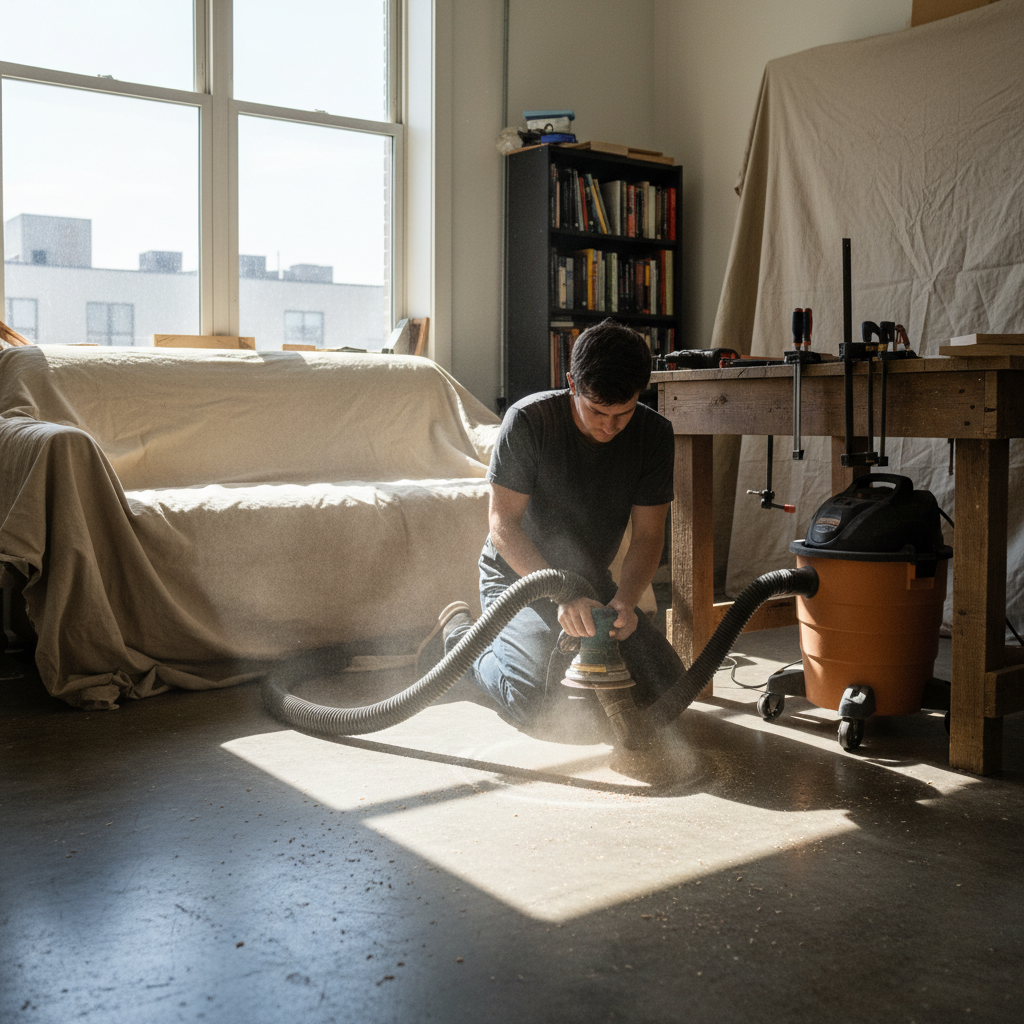
Source capture starts with a shop vac or dedicated dust extractor connected directly to your tool. For sanders, routers, and jigsaws, look for a unit with a minimum of 100 CFM suction and a filter rated to capture particles at 1 micron or finer. Festool and Bosch both make extractors in this class; general HEPA-filter shop vacs from brands like Ridgid also reach this filtration level if you use a genuine HEPA cartridge filter rather than the standard pleated paper alternative. The HEPA designation matters: it means the filter captures 99.97 percent of particles at 0.3 microns, which covers the respirable fraction.
Secondary filtration handles what source capture misses. A ceiling-mounted or freestanding ambient air filtration unit cycles the room air through a filter, typically a 1-micron or finer bag, to remove suspended fine dust over time. In a 400-square-foot room with 8-foot ceilings, a unit rated for 500 to 800 CFM will cycle the air volume roughly every 5 to 10 minutes. Run it during work and for at least an hour afterward. Check sq footage, ceiling height, and CFM rating first before buying.
That framing misses something. The order of operations between these two systems matters as much as owning both. Source capture reduces the volume of dust that reaches the air. The ambient filter handles residual. If you run the ambient filter without source capture, you're chasing particles that didn't need to be released in the first place. Reverse the sequence and you're treating a symptom rather than the cause.
For hand tool work, the picture is different. Chisels, hand planes, and card scrapers produce shavings and chips, not fine airborne dust. A shop vac nearby and a quick floor sweep every 30 minutes is usually sufficient. This guide is not about hand-tool-only setups; it's aimed at woodworkers using at least one power tool that generates fine dust.
Containing the Mess: Spatial and Surface Strategies
Dust control isn't purely mechanical. How you arrange the workspace determines how far contamination spreads before your equipment can catch it.
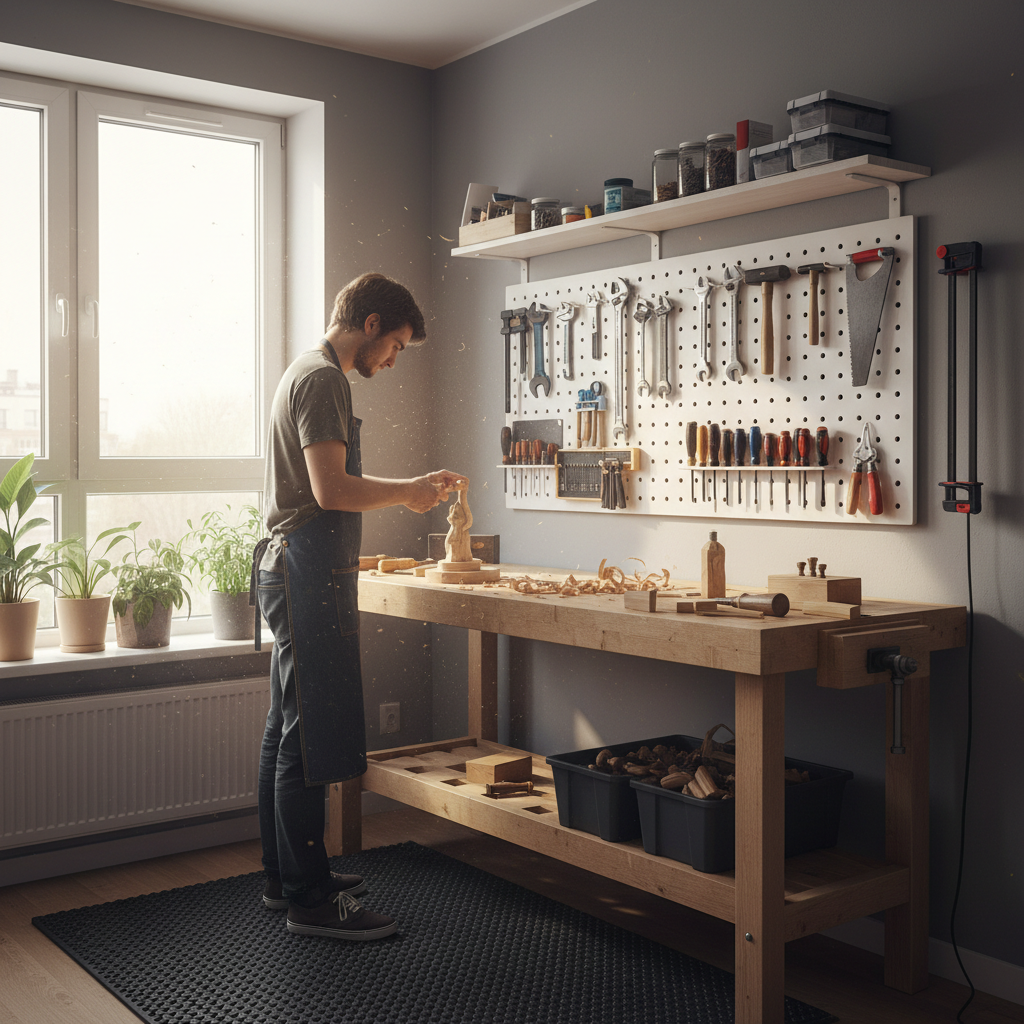
Working in a dedicated corner rather than the center of a room reduces the number of exposed surfaces by roughly half. Positioning your workpiece so the dust stream from the tool points toward a wall or into a collection port, rather than into open room air, makes a real difference in how much escapes. This sounds obvious, but most small-space setups I've seen prioritize convenience of access over dust directionality.
Temporary containment is worth the ten minutes it takes. A canvas drop cloth or a sheet of 6-mil polyethylene plastic draped over furniture and shelving near your work area dramatically reduces cleanup time and keeps fine dust off upholstered surfaces where it's difficult to remove. Fabric furniture and rugs are essentially dust reservoirs; once fine particles settle into them, a standard vacuum won't extract them completely.
Floor surface matters too. Hard floors, wood, tile, concrete, are far easier to clean than carpet. If your space has carpet, consider a 4x8 sheet of hardboard or a rubber mat under and around your work area. You can roll it up and shake it outside when you're done. Working on carpet without this kind of layer means grinding wood dust further into the fibers every time you move your feet.
When the Standard Approach Breaks Down
Source capture plus ambient filtration works well for routers, sanders, and jigsaws. It works less well, or not at all, for table saws and planers. Both tools produce a combination of large chips and very fine dust at high velocity, and most portable dust extractors don't have the CFM capacity to capture everything at the blade or cutterhead.
A table saw in a small living space is a serious problem even with a good dust collector. The blade ejects chips backward and fine dust sideways; even a blade-mounted guard with a dedicated port won't capture everything. Add the confined air volume of a small room and you're looking at dust levels that, over repeated sessions, would exceed OSHA's permissible limits in a professional context. The realistic answer for small-space woodworkers who need ripping capacity isn't better dust control; it's a track saw with a guide rail and a connected extractor. Track saws produce far less airborne dust than a table saw and are purpose-designed for close-coupled extraction.
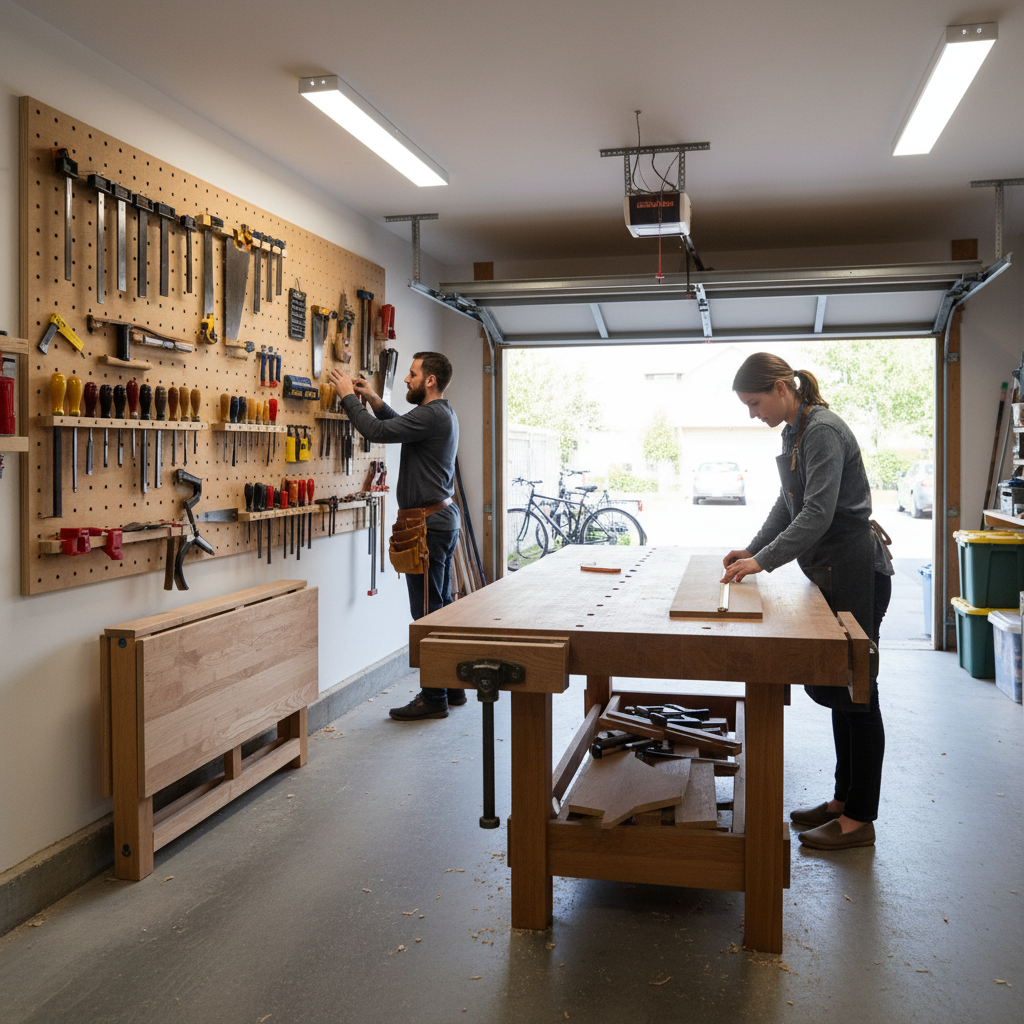
Planers belong outside or in a garage with the door open. There's no practical way to contain the volume of chips and fine dust a thickness planer produces in a small indoor space, regardless of what you connect to the dust port. If you need to thickness lumber, many local hardwood dealers and some home centers offer milling services for a small fee per board foot, or you can rent time in a makerspace. That's cheaper than replacing an air filtration unit every few months because the filter is permanently clogged.
Building a Routine That Sticks
Equipment only works if you actually use it consistently, and consistency in a small space means the setup can't be a pain to deploy every session.
I'd start with a simple rule: nothing runs without the extractor running first. Flip the vac on before you pick up the tool, not after. The delay between tool start and dust capture is where most of the fine particle release happens. Thirty seconds of unextracted sanding can put more respirable dust into a small room than the entire remaining session with extraction running.
End-of-session cleanup has a sequence that matters. First, let the ambient filter run for at least 30 minutes after the last tool use. Then wipe horizontal surfaces with a damp cloth, not a dry one; dry wiping resuspends fine dust into the air. Then vacuum the floor with a HEPA-filtered vacuum moving slowly, under 1 foot per second, so the suction can actually capture particles rather than just pushing them along.
And keep a log, even a rough one. After each session, note which tool you used, how long the session ran, and how the space looked and felt afterward. Over three or four sessions, patterns emerge: certain operations are consistently messier than expected, certain corners collect more dust than others. That information shapes which habits you tighten and which equipment upgrades are actually worth the money.
Starting Points and What to Buy First
If you're setting up from scratch, the sequence of investment matters more than the total budget.
Buy source capture before ambient filtration. A HEPA-filter shop vac or a dedicated dust extractor with a 1-micron or finer filter is the first line of defense. Without it, the ambient filter is working 10 times harder than it needs to. Prices for a capable HEPA shop vac start around $80 to $120 for a Ridgid unit with a genuine HEPA cartridge, or $250 and up for a dedicated extractor from Festool or Bosch. The extractor class is quieter and maintains suction better as the filter loads; the shop vac is adequate for most small-space woodworkers on a tighter budget.
Second: respiratory protection. An N95 rated mask for short sessions, a half-face respirator with P100 cartridges for anything longer than 30 minutes or involving MDF, plywood, or any wood species you haven't worked before. Exotic hardwoods and composite sheet goods can cause sensitization reactions; after your immune system becomes sensitized to a specific wood dust, exposure to that same species can trigger responses even at very low concentrations.
Third: an ambient air filtration unit sized correctly for your space. Fourth: drop cloths and a dedicated cleanup protocol. The order matters because each layer addresses a different point in the contamination chain, and buying out of sequence means spending money on equipment that can't perform without the previous layer in place.
Budget to replace your extractor filter every 6 to 12 months depending on use frequency. A clogged filter doesn't just reduce suction; it can cause the motor to overheat and, in some units, blow fine dust back out rather than capturing it. That's the worst possible outcome.