
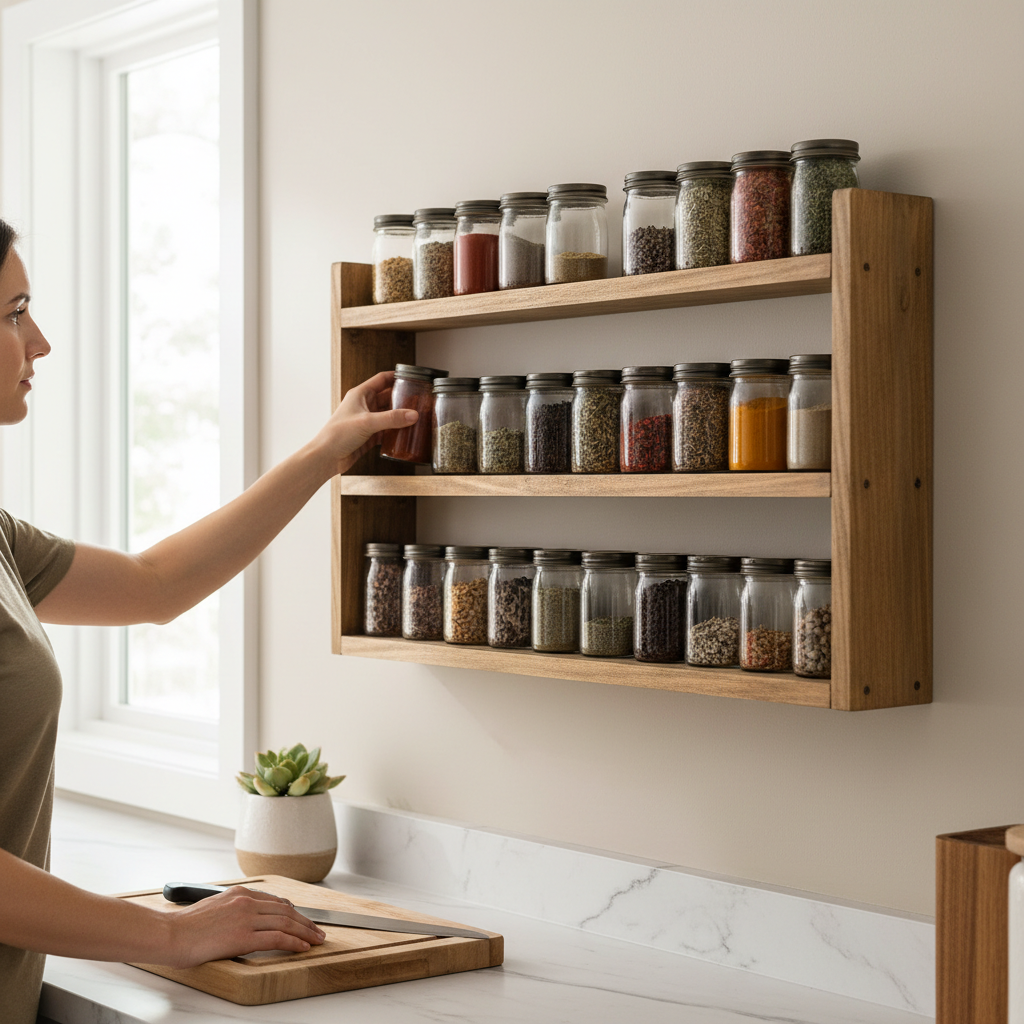
Carpenters will tell you to settle the mounting strategy before you cut a single board, and there's a reason for that. A wall-mounted wooden spice rack that pulls free from drywall three months after installation isn't a woodworking failure. It's a hardware failure, and most plans don't separate the two clearly enough.
The core variables are wood species and thickness, shelf depth relative to your jar sizes, and whether your wall studs line up with where you actually want the rack. Get those three right and the joinery is almost secondary. Get them wrong and you're patching holes and starting over.
Here's the tension most builders don't name upfront: the locations that look best in a kitchen (tile backsplashes, plaster walls between windows) are often the hardest to mount into securely. The rack you build in the shop can be excellent. The wall decides whether it stays there.
Wood Selection and Dimensions
For a wall-mounted rack, wood choice matters more than most tutorials admit. You need something dimensionally stable enough to stay flat after seasonal humidity changes, because a warped shelf gaps at the bracket and transfers stress unevenly to the fasteners. Hard maple, poplar, and red oak are the reliable domestic choices at most US lumber yards. Pine works, but knot placement can weaken a narrow shelf unpredictably, and a 3-inch-wide pine shelf near a knot is a liability.
Shelf thickness is a real decision gate. Three-quarter-inch stock (actual 23/32-inch from a big-box store) handles a fully loaded row of spice jars without noticeable flex across a 24-inch span. Drop to half-inch and you're in deflection territory once the jars are doubled up. Go thicker than three-quarter-inch and the rack starts looking heavy relative to its purpose. So 3/4-inch is not arbitrary: it's the point where stiffness, weight, and visual proportion converge for spans under 30 inches.
Or rather: the 3/4-inch rule applies to solid wood. If you're using plywood (a legitimate choice, especially Baltic birch), 1/2-inch is adequate because the cross-ply construction resists deflection more efficiently than solid grain. Baltic birch in 1/2-inch handles a 24-inch span loaded with spice jars without measurable sag. That's a meaningful distinction if you're trying to keep the rack slim.
Shelf depth depends on your jar inventory before you design. Standard 4-ounce spice jars are about 1.75 inches in diameter. A 3.5-inch-deep shelf holds them comfortably with a front lip, leaves room to grab them, and keeps the rack from projecting too far off the wall. If you stock McCormick-style 2-ounce tins (roughly 2 inches tall, 1.5 inches wide), you can go shallower. If you're storing 8-ounce jars, plan for 4.5 inches minimum. Measure what you own before picking shelf depth. This is the step people skip and then regret.
Cutting and Joinery
A basic two- or three-shelf wall rack needs four components: two side panels, your shelves, and a back panel (optional but useful). The side panels take the load from the shelves and transfer it to the wall mount. They should be at least 3 inches wide to give you sufficient bearing surface at the mounting point.
For joinery, dado joints cut into the side panels are the cleanest structural choice. A dado that's half the thickness of the shelf stock deep (so 3/8-inch dado for 3/4-inch shelves) gives you positive mechanical support so the shelf can't pull out under load. Pocket screws work and are faster, but they rely entirely on the screw's withdrawal strength rather than a shoulder of wood, which matters when the rack is vibrating slightly every time a cabinet nearby slams. Dado plus a single 1-1/4-inch brad nail from below is more than sufficient and doesn't require a table saw: a router with a straight bit and a fence handles it cleanly.
If you don't have dado capability, glue and screw from the outside of the side panel into the shelf end grain is acceptable for jars this light, as long as you're using #8 screws at least 1-1/4 inches long and you pre-drill to avoid splitting. End-grain glue joints are weak in tension, but a spice rack isn't in tension: the load is downward, and the screw handles shear. Just countersink and plug the holes if appearance matters to you.
Add a front lip to each shelf if the rack will be anywhere near a cooking zone. A 1-inch-tall lip (half-inch stock, glued and pinned) prevents jars from walking off the edge when someone nearby shuts the oven door hard. It also stiffens the shelf. That's worth 20 minutes.
Finishing Before You Mount
Finish the rack completely before it goes on the wall. This is the sequence most first-timers reverse, then regret.
For a kitchen environment, food-safe finish options include hardwax oils like Rubio Monocoat, general finishes water-based polyurethane (labeled food-safe once cured), or simple mineral oil if you want the most straightforward application. Mineral oil doesn't build a surface film, so it won't chip or peel near heat and moisture, but it needs reapplication annually. A water-based poly cures in about a week to full hardness and is easier to clean. Pick one and commit rather than layering incompatible products.
Sand to 180-grit before finishing. You don't need to go finer than that for a spice rack; 220-grit is fine but doesn't add meaningful protection. Raise the grain with a damp cloth, let it dry, then sand lightly with 220 before the first coat if you're using a water-based finish. Two coats, light scuff between them. Done.
Stain is optional and purely cosmetic. If you're matching existing cabinetry, test the stain on an offcut from the same board, not a random scrap from the bin. Wood from different parts of the same species absorbs stain differently based on grain density.
Mounting the Rack Securely
This is where the project either works or doesn't, and it's where most wall-mounted spice rack disasters originate. Drywall alone holds nothing meaningful. A fully loaded spice rack can weigh 8 to 12 pounds without the rack's own weight. That's not speculative: a standard 4-ounce spice jar weighs roughly 5 to 6 ounces with contents. Thirty jars across three shelves puts you near 12 pounds of contents alone. Drywall anchors rated for 20 pounds sound fine until you factor in dynamic load from someone grabbing a jar firmly, or the wall flexing slightly when a door slams.
Stud mounting is the right answer for any rack intended to carry this kind of sustained, dynamic load. US residential framing places studs 16 inches on center in most construction built after 1950, though older homes and some newer construction use 24-inch spacing. Find your studs with a magnetic stud finder (it's locating the drywall screws that hit the stud, which is more reliable than capacitance-based detection through thick walls). Mark two studs. If they're at 16-inch spacing and your rack's side panels don't land on studs, shift the rack location rather than reengineering it around anchors.
If stud placement is genuinely impossible at your preferred location (tile, brick, or the studs are just in the wrong places), use toggle bolts rated for three times your expected load. A Toggler SNAPTOGGLE bolt in a 1/2-inch drywall cavity is rated for over 200 pounds in shear; two of them are more than sufficient. But read the packaging for the specific product you buy: ratings vary by wall material and installation method, and I'd verify with the manufacturer's spec sheet rather than a third-party review.
The mounting hardware itself should be recessed or integrated into the rack's side panels rather than surface-mounted keyhole brackets, if you want a clean look. Two options that work cleanly: a French cleat (a 45-degree beveled strip screwed to the wall, with a matching bevel on the rack's back) or simple through-bolts with finish washers countersunk into the side panels. The French cleat is particularly good here because it distributes load along the full cleat length rather than at two point fasteners, and it lets you adjust the rack's horizontal position easily after mounting.
If you skip stud mounting and rely on standard plastic expansion anchors in drywall, the rack will eventually pull free. Not might. Will. The repeated minor loads from daily jar removal cycle the anchor's grip until the drywall crumbles around it. This is the consequence of shortcuts at the mounting stage, and no amount of good woodworking recovers from it.
One note on scope: this guide covers wood-construction wall racks for standard kitchen walls. If you're mounting into tile, masonry, or a wall with a vapor barrier (common in bathrooms), the fastener selection changes substantially and you'd want to consult a contractor or the tile manufacturer's guidelines for anchor selection.
Quick-Reference Build Summary
| Component | Recommended Spec | Notes |
|---|---|---|
| Shelf stock | 3/4-inch solid wood or 1/2-inch Baltic birch | For spans under 30 inches |
| Shelf depth | 3.5 to 4.5 inches | Measure your jars first |
| Joinery | Dado + brad nail preferred | Glue/screw acceptable for light loads |
| Finish | Water-based poly or hardwax oil | Apply before mounting |
| Mounting | Stud-fastened or French cleat | Avoid plastic expansion anchors for dynamic loads |
The table above reflects the decision points that actually affect whether the rack lasts. Everything else is preference.
When This Approach Doesn't Work
Renters face an obvious constraint: stud holes in drywall mean security deposit deductions in most leases. For renters, a wall-mounted wooden spice rack is probably the wrong solution entirely. A countertop block, an over-door organizer, or a freestanding narrow cabinet does the same job without permanent fastening. Committing to this build when you're in a rental without written landlord approval is a financial mistake, not just an inconvenience.
The same caution applies to anyone with a kitchen wall that's already cracked plaster over lath. Old plaster is brittle, adhesion to lath varies significantly, and stud-finding is less reliable because the lath creates misleading density readings. A French cleat screwed into lath (not just plaster) can work, but you'll want longer fasteners (at least 2.5 inches) to bite solidly into the lath and ideally the stud behind it. If the plaster is already failing, mounting a loaded rack accelerates the damage. Have the wall assessed first.
And if you're building this rack primarily because commercial metal versions look cheap: that's a reasonable motivation, but be honest that a wooden rack in a humid kitchen near a range requires more maintenance than stainless. Wood near steam warps and checks over time. Finish it well, keep it away from direct steam, and plan to refresh the finish every few years. That's not a dealbreaker; it's just the real cost of the material choice.
Putting It Together
Start with the mounting plan, not the wood selection. Locate your studs, decide your position, then design the rack to hit those studs with its side panels or back cleat. That sequence prevents the most common failure mode before you've spent a dollar on lumber.
Buy your wood dimensioned to rough size from a hardwood dealer if you have one nearby; big-box store lumber is fine but check each board for twist before buying. Cut dados first, dry-fit before gluing, finish before mounting. Use a French cleat if you want flexibility, stud fasteners if you want permanence.
The rack you mount correctly in an hour will outlast three racks that were beautifully built but pulled from the wall.