
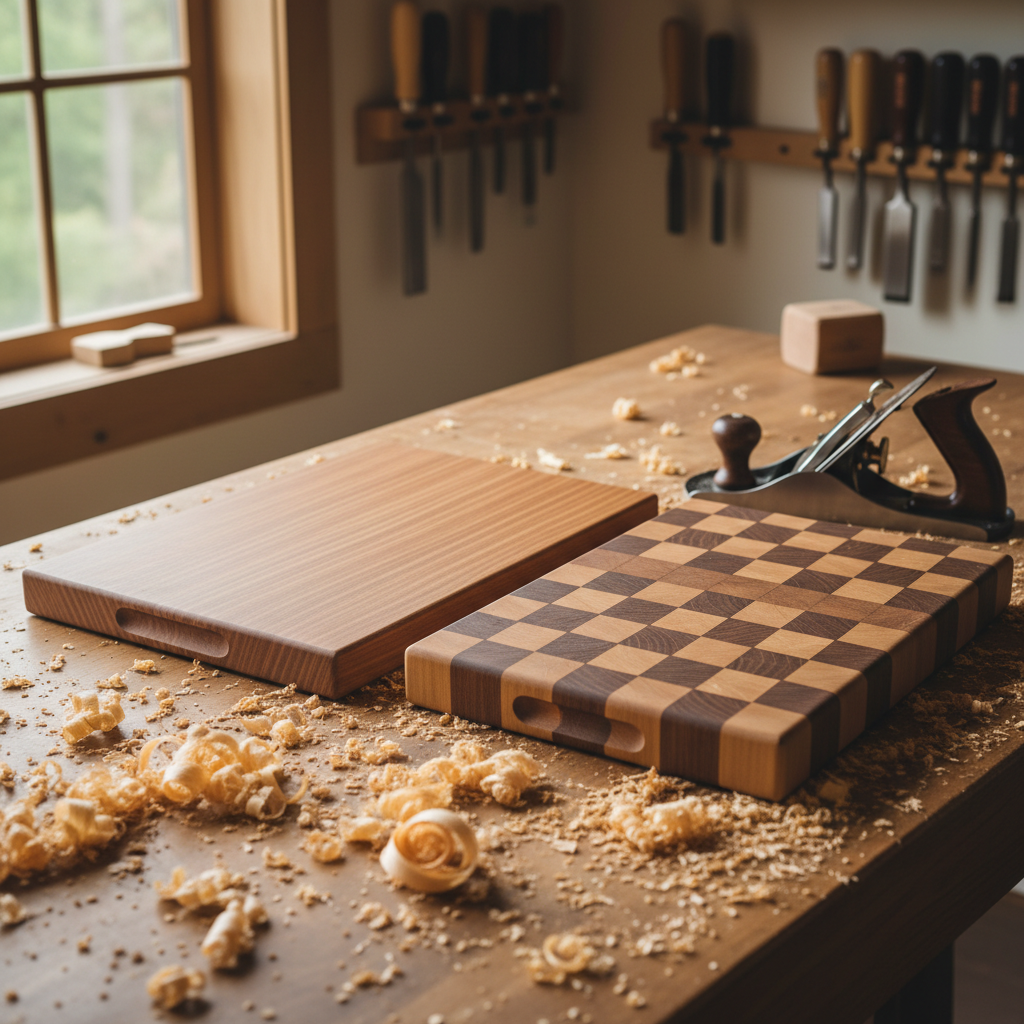
Woodworking instructors tend to recommend a cutting board as a first project before they discuss anything else, and there's a reason for that. It's the rare project that teaches glue-up technique, surface flattening, and finish application without demanding joinery. But the moment you search for plans, you hit a split: face-grain boards and end-grain boards are both called beginner projects, and they are not the same thing in any meaningful way.
The gap between them isn't just aesthetic. End-grain boards take two to three times longer to build, require more board-feet of lumber, and punish surface prep errors that a face-grain board simply hides. What looks like a style choice is actually a decision about your current skill level, your tool setup, and how much a failed glue-up will sting your motivation in week one.
Face-grain orientation, end-grain orientation, glue-up complexity, and surface flattening method each pull the decision in a different direction. If you're standing in the lumber aisle right now trying to figure out how much 8/4 hard maple actually costs, this is the article for you. It won't tell you end-grain is impossible for beginners. It will tell you the specific conditions under which starting there is a mistake you'll regret after three hours of hand-planing a cupped panel.
What the Two Boards Actually Ask of You
A face-grain cutting board is built from planks ripped to width, glued face-to-face or edge-to-edge with the wide, flat face of the wood pointing up. The glue lines are parallel and predictable. You flatten the panel with a hand plane, a belt sander, or a router sled, and you're done. The wood grain runs along the length of the board. A beginning woodworker with a table saw, a random-orbit sander, and a set of pipe clamps can produce a functional, attractive board in an afternoon.
An end-grain board turns that geometry ninety degrees. You glue up a panel, slice it into strips across the grain, rotate those strips so the end grain faces up, then glue everything together again. That second glue-up is where the trouble lives. End grain absorbs glue aggressively and unevenly, so squeeze-out patterns lie. Joints that look tight before clamping can open as the glue sets if you haven't surfaced each strip perfectly flat first. And flattening an end-grain panel after assembly is genuinely hard: you're planing against alternating grain directions, which means a dull iron or the wrong technique tears the surface instead of cutting it.
Or rather: the difficulty isn't the concept, it's the compounding. Each step in an end-grain build has a tighter tolerance than the equivalent step in a face-grain build, and the steps depend on each other. A slightly out-of-square rip in step one becomes a gap in the final glue-up. That compounding is what catches beginners.
This article is not for woodworkers who already have a functioning shop and are choosing between two styles for a gift. It's written for people starting from scratch or within their first five projects, and the recommendation changes for that specific reader.
The Real Costs: Time, Lumber, and Tools
Budget matters more on a first project than most guides admit. A face-grain board in hard maple or walnut typically requires 4 to 6 board-feet of 4/4 lumber. At retail hardwood prices in the US, that runs roughly $15 to $40 depending on species and whether you're buying from a hardwood dealer or a big-box store. The board-feet calculation for a standard 12-by-18-inch board is forgiving: if you misread a board and rip it slightly narrow, you adjust the design. Waste is low.
An end-grain board in the same final dimensions needs significantly more raw material because you're cutting the panel into strips and regluing. A common rule of thumb is to start with stock that's three to four times the final board thickness, which means you're buying 8/4 lumber and milling it down, or buying extra 4/4 and laminating before the first glue-up. Budget at least 8 to 12 board-feet for an equivalent board, and plan for more if your strips come out uneven on the first pass.
The tool question is sharper still. A face-grain board requires a reliable way to flatten the panel after glue-up. A random-orbit sander with 80-grit through 220-grit paper works, though a hand plane is faster. A thickness planer is the cleanest option if you have one. Any of those paths gets you there. An end-grain board pushes harder: you need very sharp blades (a dull table saw blade causes tearout on end grain that shows up in the final surface), and flattening after the second glue-up really does favor a planer or router sled over sanding alone. Sanding end grain flat by hand is a pain. It takes longer than you expect and burns through paper fast.
If you're working with a basic tool set, face-grain wins on cost and time without contest. Check your tool inventory, lumber budget, and available hours before you commit to a species.
Where End-Grain Earns Its Reputation (and When That Matters)
End-grain boards are genuinely better on a knife edge over time. The blade enters the wood between the fibers rather than cutting across them, which means the surface self-heals to a degree. That's not marketing; it's a real functional difference you can observe after a year of daily use. A face-grain board that gets heavy use will show score marks that don't close. An end-grain board won't be perfect, but it holds up noticeably longer under the same conditions.
The better question is whether that functional advantage matters for a first project. You're learning to build, not building a family heirloom on attempt one. The face-grain board you finish and use is worth more to your skill development than the end-grain board you abandon halfway through a frustrating second glue-up. I'd start with face-grain specifically because completion matters more than perfection at this stage, and face-grain lets you reach a finished, sanded, oiled product in a single session.
That framing misses something, though. There's one scenario where going straight to end-grain makes sense: if your primary goal is to give the board as a gift and you want it to look impressive, and you have at least a weekend to spend on it, and you already own or can borrow a thickness planer. Those three conditions together change the math. Without all three, the face-grain board is the better gift anyway because it'll actually be finished on time.
What specifically happens if you ignore this and start with end-grain underprepared? You'll likely end up with a panel that has visible glue-line gaps after the second glue-up, which you can't sand out without removing so much material that the board becomes thin and prone to warping. Some people sand through the gaps and finish anyway. The board works, but it looks like a first project in a way that stings. Starting with face-grain and building a clean board you're proud of does more for your next project than a technically ambitious failure.
Making the Call: A Direct Comparison
The table below puts the two project types side by side across the factors that actually affect a beginner's success rate. Read across each row before you decide.
| Factor | Face-Grain Board | End-Grain Board |
|---|---|---|
| Glue-up complexity | Single glue-up, parallel joints | Two glue-ups, second requires very flat strips |
| Lumber cost (approx.) | 4 to 6 board-feet | 8 to 12 board-feet |
| Flattening method | Sander, hand plane, or planer | Planer or router sled strongly preferred |
| Time to completion | Half-day to full day | Full weekend minimum |
| Knife-edge durability | Good for moderate use | Better for heavy daily use |
| Margin for error | Wide: design adjusts easily | Narrow: errors compound through steps |
| Finish difficulty | Straightforward: oil or wax | Same finish, but surface prep takes longer |
The durability advantage of end-grain is real but irrelevant if the board never gets finished. Face-grain is the stronger first project for almost every beginner, and it's a better second project too if you want to refine your glue-up and surfacing technique before adding the complexity of the end-grain geometry.
Setting Up for a Clean Face-Grain Build
Pick a species that machines cleanly and stays stable. Hard maple and cherry are the workhorses of American cutting board making: both are food-safe, both take finish well, and both are available at hardwood dealers in most US metro areas. Walnut is a step up in cost but forgiving to work with. Avoid pine, cedar, and any softwood. They're too soft to hold up as cutting surfaces and will dent within weeks of daily use.
Mill your boards flat and square before glue-up. This is the step buyers skip when they grab pre-dimensioned lumber from a home center and go straight to gluing. Pre-dimensioned lumber is rarely flat enough for tight glue joints. Run each piece through a jointer or hand-plane a reference face, then thickness-plane to uniform dimension. Your glue joints close under clamp pressure, but they can't fix a twist that's baked into the stock.
Apply glue to both mating faces, not just one. Spread it evenly, let it tack for 30 to 60 seconds if you're using standard PVA woodworking glue (Titebond II or III are both food-safe once cured, per Titebond's published technical data), and clamp with enough pressure to see a thin, even bead of squeeze-out along the full joint length. Uneven squeeze-out means uneven glue distribution. Correct the clamping pressure before the glue sets.
After cure, flatten with 80-grit on a random-orbit sander working diagonally, then switch to the grain direction at 120, then 180, then 220. Apply a food-safe finish: pure mineral oil, walnut oil, or a beeswax-and-mineral-oil blend. Finish both faces and all edges to minimize seasonal moisture movement. And then use it.
When to Try End-Grain Next
Build two or three face-grain boards first. By the third one, your glue-ups will be tighter, your surfacing technique will be faster, and you'll have a feel for how different wood species behave under a plane or sander. That foundation makes the end-grain build go better in almost every way.
Before your first end-grain attempt, sort out access to a thickness planer. Borrowing one from a local makerspace (most major US cities have at least one with day-use or monthly membership options) costs far less than the frustration of hand-flattening a 14-inch end-grain panel. Get your table saw blade sharp or replace it: a quality carbide blade makes a real difference on end-grain tearout. Then work through the sequence deliberately, check each strip for flatness before the second glue-up, and don't rush the cure time.
But start with face-grain. Finish something. Then build on it.