
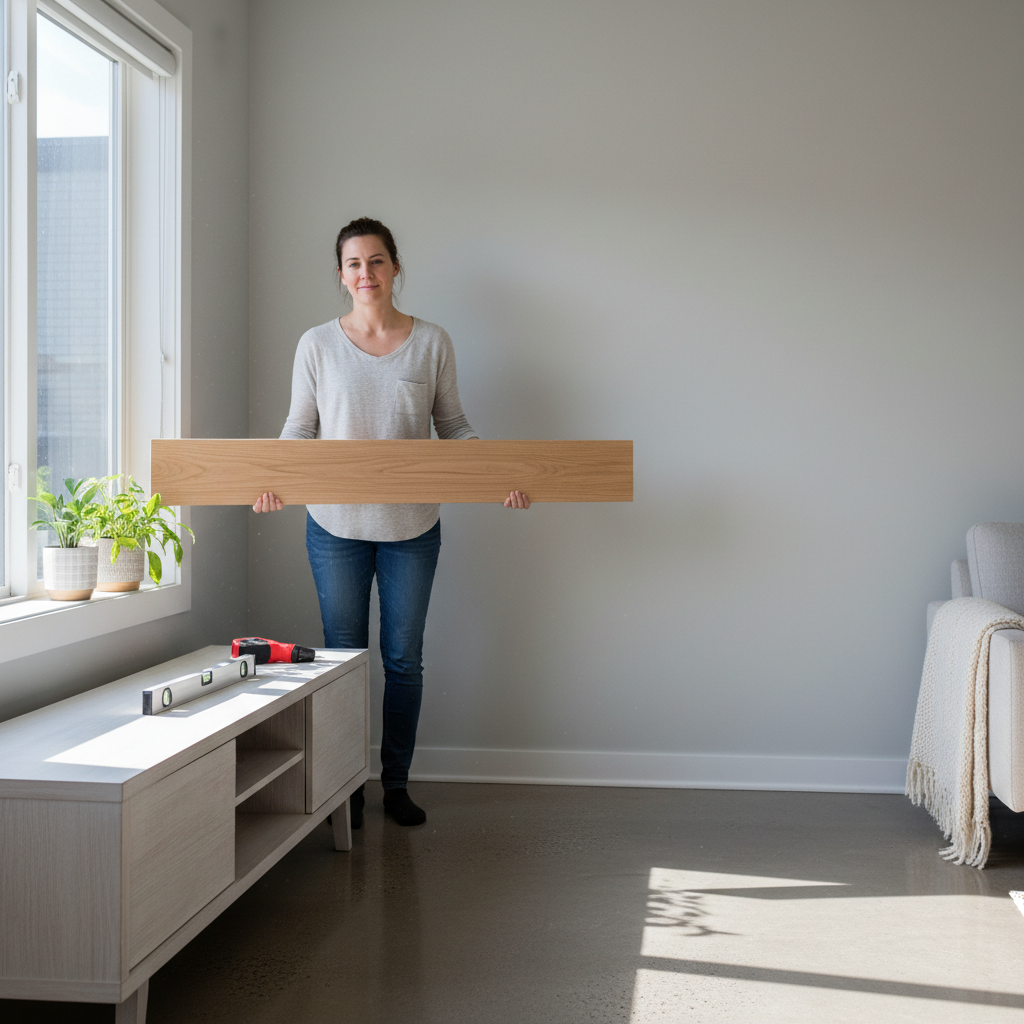
Carpenters will tell you to find your studs before they discuss anything else about hanging shelves, and there's a reason for that. The display ledge itself is easy to build. What fails isn't the wood or the joinery; it's the wall connection, and that depends on variables most weekend project guides gloss over: stud spacing, drywall thickness, and the actual load you're putting up there.
A wall-mounted wooden display ledge sounds straightforward, but the gap between "looks solid" and "actually solid" comes down to how you attach it. Pots, trailing plants, and ceramic objects can push a 36-inch ledge past 20 pounds without much effort, and a ledge hung on toggle bolts through drywall alone will eventually remind you of that fact in the worst way.
This guide covers building a ledge from rough lumber through wall installation. It won't cover floating box shelves with concealed hardware, freestanding display furniture, or built-in cabinetry. If you're looking for something that spans an entire wall or requires a face-frame, that's a different project.
Wood Selection and Ledge Dimensions
The wood you pick sets the visual weight of the finished ledge as much as the dimensions do. For a display ledge carrying plants and objects, you want something that takes a finish cleanly and doesn't cup or twist after installation. Common choices in US lumber yards break down usefully.
| Wood Species | Typical 1x6 Board Cost (8 ft) | Stability | Finish Quality | Best For |
|---|---|---|---|---|
| Poplar | $8 - $14 | Good | Excellent (paint-grade) | Painted ledges, modern interiors |
| Select Pine | $6 - $12 | Moderate | Good (knot variation) | Rustic or stained finishes |
| Hard Maple | $18 - $28 | Excellent | Excellent (natural grain) | Natural finish, heavier loads |
| Red Oak | $14 - $22 | Excellent | Excellent | Stained finishes, traditional rooms |
Poplar is the practical choice for most painted ledges. It mills cleanly, holds screws well, and sits in the middle of the price range. If you're going natural or stained, red oak earns its cost in grain consistency. Avoid common pine boards marked "#2" or lower; the knots are unpredictable and they'll cup after a season in a climate-controlled interior.
For dimensions, a depth of 3.5 inches (a ripped 1x6 at true width) holds small pots and objects without feeling like a shelf. Go to 5.5 inches if you want larger planters or deeper frames. Length is your call aesthetically, but anything over 48 inches without a center support bracket will show sag within a year under load. That's not a scare tactic; wood creeps under sustained weight, especially across the grain.
Or rather: it's not just the weight at installation that matters. Seasonal humidity shifts cause wood to expand and contract, and a long unsupported span amplifies that movement at the center point. Plan your mounting bracket spacing before you cut the ledge board to length.
Building the Ledge: Cut List and Assembly
A display ledge with a front lip is more useful than a flat board. The lip keeps objects from sliding off, gives the ledge visual definition, and stiffens the front edge against twist. You need three pieces: the main deck, a front rail, and optionally a back cleat that doubles as your wall-attachment point.
Standard cut list for a 36-inch ledge:
- Deck board: 1x4 or 1x6 select lumber, 36 inches long
- Front rail: 1x2, 36 inches long, glued and nailed to the front underside edge of the deck
- Back cleat: 3/4-inch plywood or 1x3, 36 inches long (this is what mounts to the wall)
Sand all faces through 150-grit before assembly. Finish sanding after glue-up is a pain when you're working into corners. Glue the front rail to the deck with wood glue and 1.5-inch finish nails or 18-gauge brad nails; no screws visible on the front face. Clamp and let it cure for at least an hour before handling.
The back cleat is where most guides get vague. You have two options. First: attach the cleat permanently to the deck and mount the whole assembly as a unit. Second: mount the cleat to the wall first, then hook or screw the deck assembly onto it. The second approach (a French cleat or a simple ledger strip) makes leveling easier and lets you remove the ledge without wall damage. I'd start with the ledger strip method for a first build, cutting a 45-degree bevel on both the wall cleat and the back edge of the deck so they interlock like a French cleat. It's forgiving and genuinely elegant once you understand the geometry.
Apply your finish before mounting. Stain or paint the assembled ledge, let it cure fully (at least 24 hours for water-based poly, 48 for oil-based), then install. Trying to finish around wall hardware is a waste of time.
Wall Mounting: Studs, Anchors, and Load Reality
This is the section that determines whether your ledge is there in three years. Everything above it is woodworking. This is structural.
US residential framing puts studs at 16 inches on center in most construction, though older homes and some modern builds use 24-inch spacing. Find your studs with a reliable stud finder; the magnetic type that locates screw heads in drywall is more trustworthy than the cheap capacitance models. If your ledge length lands screws in two studs, you're done: use 3-inch coarse-thread wood screws through the cleat, through the drywall, and at least 1.5 inches into the stud. Two stud connections handle 50-plus pounds without any calculation needed.
The problem comes when your desired ledge placement doesn't align with studs, or when you're mounting into plaster over lath in an older home. In standard half-inch drywall with no stud backing, your anchor options are toggle bolts (also sold as Toggler snap toggles or hollow-wall anchors) rated for the load you're carrying. Check the anchor's rated shear load, not just its pull-out strength; shelves load anchors in shear, not tension. A 3/8-inch toggle bolt in half-inch drywall typically carries 50-plus pounds in shear, but mix your anchor types and check the package specs for your specific drywall thickness.
Buyers skip the load calculation until they're burned: add up the weight of the ledge itself (a 36-inch poplar ledge runs roughly 3 - 4 pounds), the heaviest arrangement you'd realistically place on it, and double it as a safety margin. That number tells you what your anchor system needs to hold. If it exceeds what drywall anchors can reliably provide for your wall construction, find the studs or choose a shorter ledge span.
For plaster walls: use longer screws and expect more variation. Plaster over wood lath is stronger than it sounds for anchor purposes, but plaster over metal lath or gypsum board requires the same analysis as drywall. When in doubt, locate the studs and use them.
Leveling, Final Fastening, and Styling the Ledge
Level matters more on a display ledge than on a utility shelf because objects sit visually against a wall and a 1/4-inch drop over 36 inches is obvious to anyone in the room. Use a 4-foot level; a torpedo level is too short to catch gradual drift.
Mark your wall line with a pencil at the top of the cleat position. Hold the cleat to the wall, check level, and mark your fastener locations. Pre-drill pilot holes in the cleat before going to the wall; it prevents split-out at the ends of the board. Drive your first fastener at one end, recheck level, then drive the second. For a French cleat, the wall half of the cleat needs to be perfectly level or the ledge will rock slightly when loaded.
Once mounted, the styling part is where you recover any visual error. A few practical notes on display arrangements for plants and objects on a narrow ledge: weight toward the wall (heavy pots at the back lip, lighter objects forward), odd-number groupings read better than even in most rooms, and leave at least 20 percent of the ledge surface open or the display reads as cluttered. That last point is an aesthetic observation, not a structural one, but it matters if the ledge is in a main living area.
What happens if you skip the leveling step and mount by eye? At minimum, the display objects look wrong and you'll notice it every time you walk past. At worst, a ledge that's not level creates uneven load distribution across the mounting points, which matters more on anchor-only installations than stud-mounted ones. Fix it before the hardware is fully tightened. After that, you're patching drywall.
When This Approach Doesn't Work
A standard built ledge with a back cleat works well in most US residential interiors with standard drywall construction. It doesn't work in every situation, and it's worth knowing where it breaks down before you start cutting wood.
Tile or masonry walls require masonry anchors and a hammer drill, and the French cleat approach is harder to execute cleanly on tile without professional drilling. For a tiled backsplash area or a brick accent wall, a surface-mounted cleat with masonry screws is more reliable, but the aesthetics are different and the mounting is less forgiving of mistakes.
Renters who can't make wall penetrations beyond small picture hooks should skip this project entirely and look at tension rod systems, over-door organizers, or freestanding ladder shelves instead. A wooden display ledge requires wall fasteners, and there's no version of this project that works well without them.
And if you're mounting in a wall that has plumbing or electrical runs in unknown locations, slow down. A stud finder won't detect pipes or wires reliably, and the consequences of hitting either are serious. In kitchens and bathrooms especially, trace your utility locations before drilling. That framing misses something most project guides skip: the cost of being wrong isn't just a patched hole; it's a service call.
Finishing Touches and Long-Term Care
A water-based polyurethane topcoat is the most practical finish for a display ledge that will hold plants. Moisture from pots, condensation from terracotta, and dust accumulate on horizontal surfaces. Two coats of water-based poly over your stain or paint layer gives you a cleanable surface that holds up to normal use without yellowing the way oil-based products do over white paint.
For plants specifically, add a small felt pad or cork mat under each pot. Direct contact between a wet terracotta base and a wood surface will raise the grain over time and eventually damage the finish regardless of topcoat. This is basic preventive care, not over-caution.
Check your mounting hardware once, about six months after installation. Screws into studs don't drift, but toggle anchors in drywall can loosen with repeated load shifts, especially if you rearrange the display often. A 30-second check with a screwdriver is all it takes. If anything feels loose, that's your signal to evaluate whether the anchor system is right for the load you're actually carrying, not just the load you estimated at installation.
Build this ledge once with solid mounting, and it'll outlast the trend that made you want it.
Putting It Together
If you're mounting into studs, use 3-inch wood screws through a back cleat, sand to 150-grit, apply water-based poly, and you're done. That covers 80 percent of situations and takes a Saturday morning.
If your stud layout doesn't cooperate, choose toggle anchors rated for the shear load you've calculated, keep the ledge under 36 inches, and add a center support if you're going longer. The reframe worth keeping: a display ledge is a mounting problem first and a woodworking project second. Get the wall connection right and the rest is just finishing work.
Use poplar for painted finishes, red oak for stained ones. Build the front rail in. Finish before mounting. Level carefully. Those four steps separate a ledge that looks handmade in the best sense from one that just looks handmade.