
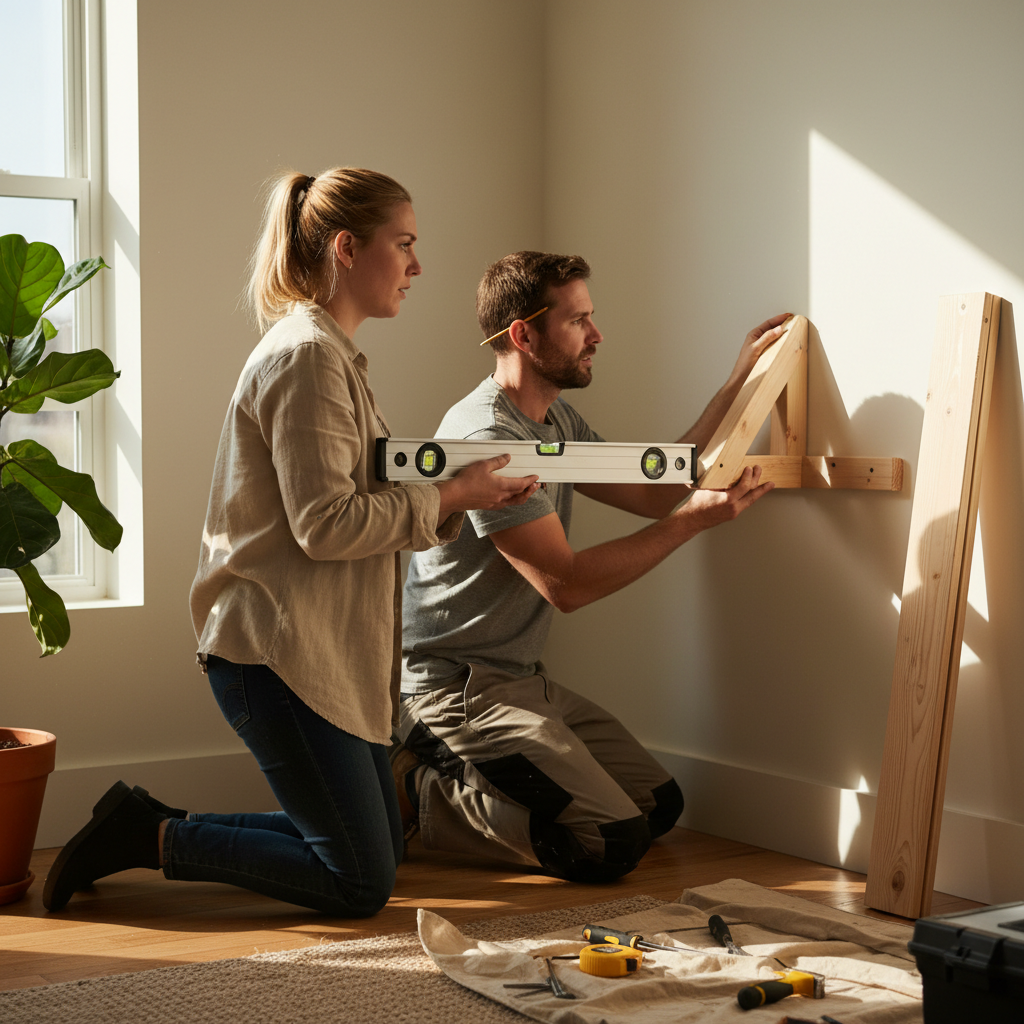
Carpenters will tell you the shelf board is almost never the problem before they discuss anything else, and there's a reason for that. Most DIY corner shelves fail at the wall, not the wood, and they fail in a specific, preventable way: the installer chose the wrong fastener for what's behind the drywall.
Building a corner floating shelf that holds meaningful weight, say a stack of books or a few cast-iron pieces, comes down to three variables that most tutorials either gloss over or get flat wrong: anchor type, bracket embedment depth, and whether your corner framing actually has a stud where you need one. Get those right and the shelf is nearly indestructible. Ignore any one of them and you're guessing.
Here's the tension this article won't resolve for you upfront: the "correct" fastener and bracket depend entirely on what's inside your specific walls. A corner in a 1950s balloon-frame house is a different beast from a corner in a 2010 tract home with engineered lumber. That dependency is the whole game, and it's where generic shelf guides fall apart.
Why Corner Shelves Are Harder Than Standard Floating Shelves
A standard floating shelf mounts to a single flat wall. You find studs, drive lag screws, done. Corner shelves introduce a structural problem that most guides skip past: the two walls meeting at a corner don't always share framing in the way you'd expect.
In typical wood-frame construction, an inside corner is formed by nailing a stud flat against the intersecting wall's top and bottom plates, then adding a second stud beside it to give the drywall on the adjacent wall something to nail to. The result is a "corner assembly" that's actually solid lumber, wall-to-wall, in roughly the first 3 inches of each wall from the corner. This sounds like good news. It isn't always. That corner assembly is often inaccessible with a standard stud finder because the mass of wood behind the drywall confuses the sensor into reading the entire corner zone as "solid."
Or rather: the issue isn't that the corner is solid, it's that you can't distinguish the corner assembly from a load-bearing stud without probing. Drive a screw into the drywall gap between two corner studs and you'll get zero holding strength. Drive into the corner assembly itself and you're anchored to something that's connected to the floor plate and ceiling plate of the building. That's a meaningful difference when you're hanging 40 pounds of anything.
The practical move is to probe before you commit. A long finish nail or a thin awl driven into the wall at an angle will tell you within two or three test holes exactly where solid lumber begins. This takes five minutes and saves a shelf.
Choosing the Right Bracket and Fastener for Your Wall Type
The bracket is where most people overspend on aesthetics and underspend on engineering. A visible bracket with thin steel arms looks industrial-chic but flexes under load. A hidden rod-style bracket driven 5 or more inches into solid wood is what actually holds weight. Choose the bracket based on your wall, then design around it.
Wall type drives everything: fastener choice, bracket length, and how much weight you can honestly expect the shelf to hold.
- Solid stud or corner assembly: Use 3/8-inch steel rod brackets or heavy-duty steel keyhole brackets with 3-inch minimum lag screws into the stud. A single rod bracket seated 5 inches into a 2x4 stud, with the rod extending 8 inches into the shelf, will hold well over 50 pounds per bracket under static load (a common guideline among finish carpenters, not a rated standard).
- Drywall only, no stud access: Toggle bolts are the only viable option for meaningful weight. Snap toggles or strap toggles, rated for the wall thickness you have, are far more reliable than traditional butterfly toggles. But even the best toggle bolt in half-inch drywall has a practical ceiling around 30 pounds total shelf load before deflection becomes a problem.
- Masonry or concrete walls: Concrete screws (Tapcon is the common brand name) or sleeve anchors are required. A standard wood-rated bracket lag screw driven into concrete does nothing. For a corner against a concrete or block wall, pre-drill with a hammer drill bit sized to the anchor manufacturer's specification, not a general estimate.
If you're working with drywall-only anchors on a corner shelf intended to hold anything heavy, stop. Redistribute the load to lighter decorative items, or open the wall and add a backing cleat nailed directly to the corner framing. The cleat approach takes an afternoon and gives you a shelf that will outlast the house.
Building the Shelf Board: Wood Choice, Dimensions, and Span Limits
The board matters, but not in the way most people think. The question isn't which species of wood looks best; it's whether the shelf span and thickness combination will deflect under the load you're putting on it.
A simple rule of thumb that finish carpenters use: for a shelf 10 to 12 inches deep, 3/4-inch solid hardwood or 3/4-inch hardwood plywood with a solid-wood edge band handles spans up to about 36 inches without visible sag under normal household loads. Go past 36 inches at 3/4 inch and you'll see deflection over time, especially with books. At spans beyond 36 inches, step up to 1-1/2-inch laminated stock or add a center bracket.
For a corner shelf specifically, the geometry creates a triangular board. The two back edges run along the walls; the front edge is the hypotenuse. If each wall-side leg is 16 inches, your front span across the diagonal is roughly 22.6 inches (that's just the Pythagorean theorem: 16 squared plus 16 squared, square root of the sum). That diagonal is your structurally unsupported span, and it's where the board flexes. A 3/4-inch board at that span is fine for light loads. For anything over 25 to 30 pounds, use 1-inch solid stock or laminate two pieces of 3/4-inch plywood together with construction adhesive.
That understates it. The corner joint itself, where the two wall-side edges meet at 90 degrees, needs to be cut precisely. A miter joint at the back corner looks clean but is structurally weak end-grain to end-grain. A butt joint where one board overlaps the other at the corner is stronger and easier. For a shelf that's going to hold real weight, the butt joint is the right call.
For wood species: poplar machines cleanly and paints well. Red oak and hard maple hold screws better than pine and take a stain more evenly. Pine is fine for a painted shelf carrying light loads but dents easily and can sag at longer spans. This isn't a recommendation to avoid pine; it's a note that pine at 3/4 inch over a 30-inch span with 40 pounds on it will tell you about its limits within a year.
The Installation Sequence That Prevents the Most Common Failures
The sequence matters as much as the hardware. Installing brackets before the board is cut to final size is a pain you can avoid. Here's the order that minimizes rework.
- Locate the framing first. Use a stud finder to get a general read, then probe with a finish nail in the corner zone to confirm solid lumber. Mark every stud center with painter's tape, not pencil, so marks don't bleed through paint later.
- Set the bracket height and level. Hold a level across both wall faces at your intended shelf height. Corner shelves are unforgiving of even a 1/4-inch height mismatch between walls, because the eye follows the diagonal front edge and any slope is obvious.
- Mount brackets before the shelf board goes on. Drive your lag screws or anchors, check that each bracket is level and plumb, and do a pull test by hand before putting any board on. A bracket that rocks or pulls slightly away from the wall under hand pressure will fail under load.
- Cut the board to fit after brackets are set. Walls are rarely perfectly square. Cut your corner board 1/16 to 1/8 inch undersized on the wall-side edges, then scribe and trim for a tight fit. Trying to force an oversized board into a corner will rack your brackets out of plumb.
- Attach the board to the brackets securely. For rod-style hidden brackets, the rod should run at least halfway through the shelf's depth. For surface brackets, predrill pilot holes and use screws, not just the provided hardware if the provided hardware is undersized.
If you skip the pull test on step three and go straight to loading the shelf, you'll find out the bracket was inadequately anchored the hard way. That's not a hypothetical; it's the most common call a finish carpenter gets on a callback.
I'd start the layout process with the level, not the stud finder. Knowing your exact height first makes the stud search faster because you're only looking at one horizontal line, not scanning the whole wall.
When This Approach Won't Work (and What to Do Instead)
A corner floating shelf mounted with rod brackets and stud anchors is the right solution for most situations. But there are real conditions where it's the wrong answer, and knowing them upfront saves a wall repair.
Plaster walls are the biggest exception. Homes built before roughly 1950 commonly have plaster and lath rather than drywall. Standard toggle bolts grip plaster poorly because the plaster layer is brittle and the lath behind it is thin (typically 1.5 inches wide with gaps between strips). Rod brackets driven into plaster without hitting a stud will crack the plaster face over time under load. For plaster walls, either locate studs precisely with a magnet (look for the drywall screws that secured the lath during construction) or use a surface-mounted cleat system nailed directly into studs rather than a hidden bracket. The cleat approach isn't as sleek, but it's the honest solution for plaster.
Tiled corners in bathrooms or kitchens are another case where the hidden-bracket approach gets complicated. Drilling through tile without cracking it requires a diamond-tipped tile bit and a slow, steady hand. If the tile is over a fiberglass or cement board substrate rather than drywall, your anchor options change further. For a tiled corner carrying anything beyond light decorative objects, consult a tile installer before you drill.
And if the corner you're working with is an outside corner rather than an inside corner, the framing situation reverses. Outside corners often have less solid backing than inside corners, and the visual geometry of the shelf changes entirely. This article is about inside corners. Outside corner shelves are a separate project with different structural considerations.
How Much Weight Can a Corner Floating Shelf Actually Hold?
This is the question everyone searches for a clean number on, and the honest answer is: it depends on three compounding variables, not one.
The wall anchor is the first limiting factor. A 3/8-inch lag screw driven 2.5 inches into a dry Douglas fir stud has a withdrawal strength (resistance to being pulled straight out) often cited in wood engineering references at well over 500 pounds per screw under ideal conditions. But that number drops significantly with wet wood, aged fasteners, or screws driven at an angle. The second limiter is the bracket itself: a thin stamped-steel decorative bracket will bend before the lag screw pulls out. The third is the shelf board's deflection under load, which is a function of span, thickness, and wood species.
Working those three together gives you a practical ceiling that's lower than any single factor suggests. For a corner shelf with each wall-side leg around 16 inches, two rod brackets seated into studs, and 3/4-inch solid hardwood: a reasonable working load limit is 40 to 60 pounds, distributed evenly. This is a practical heuristic derived from standard finish carpentry guidelines, not a rated engineering specification. For anything approaching that upper range, use three brackets (one per wall plus one at the midpoint of the longest unsupported span) rather than two.
What happens if you ignore the load limit? The failure mode for an overloaded floating shelf isn't usually catastrophic and sudden; it's a slow pull. The brackets begin to tilt forward as the anchors work loose under sustained load, and the shelf develops a forward lean you can see before anything falls. By the time you notice it, the drywall around the anchors is already damaged, which means rehanging the shelf requires moving to a new stud location or patching and redrilling. That's a repair, not just a rehang.
Finishing the Shelf: What Holds Up and What Looks Good
The finish is where you can lose a structurally sound shelf to a bad look, or put good work on display. Keep the choices simple.
For a painted shelf: two coats of oil-based primer, sanded lightly between coats, then two coats of a water-based topcoat in a satin or semi-gloss sheen. Flat paint on a shelf looks good for about a month before it starts showing every fingerprint and wipe mark. Semi-gloss holds up.
For a stained and clear-coated shelf: wipe-on poly is forgiving and produces a clean result for a beginner. Three coats, sanded to 320 grit between each, gives a surface that's durable enough for daily use. Oil-based polyurethane is harder and more durable than water-based but takes longer to dry and has stronger fumes. For a kitchen or bathroom shelf with any moisture exposure, oil-based is worth the extra wait.
The wall around the shelf matters too. Caulk the back edges of the shelf where it meets the wall with a paintable latex caulk before the final coat. This closes the gap, makes the shelf look built-in rather than hung, and keeps dust from accumulating in the seam. It's a five-minute step that changes how professional the finished result looks.
The Shelf That Lasts
If you anchor into solid framing, match your bracket type to your wall, and size the board to the load, a corner floating shelf should hold without drama for the life of the wall. There's no magic to it, just the right sequence applied to the right materials.
The single step that determines whether this goes well or poorly is the wall probe before you drive anything. Spend five minutes finding what's actually inside the corner. Everything after that is straightforward woodworking. Skip that step and you're installing a shelf based on a guess about what's holding it up.
One immediate action: before you buy any hardware, take a stud finder and a finish nail to the corner right now and confirm whether you have solid framing within 4 inches of the corner on both walls. If you do, rod brackets and lag screws are your path. If you don't, add a backing cleat to your material list before you order anything else.