
Finishing your first woodworking project is where a lot of beginners quietly lose their confidence. The joinery held, the sanding went fine, and then the finish goes on streaky, bubbly, or full of brush marks that won't sand out. Polyurethane and wipe-on poly are the two finishes beginners reach for most, and they behave very differently under inexperienced hands.
The gap between them isn't just about technique. It's about how much the product forgives mistakes in real time, and that difference can mean a smooth first coat versus an afternoon of remedial sanding. Wipe-on poly is essentially oil-modified polyurethane thinned to roughly 50 percent solids, and that thinning changes what it asks of the person applying it. But the same thinning that makes it forgiving is also what makes it slow to build a protective film.
Which one you should use depends on three things: the size of your project, how much time you're willing to trade for convenience, and whether surface perfection or reasonable protection is your actual goal right now.
Why Application Difficulty Is the Real Comparison
Brush-on polyurethane, the kind sold in quart cans at every hardware store, is a thick finish. That viscosity is what lets it build a durable film in two or three coats. It also means it holds brush strokes, traps bubbles, and sags on vertical surfaces if you load the brush too heavily. For a beginner, each of those failure points requires either confident brush technique or a willingness to sand back and try again.
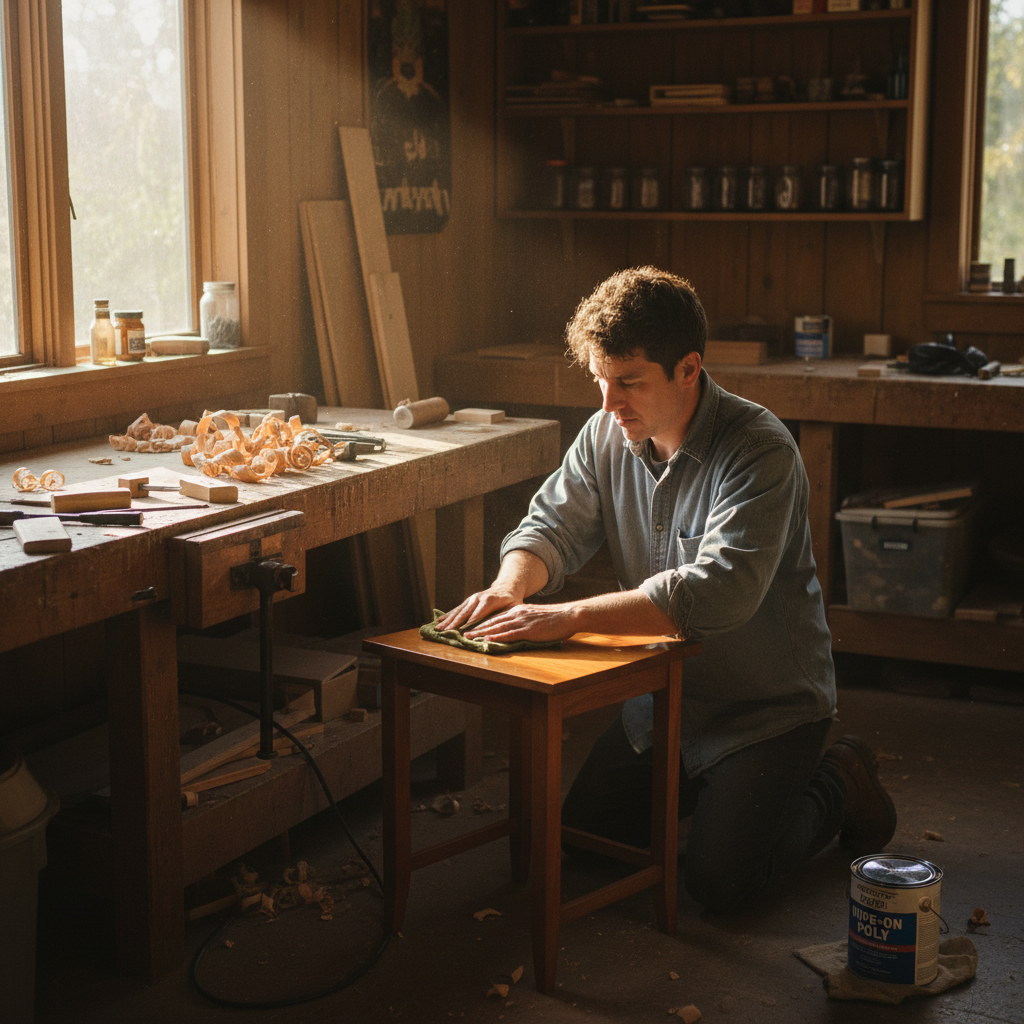
Wipe-on poly removes most of those failure points by removing most of the solids per coat. You apply it with a lint-free cloth or foam pad in thin, overlapping passes. There's no brush to drag, no loading to miscalibrate, and the thin film levels itself before it cures. The most common mistake beginners make with brush-on poly is applying it too thickly, which traps solvent and causes the surface to stay tacky or wrinkle. Wipe-on poly makes that mistake nearly impossible.
Or rather: it doesn't make mistakes impossible, it makes the most expensive mistakes (drips, heavy brush marks, lifted grain) structurally harder to commit. You can still apply wipe-on poly over a dusty surface or skip a light scuff-sand between coats, and you'll see it in the result.
The tradeoff is coat count. Where brush-on poly typically reaches a serviceable protective build in two to three coats, wipe-on poly generally needs four to six coats to reach comparable film thickness. On a small box or a decorative piece, that's fine. On a dining tabletop, it adds real time to the project.
When Each Finish Makes Sense
Wipe-on poly is the right starting point for most beginners working on small to medium projects: frames, shelves, small cabinets, anything with complex profiles or inside corners where a loaded brush would puddle. The application margin for error is wide enough that a first-time finisher can get a presentable result on the first attempt.
Brush-on polyurethane earns its place on flat, horizontal surfaces where you want maximum durability without stacking six coats. Tabletops, workbench surfaces, and flooring coatings are where its build rate matters. If you're finishing a hardwood floor, Minwax and Varathane both make oil-modified polyurethane products specifically formulated for high-traffic durability, and wipe-on poly isn't a real substitute in that context.
The beginner who skips learning brush-on poly entirely will eventually hit a project where wipe-on isn't practical, usually a large flat panel, and have no technique to fall back on. I'd start with wipe-on poly to finish your first two or three projects, then deliberately tackle one flat surface with brush-on so you learn brush control under lower stakes.
One thing most beginners don't think about: the sheen level matters as much as the product. Both wipe-on and brush-on poly come in flat, satin, semi-gloss, and gloss. A gloss finish amplifies surface defects; satin is far more forgiving of minor dust nibs and light scratches. For a first project, satin in either product will hide more than gloss ever will, regardless of how cleanly you apply it.
The Coats, Drying Times, and What to Expect
Here's what a realistic finishing schedule looks like for each approach, assuming you're working in a typical home shop at around 70°F with moderate humidity.
Brush-on oil-modified polyurethane (Minwax Fast-Drying Polyurethane is a common first choice): apply one coat, wait four to six hours to touch-dry, lightly sand with 220-grit, wipe clean, apply second coat. Two coats cover most projects. Three coats on surfaces that will see daily use. Total active time across the project is roughly forty-five minutes of application spread over two days.
Wipe-on poly (Minwax Wipe-On Poly or a DIY mix of oil-based poly thinned with mineral spirits at roughly one-to-one by volume): apply one thin coat, wait two hours, apply another. Four to six coats for a furniture-grade build. Total active time is similar, but you're committing to more sessions. Each session is faster and lower-stress, but the project takes longer to finish and clear for use.
That framing misses something. The relevant comparison isn't just total time; it's recoverable time. With brush-on poly, a bad coat often means thirty minutes of sanding to fix. With wipe-on poly, a bad coat usually means you simply apply the next one over it. For beginners, recoverable mistakes have a different psychological cost than ones that require undoing your own work.
Water-based polyurethane is a third option this article isn't recommending for most beginners. It dries faster and cleans up with water, but it raises grain more aggressively, requires more coats than oil-based for equivalent hardness, and its shorter working time punishes slow applicators. It's not a bad product; it's a product that rewards experience rather than compensating for its absence.
Where This Goes Wrong
The main failure mode with wipe-on poly isn't application technique. It's underbuilding. A beginner applies two coats of wipe-on poly, thinks the project is done, and then puts a coffee mug on it six months later and sees a ring. Two coats of wipe-on poly is a sealer, not a finish. Four coats minimum, five if the wood is open-grained like oak or ash.
Brush-on poly fails beginners most often at the edges and profiles of a piece. Flat surfaces are manageable. The moment you're finishing a raised-panel door or a table apron with curved details, brush-on poly puddles in the recesses and sags on the vertical faces. That's not a beginner error so much as a product mismatch: wipe-on was built for exactly those surfaces.
If you ignore the coat-count requirement for wipe-on poly and call the project done after two coats, you're not protecting the wood; you're coloring it. Moisture, heat, and abrasion will get through thin film faster than you'd expect, and refinishing means stripping back to bare wood.
Which One to Buy First
Buy wipe-on poly for your first project. Minwax Wipe-On Poly in satin is available at Home Depot and Lowe's for roughly $14 to $18 per quart, which covers about 40 square feet per coat. Apply four coats minimum, scuff lightly with 320-grit between coats two and three, and don't rush the final cure: oil-modified finishes reach full hardness in about 30 days even when they feel dry to the touch in hours.
Check sheen, project size, and your time commitment before you buy. Satin for most furniture, gloss only if you want to see every flaw highlighted, and flat if the piece is purely decorative. Those three variables matter more than which brand is on the shelf.
When you're ready to learn brush-on, use a good quality natural-bristle or China-bristle brush, not a foam brush, and thin the first coat by about ten percent with mineral spirits to get it to lay flat. That single adjustment eliminates most beginner brush-mark problems before they start.