Veteran woodworkers will tell you to buy the table saw first, before they discuss anything else, and there's a reason for that. It's not bad advice. But it's advice shaped by shops that already have 200 square feet of dedicated space and a dust collection system, not by a spare bedroom with a folding workbench.
For most beginners researching table saws vs. circular saws, the honest answer is that a circular saw gets you further than you'd expect, and a table saw costs more than the sticker price once you account for the outfeed table, the blade upgrades, and the floor space it permanently occupies. That's the tension this article works through.
The answer turns on three factors: what you're building, where you're building it, and whether the saw you buy will still fit your workflow in 18 months. None of those is a simple yes or no.
What Each Saw Actually Does (and What It Doesn't)
A circular saw is a handheld tool. You bring it to the wood. A table saw is a stationary tool. You bring the wood to it. That distinction sounds obvious, but it drives every practical difference between the two.
With a circular saw and a decent straightedge guide, you can break down a full sheet of plywood accurately enough for furniture, cabinetry, and framing. The technique takes an afternoon to learn. What a circular saw can't do reliably is rip narrow strips, cut identical widths repeatedly without resetting the fence each time, or produce the consistent repeatability that table joinery demands. If you're making a bookcase with five identical shelf widths, a circular saw will get you there, but it'll take longer and require more careful setup every cut.
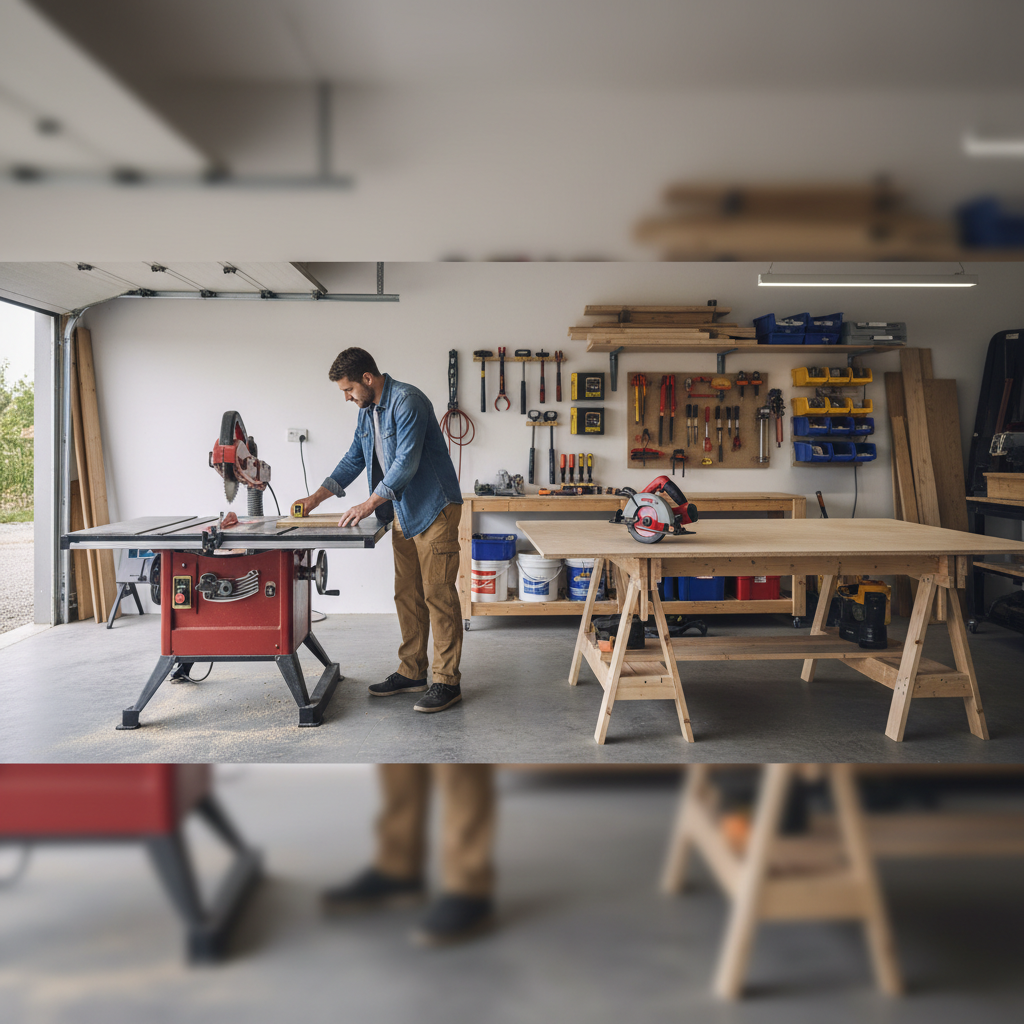
A table saw runs a blade through a fixed fence, which means once you set your width, every rip cut comes out the same. That repeatability is the actual value proposition, not raw cutting power. Entry-level contractor saws from brands like DeWalt and Ridgid come in around $500 - $650 at most big-box retailers, and they cut accurately enough for furniture-grade work. The hidden costs are the real issue: a quality rip fence upgrade if the stock fence is imprecise (common on cheaper models), a flat sacrificial outfeed surface so 8-foot boards don't tip the saw at the end of the cut, and, in most cases, a dedicated circuit if you're running the saw in a garage.
Or rather: it's not just the purchase price that changes your budget math. It's that a table saw demands an infrastructure around it that a circular saw simply doesn't. A circular saw, a quality straightedge guide like the Kreg Rip-Cut or a shop-made fence, and a set of good blades can be had for under $200 total. That $400 gap is real money that could go toward wood.
The Case for Starting with a Circular Saw
The most common mistake beginners make is buying a table saw before they know what they're building. It sounds backward, but it's true: most woodworking beginners overestimate how much of their early work requires a table saw and underestimate how capable a circular saw is with proper technique.
Sheet goods are the foundation of beginner woodworking. Plywood bookshelves, workbenches, simple boxes, storage cabinets. Breaking down a 4×8 sheet of plywood on a table saw is actually harder than it sounds without proper support, because you need the full length of the board supported on both sides of the blade. A circular saw with a straightedge clamped to the sheet handles this more safely for one person working alone.
Consider the space requirement honestly. A contractor table saw needs roughly 8 feet of clearance in front and behind the blade to handle full-length boards. That's 16 feet of clear runway, plus 4 feet of width for the saw and working room on each side. If your shop is a one-car garage you share with a car, that math probably doesn't work. A circular saw lives on a shelf when you're not using it.
And here's the part that most guides leave vague: a circular saw with a sharp 40-tooth carbide blade and a well-clamped straightedge will produce cuts that need no more sanding or cleanup than a table saw cut from a stock blade. The difference in cut quality between the two tools, for a beginner making furniture, is smaller than the difference between a sharp blade and a dull one on either tool.
When a Table Saw Actually Justifies the Cost
There are genuinely valid reasons to start with a table saw. But they require specific conditions, not just enthusiasm for the craft.
The clearest case: you're building projects that require repeated identical rip cuts. Solid wood furniture (not sheet goods), raised panel doors, drawer components, cabinet face frames. These involve ripping boards to consistent widths many times per project. A circular saw can do it, but the setup time per cut becomes a real friction that slows you down and increases the chance of small errors compounding into joints that don't fit.
A second legitimate case: you have the space already configured. If you're inheriting a shop, buying a house with a dedicated woodworking space, or have a full two-car garage where one bay is permanently your workshop, the space argument evaporates. In that situation, a contractor saw is a reasonable first purchase alongside a circular saw, not instead of one.
A third case that beginners often miss: you're building furniture from dimensional lumber (2×4s, 1×6s, rough-sawn hardwood) rather than sheet goods. Rough hardwood almost always needs to be ripped to final width and thickness-planed, and while a circular saw handles the ripping, the consistency and control of a table saw becomes genuinely valuable there.
What a table saw will not do is make you a better woodworker faster. Tool quality follows skill development, not the other way around. If you haven't built a project yet, you don't yet know which tasks you'll repeat often enough to justify a dedicated stationary saw for them. Buy the circular saw, build three or four projects, and you'll know exactly what you're missing (if anything) before you spend $600.
The Space and Safety Equation
Table saws are the single most injury-prone woodworking tool in home shops, according to the U.S. Consumer Product Safety Commission, which has tracked table saw injuries for decades as part of ongoing power tool safety reporting. The CPSC has estimated tens of thousands of emergency room visits per year from table saw incidents, with the majority involving contact with the blade during ripping operations.
That's not an argument against table saws. It's an argument for understanding the safety requirements before buying one. A table saw without a properly adjusted blade guard, riving knife (the piece of metal directly behind the blade that prevents the kerf from closing and binding), and anti-kickback pawls is substantially more dangerous than one with all three components in place and properly set. Many budget saws ship with these components but users remove them because they're awkward and never reinstall them correctly.
A circular saw has its own injury risks, primarily kickback when the blade binds in a cut, but the geometry of the tool means the saw typically moves away from the operator when kickback happens rather than throwing a workpiece back at them at high speed. This is not a minor distinction for someone still developing their sawing habits.
The practical heuristic most experienced woodworkers apply: don't buy a table saw until you've taken at least one hands-on safety course or had an experienced woodworker walk you through proper fence use, blade height adjustment, and kickback prevention in person. YouTube videos on table saw safety are genuinely useful, but they're not a substitute for having someone watch your hand position on the first 20 rip cuts. Many community woodworking clubs and makerspaces across the US offer exactly this kind of supervised introduction, and membership often includes access to tools before you've bought anything.
A Straightforward Comparison
The decision comes down to a handful of criteria that map cleanly to your situation. Here's how the two tools stack up across the dimensions that actually matter for a beginner.
Before reading this table, understand one thing: no single criterion is decisive on its own. The pattern across criteria is what points you toward the right tool.
| Criterion | Circular Saw | Table Saw |
|---|---|---|
| Initial cost (tool only) | $60 - $150 for a quality model | $450 - $700 for a contractor saw |
| Space required | Shelf or drawer when stored | 16+ feet of clear runway in use |
| Sheet goods breakdown | Excellent with a straightedge | Awkward solo, better with support |
| Repeated rip cuts (solid wood) | Workable but slow to set up | Fast and consistent |
| Portability | Fully portable | Effectively stationary |
| Safety learning curve | Moderate | Steeper; kickback consequences higher |
| Dust management | Manageable with a dust bag or shop vac | Requires dedicated dust collection |
| Beginner skill requirement | Low to moderate | Moderate to high for safe operation |
If you're checking this table and finding that most rows favor the circular saw for your situation, that's not a coincidence. A beginner working in a limited space on sheet-goods projects will get more value and more safety from a circular saw for the first year or two. The table saw rows that flip toward worthwhile are when you're ripping solid hardwood repeatedly, have dedicated space, and have some supervised time on the tool already.
Who Should Skip the Table Saw Entirely (For Now)
This article isn't for the beginner who already has a dedicated woodshop and is upgrading from hand tools. That person knows what they need. This section is for the person who's genuinely deciding what to buy first, probably from a short list of tools, probably with a budget under $1,000 for their entire initial setup.
If you're in a rental property, an apartment with a shared garage, or a house where woodworking competes with parking and storage, buy the circular saw. Full stop. A table saw in a space that can't accommodate it safely is more likely to cause an injury than to make you a better woodworker.
If you haven't built a project yet, buy the circular saw. The table saw's advantages are most visible when you're building repeatedly, to consistent dimensions, from solid wood. A beginner on their first or second project won't hit those constraints often enough to feel the circular saw's limitations. That framing is the one thing worth holding onto: a circular saw isn't a compromise that you'll outgrow in six months. It's a genuinely capable tool that covers 80% of beginner woodworking without the overhead.
But don't ignore the 20%. If you never buy a table saw, you'll eventually hit projects where repeatability and ripping speed matter enough that you're working around the tool rather than with it. That's a fine point to know before you buy, not after.
The Practical Path Forward
If you're buying your first saw this weekend, buy a quality circular saw in the 15-amp range (the Ridgid R3205 and the Skilsaw SPT67WL-01 are both well-regarded in this category), a Kreg Rip-Cut or similar straightedge guide, and a 40-tooth carbide blade. That combination handles sheet goods, dimensional lumber, and most beginner furniture projects. Total cost: around $150 - $200.
Build two or three projects. Then ask yourself these four questions before buying a table saw: Am I ripping solid hardwood regularly? Are my projects demanding identical widths cut 10 or more times per session? Do I have at least 16 feet of clear space available whenever the saw is running? And have I spent time on a table saw with someone who can correct my technique?
If you answer yes to at least three of those, add a contractor table saw to your shop. If you answer yes to fewer than three, keep building with the circular saw and come back to the question in six months. The table saw will still be there. The money you didn't spend on it will be in more wood, better blades, or a decent router, all of which will make you a more capable woodworker faster than an underused stationary saw sitting in a corner.
I'd start with the circular saw and get genuinely comfortable with it. The beginner who knows how to use a circular saw well is already ahead of the beginner who bought a table saw and is intimidated by it.