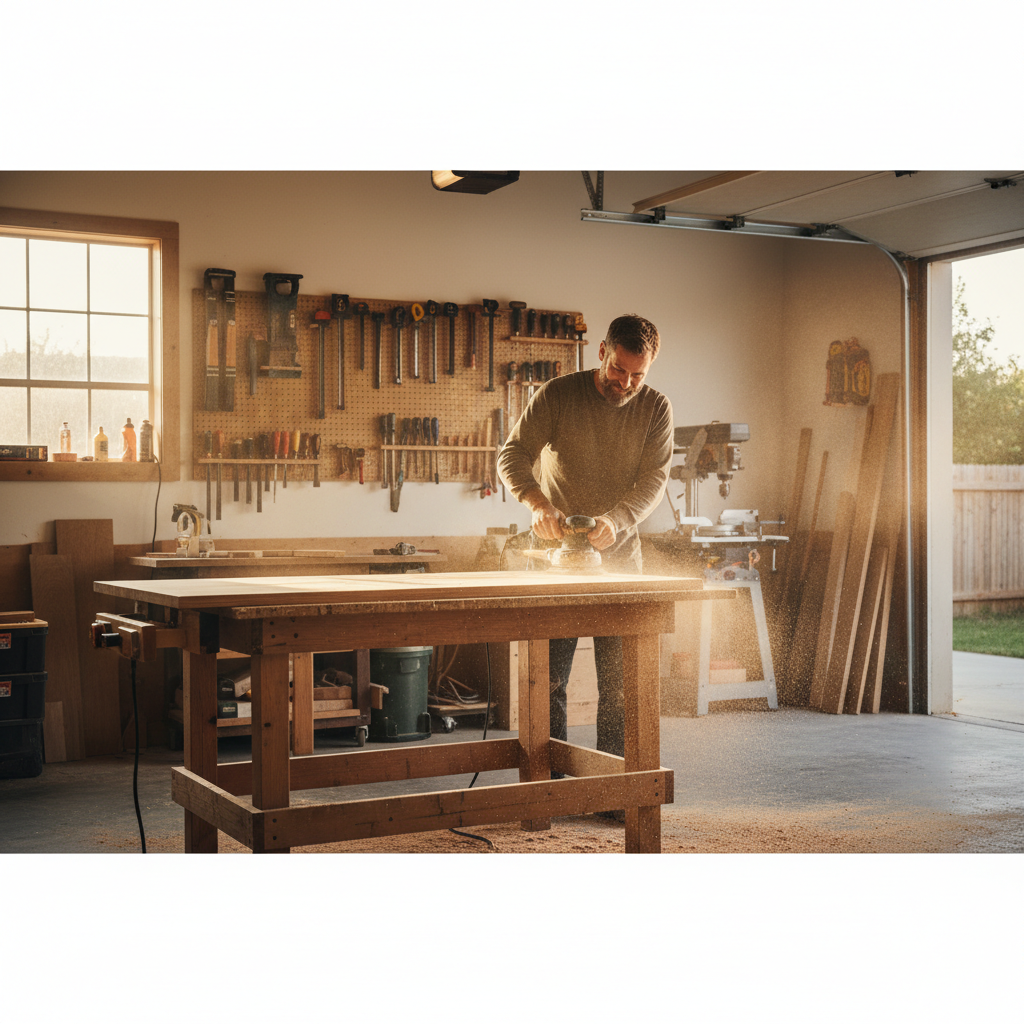
Hardware store staff will point you toward the sander aisle before they ask a single question about your project, and there is a reason for that: the answer is almost always the same tool. But almost is doing real work in that sentence. An orbital sander and a sheet sander are not interchangeable, and buying the wrong one for your first project does not just slow you down. It can leave you sanding the same board twice.
The core question here is not which sander is better in the abstract. It is which one fits how a beginner actually works: small batches of wood, irregular shapes, a need to reuse sandpaper across multiple projects, and zero interest in buying a second tool in six months. Those four variables point clearly in one direction for most new woodworkers, but the exception is real enough to cost you.
Here is the tension worth sitting with before you buy: the sander that handles the widest range of tasks uses a proprietary disc that costs more per sheet than standard sandpaper, and the sander that runs on cheap, universally available paper is slower and leaves a pattern in the wood that finish will expose. Neither problem is fatal. But one of them matters more depending on what you plan to build.
How Each Sander Actually Works
An orbital sander, specifically the random-orbital type sold at every major US retailer, moves its pad in two directions at once: it spins and oscillates simultaneously. That dual motion is why it leaves no visible scratch pattern in the wood grain. The abrasive marks cross each other at enough angles that stain and finish absorb evenly across the surface.
A sheet sander, sometimes called a finishing sander or a quarter-sheet sander, moves its rectangular pad in tight ellipses along a single axis. It cuts faster in one direction and leaves fine parallel lines in the wood. Those lines are invisible under paint. Under stain or clear finish, they catch light at certain angles and show. This is not a flaw in cheap sheet sanders. It is how the mechanism works, regardless of price.
Or rather: calling them scratch patterns understates what is happening. The marks are a record of the abrasive direction, and oil-based finishes in particular pull unevenly across directional scratches, producing blotchy color absorption on open-grained woods like oak and ash. On pine going under paint, you will never notice. On walnut going under Danish oil, you will sand the whole panel again.
The practical consequence: random-orbital sanders are the default finish-prep tool in US cabinet shops and furniture workshops for exactly this reason. Sheet sanders survive in the trade for two jobs where their rectangular pad earns its keep, which the comparison table below addresses directly.
The Real Comparison: Five Criteria That Matter to Beginners
Most comparisons online treat these two tools as close competitors. They are not, for beginners. The gap on one criterion alone, finish quality on stained wood, settles the primary question. But the four remaining criteria explain when that gap stops mattering.
| Criterion | Random Orbital Sander | Sheet Sander |
|---|---|---|
| Finish quality under stain or oil | Excellent: no visible scratch pattern | Poor to fair: directional marks visible |
| Sandpaper cost | Higher: proprietary 5-inch discs, roughly $0.50-$1.00 per disc at US retailers | Lower: standard sheets cut to quarter size, roughly $0.20-$0.40 per piece |
| Edge and corner reach | Limited: round pad cannot reach into corners | Good: rectangular pad reaches flush against edges |
| Dust collection | Very good: hook-and-loop discs align holes with pad ports | Fair: hole alignment depends on how you cut the sheet |
| Tool weight and fatigue | Moderate: 2-3 lbs typical for 5-inch models | Light: most quarter-sheet models under 2 lbs |
The finish-quality gap is decisive for any project where wood will be stained, oiled, or finished clear. The sandpaper-cost gap is real but small in absolute dollars on typical beginner project volumes. Where the sheet sander genuinely wins is corners: if you are building a bookcase with interior shelves that need sanding flush into the back corners, a round pad physically cannot do that job without hand-sanding to finish.
When the Sheet Sander Is the Right First Buy
If your first projects are painted furniture, trim work, or flat panels going under latex or chalk paint, the sheet sander is not a compromise. It is the right tool. Paint hides directional scratch patterns completely, so the random-orbital's main advantage disappears. And if you are prepping door casings or baseboard trim, the rectangular pad works with the wood instead of fighting the geometry.
There is also a budget argument worth naming honestly. A decent random-orbital sander costs $50-$80 at US hardware chains for a 5-inch model from brands like Ridgid or Dewalt. A comparable sheet sander runs $30-$50. That $20-$30 difference is real money for a beginner outfitting a workshop, and if 100 percent of your near-term projects involve paint, you are paying extra for a capability you will not use.
But here is what most beginners find out within a year: projects migrate toward stain and natural finishes as skill and confidence grow. I would start with the random-orbital for that reason, not because it wins every category, but because it stays relevant longer as your work gets more demanding. The sheet sander you might need later costs less anyway.
The reader this article is not for: someone building painted cabinetry at volume, or anyone whose shop already has a belt sander for heavy material removal and needs only a finish-prep tool for flat painted panels. That person should buy the sheet sander without hesitation.
What Beginners Get Wrong About Sandpaper and Grits
Sandpaper selection trips up beginners more than tool selection does. Start too coarse and you create scratches that need extra passes to remove. Start too fine and you close the wood grain prematurely, which reduces stain penetration on hardwoods. A practical sequence for most beginner furniture work: 80 grit to remove mill marks or old finish, 120 to smooth, 180 to prep for finish. Do not skip grits. Going from 80 to 180 in one step leaves 80-grit scratches under your finish coat.
For random-orbital sanders, the hook-and-loop disc system means you can swap grits in under ten seconds. That convenience matters more than it sounds when you are moving between pieces at different prep stages. Sheet sanders using cut standard paper require taping or clamping the sheet, which is slower and occasionally lets the paper slip mid-pass, leaving a drag mark.
Domain-specific note: PSA (pressure-sensitive adhesive) discs exist as an alternative to hook-and-loop on some orbital models, but beginners should avoid them. They are harder to remove without tearing, and repositioning a slightly misaligned disc destroys the adhesive layer. Hook-and-loop is the standard for good reason.
The Verdict and Where to Go From Here
Buy the random-orbital sander first. For a beginner in the US working across mixed projects, the finish quality on stained and oiled wood is not a marginal improvement. It is the difference between a surface you are proud of and one you explain away. A 5-inch random-orbital from a mid-range brand, budgeted between $50 and $80, covers furniture prep, refinishing projects, and flat panel work without leaving you at a dead end when your projects get more refined.
If every project on your list for the next twelve months will be painted, reconsider. The sheet sander saves money upfront and does the job cleanly. But if there is any stain or natural finish in your near-term plans, the random-orbital pays for the extra cost the first time you open a can of Minwax.
Skip the belt sander for now. It removes material fast but demands control beginners rarely have, and it will eat through an edge before you realize the pass was too slow. Add it when your projects require serious stock removal, not before.