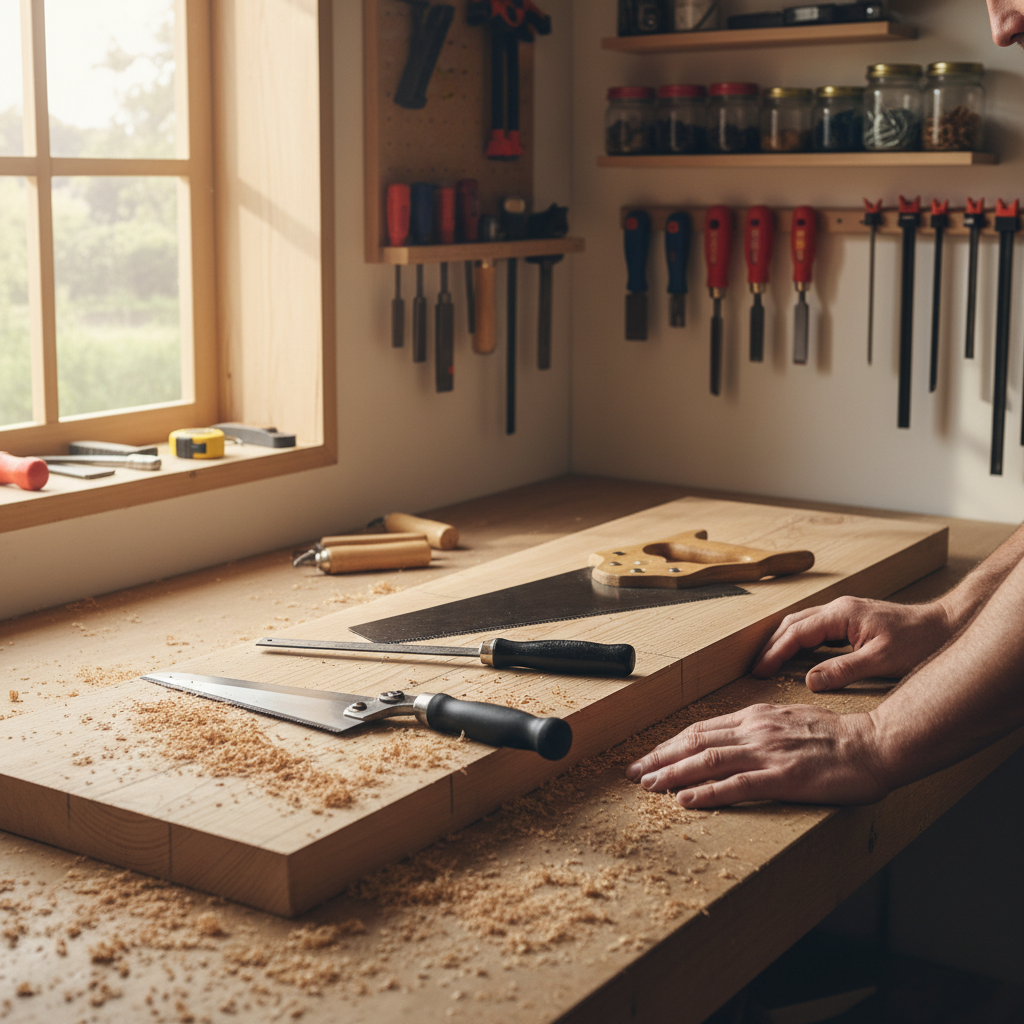
Woodworkers will tell you the first tool purchase reveals something about how you plan to learn, and there's a reason for that. The debate between Japanese pull saws and Western handsaws comes up constantly in beginner forums, hardware stores, and YouTube comment sections, and the answer isn't as simple as picking whichever looks cooler on the shelf.
Both saws cut wood. Both cost roughly the same entry-level money. What separates them is the cutting stroke, the tooth geometry, and, more practically, what kind of mistakes each one lets you make and recover from. Get that wrong and you'll fight your saw on every joint.
The tension in this choice is real: the saw that feels easier to start with isn't always the saw that teaches you better technique, and for beginners those two things frequently pull in opposite directions. That gap doesn't resolve itself just by buying the more expensive option.
This article won't cover powered alternatives or Japanese ryoba saws used for professional joinery work. The focus is squarely on the beginning woodworker in the US deciding between these two hand tool categories for general bench work and basic joinery.
How the Cutting Stroke Changes Everything
The most fundamental difference between these two saw types isn't price or brand. It's the direction of the power stroke. Western handsaws cut on the push stroke. Japanese pull saws cut on the pull stroke.
That single mechanical fact cascades into almost every other difference you'll notice. On a push stroke, the blade must be stiff enough to resist buckling under compression. Western saw blades are therefore thicker, typically around 0.040 to 0.050 inches, which means the kerf (the slot the blade cuts) is wider and removes more material. On a pull stroke, the blade is held in tension, so it can be much thinner, often around 0.020 inches, producing a narrower kerf and a finer cut surface.
Or rather: it's not just that the kerf is narrower. A thinner blade under tension also tracks more precisely because there's less blade mass deflecting under load. That tracking precision is why Japanese pull saws produce cleaner crosscuts on hardwoods with noticeably less effort once you've got the stroke down.
The catch for beginners is starting the cut. A pull saw wants to bite immediately on the first stroke. That's great when you're experienced, but when you're learning to position a cut, that instant aggression can yank the blade off your pencil line before you've established a groove. A Western saw's push stroke lets you drag the teeth backward lightly to score a starting notch, which is a forgiving technique that beginners rely on constantly. Check your comfort level with starting cuts before you commit either way.
Tooth Geometry and What It Means for Your Projects
Tooth geometry is where the two saw families diverge most sharply in practical terms.
Western handsaws come in two primary configurations: rip cut (teeth filed to cut along the grain, like a chisel) and crosscut (teeth filed at an angle to slice across fibers). Many beginner-oriented Western saws are combination patterns that do both adequately but neither excellently. The teeth are larger, more visible, and easier to resharpen with a standard triangular file, which matters if you're planning to maintain your own tools over years of use.
Japanese pull saws use impulse-hardened teeth, a heat-treatment process that makes the teeth significantly harder than the steel in the blade body. The hardness means they stay sharp much longer under normal use. But impulse-hardened teeth can't be resharpened with a file. When they dull, you replace the blade. Replacement blades for common Japanese saws like the Suizan or Gyokucho typically run $15 to $25, so it's not expensive, but it is a recurring cost and a different relationship with your tools than Western saw ownership.
The practical consequence: if you're doing mostly crosscuts on dimensional lumber and sheet goods, a Japanese pull saw's crosscut teeth will produce a cleaner surface faster. If you're doing mixed work including ripping along the grain or cutting green wood, a Western saw with separate rip and crosscut configurations, or a quality combination saw, gives you more flexibility without blade swapping.
The Beginner's Real Decision: Control vs. Efficiency
Buyers skip over this distinction until they're burned by it. The question isn't which saw is objectively better. It's which saw matches where your skills are right now and where you want them to go.
A Western handsaw rewards deliberate, controlled pushing. The thicker blade is more forgiving of slight wrist wobble because it resists deflection through mass. You feel the resistance when you're cutting off-line, which is feedback, not failure. Many traditional woodworking instructors, including the faculty at the North Bennet Street School in Boston and instructors associated with the Fine Woodworking network, start beginners on Western saws precisely because the physical feedback loop is slower and more recoverable.
A Japanese pull saw rewards economy of motion and a light grip. The thin blade under tension will telegraph every excess pressure point straight into a wandering cut. That's not a flaw; it's accuracy demanding respect. Once you've internalized a light, consistent pull, you'll cut faster and cleaner than you would with a Western saw of equivalent price. I'd start most beginners on a Japanese pull saw if and only if they're willing to practice ten or fifteen slow strokes on scrap pine before touching project wood.
The reframe that actually matters: choosing a saw isn't about which tool is easier to use cold, it's about which learning curve produces the hand skills you'll carry forward into every other hand tool you pick up. A beginner who learns to control a pull saw develops grip sensitivity that transfers directly to chisels, hand planes, and marking knives. That's a compounding skill investment, not just a saw preference.
If you skip this choice and just grab whatever is cheapest at the hardware store, you'll likely get a low-quality Western saw with imprecise tooth set that makes every cut feel like a fight. The problem won't be the Western saw category. It'll be a $12 saw that belongs in a demolition kit, not a woodworking bench.
When Each Saw Fails You
Every recommendation has a boundary. Here's where each type stops serving you well.
Japanese pull saws struggle with thick, wet, or green lumber. The thin blade can bind aggressively in wood with high moisture content because the kerf closes behind the blade as the wood fibers spring back. If you're working with green wood, reclaimed lumber, or anything above roughly 19 percent moisture content, a Western saw's wider kerf and stiffer blade handles those conditions much more reliably. A pull saw binding in a green 2x4 mid-stroke is a frustrating experience that unfairly poisons people on an otherwise excellent tool.
Western handsaws at the beginner price point (under $40) frequently have poorly set teeth that drift to one side, making straight cuts genuinely difficult without consistent, deliberate correction. A bad Western saw is harder to use than a good pull saw, full stop. If budget means you're comparing a $35 Western saw against a $30 Japanese pull saw from a reputable brand, the pull saw wins on consistent performance.
And if you ignore this comparison entirely and rely on a jigsaw or circular saw for rough cuts, expecting to skip hand saw skills? You'll hit a wall the moment you need a precise, controlled cut in an assembled piece, a situation every furniture project eventually creates. Hand saw control is not optional knowledge. It compounds.
Which One Should You Actually Buy?
For most beginning woodworkers in the US doing indoor bench work with kiln-dried dimensional lumber, a Japanese pull saw is the stronger starting choice. The Suizan 9.5-inch pull saw runs around $28 to $35 and consistently outperforms Western saws in its price class on crosscut quality. The Gyokucho 372 is a comparable alternative at a similar price.
Buy a Western handsaw first if any of these apply: you're working with green or reclaimed wood regularly, you want to learn to sharpen your own tools from the start (impulse-hardened teeth make that impossible), or you have a grip strength limitation that makes the light-touch pull stroke technique difficult to sustain. A Stanley FatMax or a Spear & Jackson crosscut saw in the $25 to $45 range are solid Western options that won't fight you the way budget no-name saws do.
Check three things before you buy: the tooth count (higher TPI for fine joinery, lower TPI for faster rough cuts), whether replacement blades are available for Japanese saws you're considering, and whether the handle fits your hand without strain across a ten-minute session.
So: pull saw for clean indoor work, Western saw for green wood and self-sharpening ambitions. Both categories have genuinely good options under $40. You don't need to spend more than that to start building real hand tool skills.