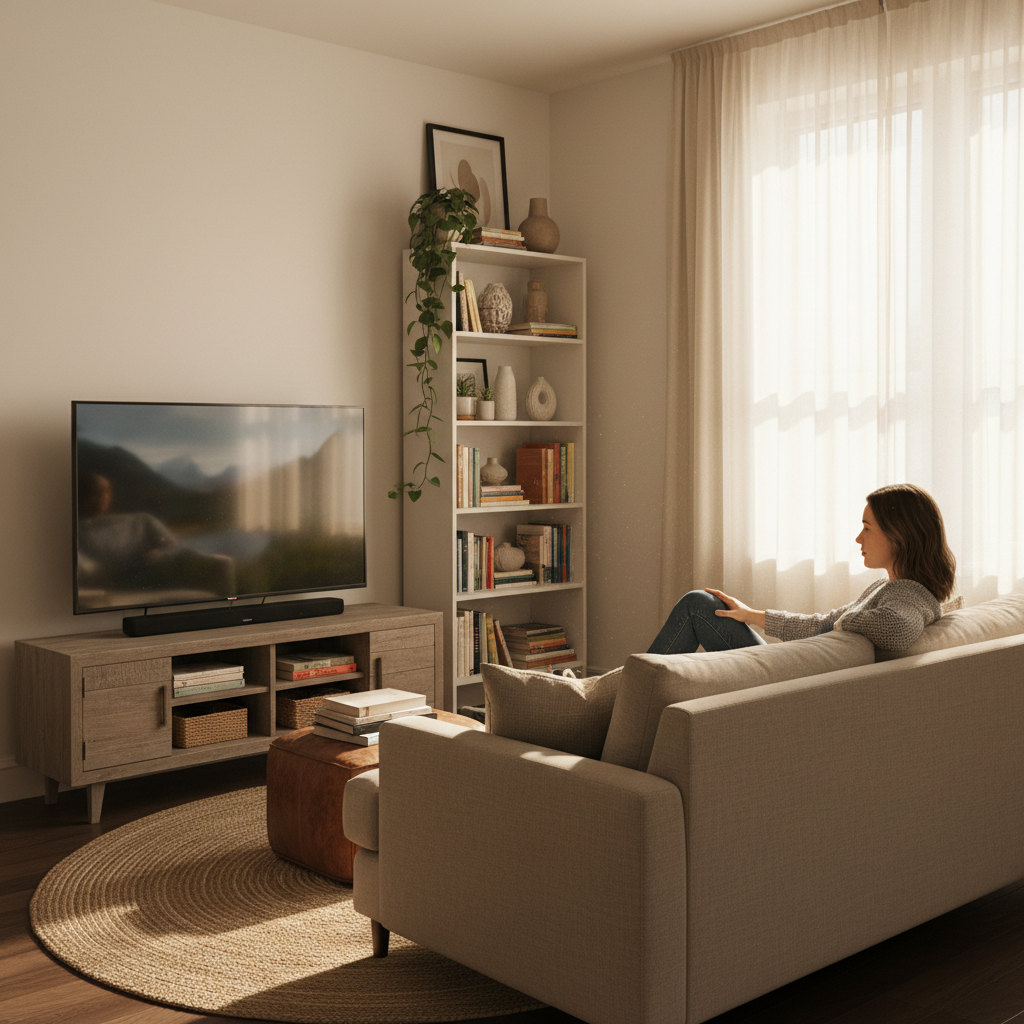
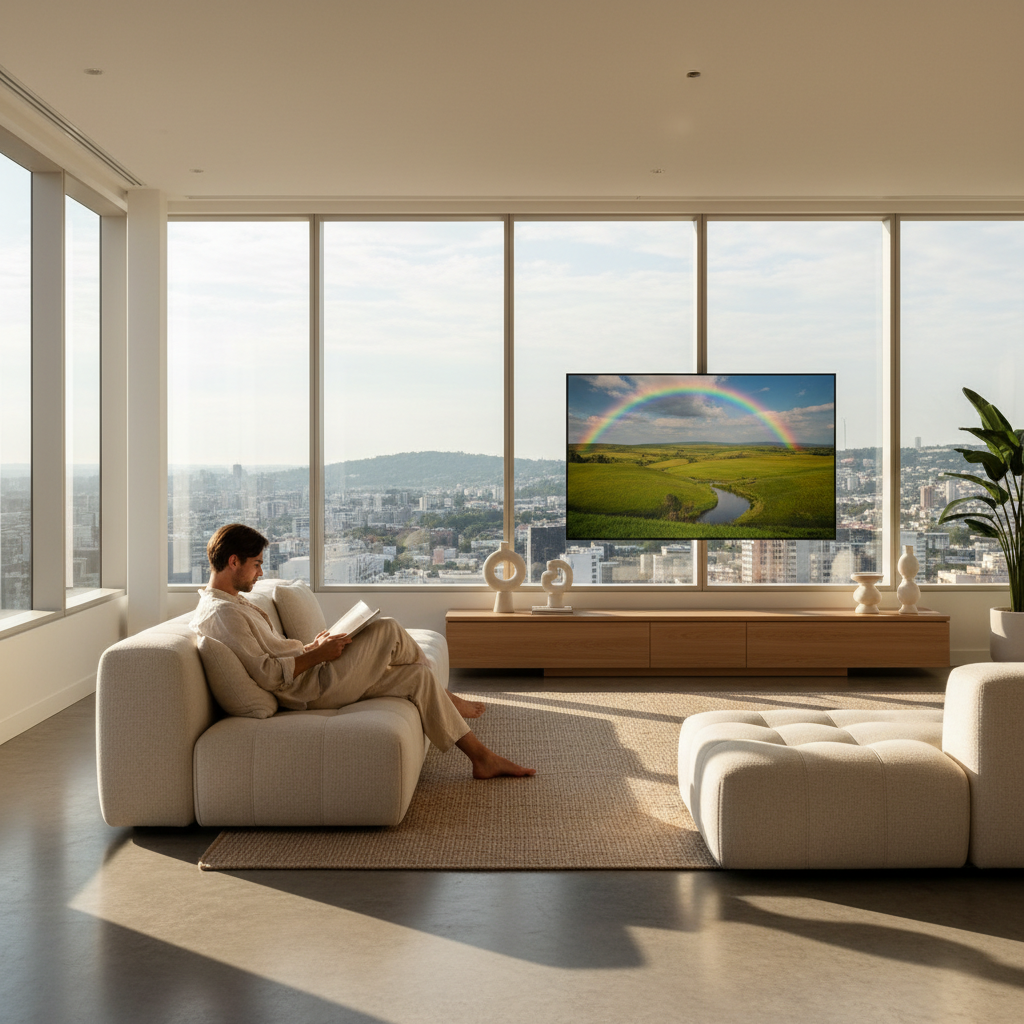
Display engineers will tell you peak brightness is the first spec to check before anything else on a TV, and there's a reason for that. A set that looks gorgeous in a dim showroom can wash out completely in a living room with south-facing windows, and no amount of local dimming rescues a panel that simply can't outrun ambient light.
Buying a TV for a bright room is genuinely different from buying a TV for a home theater. The variables that matter shift: peak nit output, panel reflectance, and the coating on the glass surface matter more than contrast ratio or deep black performance. Get those wrong and you're fighting your own windows every evening.
There's a tension here worth naming early. The best-contrast panels on the market right now, OLED displays, are also among the most vulnerable to glare in high-ambient-light environments. That creates a real decision conflict for buyers who want picture quality but live in a bright space. This guide won't pretend those two goals are always compatible.
Peak Brightness: The Number That Actually Matters
A TV's peak brightness, measured in nits, determines whether the picture holds up when sunlight is competing with it. For a moderately bright room, a panel capable of at least 400 to 500 nits of sustained brightness (not just a brief HDR peak) keeps the image readable. In a room with direct sunlight or large south- or west-facing windows, 1,000 nits of sustained output is the more practical floor.
The distinction between peak and sustained nits matters more than most buyers realize. Manufacturers typically advertise peak HDR brightness, which is a brief output on a small percentage of the screen. Sustained brightness, sometimes called full-screen brightness or APL brightness, is what the TV actually delivers across a typical image. A set advertising 2,000-nit peak may sustain only 400 to 600 nits at typical content levels. RTings.com, which publishes independent panel measurements, breaks these out separately in their TV reviews and is the most reliable public source for comparing real-world brightness figures rather than spec-sheet claims.
Or rather: the useful number isn't peak nits at all. It's sustained nits at 50% APL (average picture level), which is closer to what most content actually demands from the panel. When you're comparing models, look specifically for that figure.
Skipping this step costs you in a predictable way. A TV purchased on spec-sheet nit counts alone will frequently disappoint in a bright room because the advertised number was never achievable at normal viewing. You'll turn the backlight to maximum within a week, which accelerates LED degradation and raises your electricity draw for no picture benefit you couldn't have had at a lower price point.
Panel Type: QLED and Mini-LED Lead, OLED Struggles
For bright rooms, QLED and mini-LED LCD panels are the practical choice for most buyers. They deliver the sustained brightness that direct sunlight demands, and the best models from Samsung, TCL, and Hisense have pushed full-screen brightness well above 800 nits in independent testing. OLED panels, by contrast, typically sustain 150 to 250 nits at full-screen brightness, a level that washes out badly in direct sunlight.
That said, not all QLEDs are equal. Entry-level QLED sets use edge-lit backlights, which limits both brightness uniformity and local dimming precision. If you're spending serious money on a bright-room TV, look for full-array local dimming (FALD) with a high zone count. A FALD panel with 500-plus local dimming zones holds specular highlights in HDR content far better than an edge-lit set at the same nominal nit rating.
Here's a comparison of the main panel types against the criteria that matter most in bright rooms:
| Panel Type | Sustained Brightness | Glare Handling | HDR in Daylight | Best For |
|---|---|---|---|---|
| QLED (FALD) | High (600 - 1,200+ nits) | Good with matte coating | Strong | Bright living rooms, direct sun |
| Mini-LED LCD | Very High (800 - 2,000+ nits) | Good with matte coating | Excellent | Brighter rooms, dedicated bright spaces |
| OLED (W-OLED/QD-OLED) | Low - Medium (150 - 600 nits sustained) | Poor; glass panel amplifies glare | Weak in direct light | Dim or controlled-light rooms only |
| Standard LCD (edge-lit) | Medium (300 - 500 nits) | Moderate | Limited | Budget pick, indirect light rooms |
QD-OLED panels, which Samsung and Sony now use in their upper-tier sets, push OLED sustained brightness meaningfully higher than traditional W-OLED. A 65-inch Sony Bravia Theater QD-OLED measured above 700 nits at 50% APL in RTings.com's 2024 testing, which narrows the gap with QLED significantly. That doesn't make them the right pick for a room with direct afternoon sun, but it does change the calculus for rooms with indirect brightness.
The most common mistake buyers make is choosing OLED because they've read it has the best picture quality, without accounting for their room's actual light levels. OLED's picture quality advantage, specifically its perfect blacks and per-pixel control, is largely invisible in a bright room. You're paying a premium for a capability the environment won't let you use.
Screen Coating: Matte vs. Semi-Gloss vs. Glossy
Nit output gets most of the attention, but screen coating is just as consequential in a bright-room setup. A matte or haze-finish coating scatters reflected light across a wider angle, which reduces the intensity of any single reflection point. A glossy panel reflects a focused, mirror-sharp image of whatever light source is behind you, and there's no backlight bright enough to fully overcome that at typical viewing distances.
Most QLED and LCD panels ship with matte or light-haze coatings by default. OLED panels, including most LG and Samsung OLED models, use glossy or semi-gloss finishes that prioritize color vibrancy in controlled light but perform poorly against windows and overhead lighting. This is not a minor aesthetic preference. In side-by-side testing in real bright-room conditions, matte-coated panels with lower nit ratings have outperformed glossy OLED panels with higher ratings purely because reflections on the glossy panel obscured so much of the image.
If you're shopping in-store, ask a sales associate to turn off the showroom's overhead lighting aimed at the display section and observe the reflection pattern. Better yet, hold your phone's flashlight a few feet from each screen at a 45-degree angle and watch where the reflection goes. A matte coating diffuses it into a soft bloom; a glossy coating throws back a clear, sharp point of light. That point of light is what your window or lamp will look like in your living room.
This article isn't covering projectors or specialized ambient-light-rejecting (ALR) screens, which solve the problem differently and at a different price tier. If your room has truly uncontrollable direct light and you're flexible on format, ALR projection setups deserve their own evaluation.
Viewing Angle and Room Layout
Bright rooms are often living rooms and open-plan spaces, which means off-axis viewing is common. Panel type affects this directly. VA (vertical alignment) LCD panels produce deep blacks and high contrast but lose color accuracy and brightness sharply past about 20 to 25 degrees off-center. IPS and ADS LCD panels maintain better off-axis consistency but typically sacrifice some peak contrast. QLED sets vary: some use VA-based panels (Samsung's S-series), others IPS-adjacent structures.
The practical test: if your seating arrangement puts anyone more than roughly 30 degrees off the TV's center axis, a VA-based QLED is a meaningful trade-off. IPS-based or ADS-based alternatives from LG (their NanoCell and QNED lines) or TCL (C-series with ADS panels) hold color better at wide angles, though they generally don't match VA-based sets in peak brightness or contrast. OLED panels have the widest color-stable viewing angles of any current technology, which is one legitimate argument for them even in bright rooms where off-axis seating is a bigger problem than direct sunlight.
I'd start with room geometry before choosing panel tech. Sketch where every seat falls relative to the TV wall, measure the extreme angle, and then filter your options. That 10 minutes eliminates a category or confirms your flexibility before you've spent a dollar.
When the Bright-Room Recommendation Breaks Down
Everything above favors QLED and mini-LED for bright rooms. But if your primary viewing happens after dark, or if your bright room has controllable light (blackout shades, overhead dimmers), the recommendation changes substantially. An OLED or QD-OLED set will deliver noticeably better picture quality in dim viewing conditions, and if that's when you actually watch movies or play games, you'd be accepting a meaningful picture quality penalty to optimize for daytime casual use.
Buyers who watch in mixed conditions, some daytime ambient, most viewing in the evening with lights dimmed, should consider a QD-OLED with a matte screen protector overlay as a genuine option. Third-party matte overlays (Photodon and Vikuiti are the most commonly cited brands in display forums) reduce OLED glare substantially, though they add mild haze to the image. That trade-off is worth evaluating in person if possible.
There's also a household size variable. A TV in a room used by multiple people simultaneously, with different seating positions, weights wide-angle performance more heavily than a TV watched by one or two people from a consistent position. The right panel type genuinely differs between those scenarios.
Making the Call: What to Check Before You Buy
Before settling on a model, run through these four checks: note your room's brightest daytime condition (direct sun or indirect ambient), measure the angle from your farthest seat to the TV wall, confirm whether your primary viewing is daytime or evening, and look up the specific model's 50% APL sustained brightness on RTings.com rather than trusting the spec sheet.
For direct-sun bright rooms with conventional seating, a mini-LED or FALD QLED with a matte coating and at least 600 sustained nits at 50% APL is the reliable answer. For rooms with indirect ambient light and wide seating arrangements, a QD-OLED with a matte overlay becomes a reasonable contender.
Screen size compounds everything. At 75 inches, a mediocre bright-room TV is a mediocre bright-room TV scaled up. Don't assume larger panels will look better just because they're bigger; the same glare and brightness limitations apply, just across more glass.
The reframe that clarifies the whole decision: buying a TV for a bright room is fundamentally a problem of managing reflected light, not just generating more of it. A set that controls reflections at 600 nits will beat a set that ignores them at 1,500 nits in most real living rooms. That shift in framing, from brightness race to reflection management, points you toward the right specs from the start.
The Bottom Line
If you have a bright room and haven't mapped its light conditions before shopping, do that first. Then pull up RTings.com, filter by sustained brightness at 50% APL, and note the screen coating type before you look at anything else. A mini-LED or FALD QLED with a matte finish and 600-plus sustained nits handles the majority of bright-room situations. OLED is a better choice for dim rooms, full stop, and the QD-OLED middle ground is worth considering only if your light is controllable or your seating geometry demands wide angles.
Skip the spec sheet nit race. The showroom will lie to you. And if you measure nothing else, measure the angle from your couch to the center of the screen: that single number rules out half the panels on the market for your specific room before you've compared a single price.