
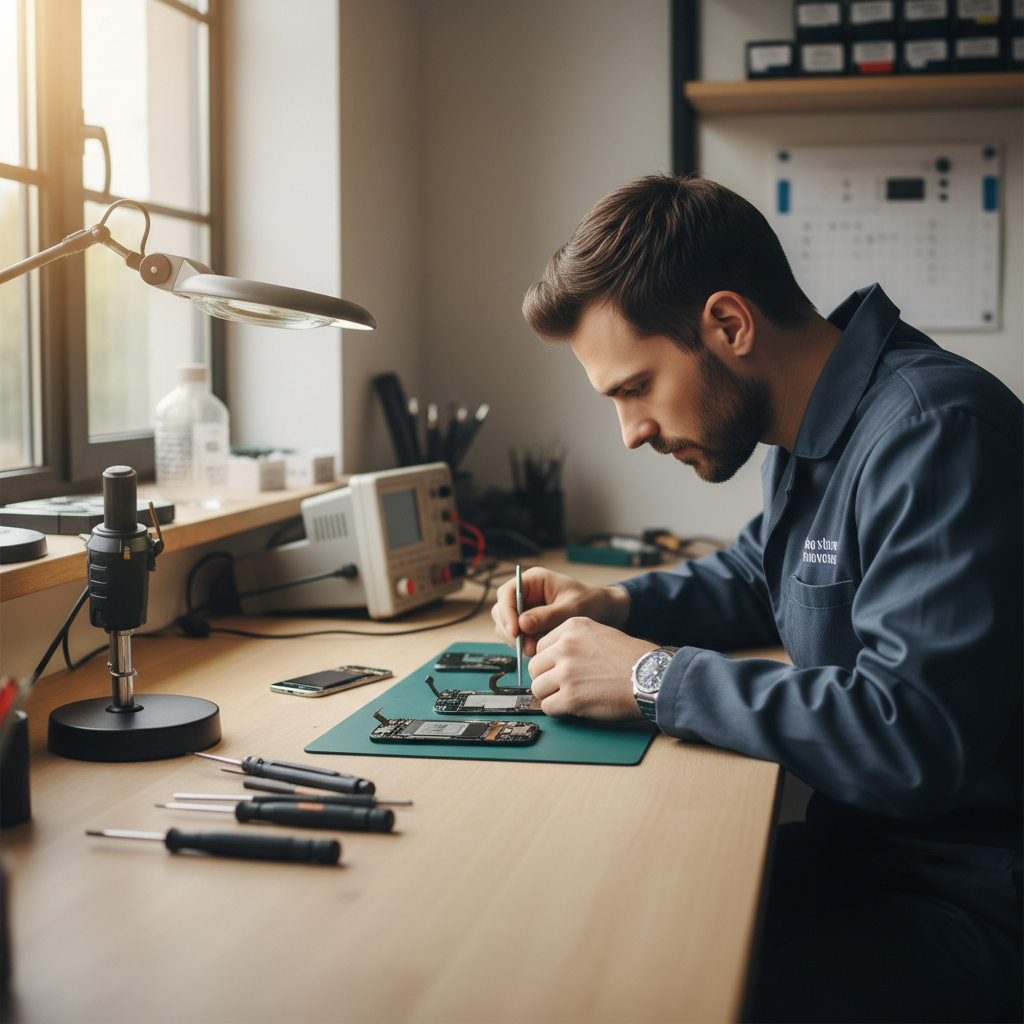
A repair technician will tell you the device's remaining useful life before quoting a screen price, and there's a reason they ask first. The cost of fixing a cracked phone screen can run anywhere from $30 at an independent shop to over $300 at an authorized service center for a flagship model, and that number only makes sense when you hold it against what the phone is actually worth and how much longer it will serve you.
Three variables drive the decision: the repair-to-value ratio, how close the device is to software obsolescence, and whether the damage is truly limited to the screen. Miss any one of them and you'll either overpay to extend a dying phone's life or discard a device that had two solid years left in it.
Here's the tension that catches people off-guard: a screen that looks like a cosmetic problem sometimes isn't. Cracked glass can mask digitizer failure, proximity sensor drift, or frame stress that affects battery seating. You may pay for a screen and discover the underlying problem doesn't go away.
The Repair-to-Value Ratio: The Number That Settles Most Cases
The most useful decision rule in this space is the repair-to-value ratio, and it works like this: divide the out-of-pocket repair cost by the phone's current resale value. A common guideline among repair professionals is that a ratio above 50 percent tilts strongly toward replacement. Below 30 percent, repair is almost always worth it. The middle range, 30 to 50 percent, is where the other factors below do real work. This is a practical heuristic, not an industry standard, but it maps to how most consumers make rational purchasing decisions.
To apply it, you need two numbers. For resale value, check listings on Swappa or eBay's completed sales for your exact model and storage tier in your condition. Don't use trade-in estimates from a carrier; those are discounted by 30 to 40 percent compared to private-market resale because the carrier absorbs the resale risk. For repair cost, get at least two quotes: one from an authorized service provider (Apple, Samsung, or Google's own programs) and one from a reputable independent shop. The gap between them is often $80 to $150 on the same job.
Or rather: the ratio is a filter, not a verdict. A phone at 45 percent still warrants a closer look at software support and secondary damage before you commit.
What you'll notice when you compare actual quotes is that authorized repairs carry a warranty on the replacement part, typically 90 days to one year, while independent shops vary widely. That warranty has real value if the digitizer fails again three months later.
Software Support: The Factor Most People Skip Until It Burns Them
A phone that won't receive OS updates is a phone with a shrinking security perimeter and an accelerating app compatibility problem. Apple currently supports iPhones for roughly six years from launch; Android OEMs vary significantly, but Google's Pixel line now promises seven years of OS updates, while many mid-range Android devices from other manufacturers stop at three to four years.
If your device is within one to two years of its end-of-support date, paying $200 to repair a screen on a phone that won't receive security patches in 18 months is a poor trade. You're spending money to delay an inevitable purchase while running on an increasingly exposed platform. Banks and payment apps have begun flagging outdated OS versions; some enforce minimum version requirements that can lock you out of mobile banking entirely.
Check your model's expected support end date before approving any repair quote. For iPhones, Apple's own support pages show which models still receive the current iOS. For Android, the OEM's product page or the Android security bulletin will tell you how far your device is covered. If you're within 18 months of that cutoff, replacement almost always wins unless the repair cost is trivially low, under $80 or so.
But software support isn't the whole picture for every user. If you use the phone primarily for calls, texts, and navigation on a secured home network, the security calculus is different from someone running banking apps and work email on public Wi-Fi. Know which category you're in.
What the Damage Actually Is: Screen vs. Everything Else
This is where most repair decisions get made too quickly. A cracked outer glass panel on a modern smartphone is rarely just glass. The display assembly on OLED-equipped phones, which covers most flagships since roughly 2017, bonds the glass, the OLED panel, and the digitizer into a single laminated unit. Replacing the glass alone isn't possible without specialized equipment; the shop is replacing the entire assembly.
Ask the technician directly: is this a glass-only repair or a full OLED assembly replacement? The answer changes the price by $60 to $120 on mid-range phones and more on flagships. It also changes the failure risk. Full assembly replacements on iPhones 12 and newer require recalibration of Face ID components; unauthorized parts that skip this step can degrade face unlock performance. Apple's Independent Repair Provider program and its Self Repair program address this through parts pairing, but it's a real friction point at off-brand shops.
Secondary damage is the other trap. Drop damage that cracks a screen often also stresses the frame and battery. A bent chassis can cause the battery to swell over the following months even if the repair looks fine on day one. Ask the technician to inspect the frame straightness and battery health reading before quoting. If battery health is already below 80 percent (the figure Apple itself uses as a service threshold), factor in the battery replacement cost too. Paying $180 for a screen and then $89 for a battery six weeks later was a $269 decision that probably should have been a replacement.
When Replacement Is the Straightforward Answer
Replacement wins outright under four conditions: repair cost exceeds 50 percent of resale value, the device is at or past its software support end date, secondary damage beyond the screen is confirmed, or the phone is three or more generations behind current flagship performance for a user who relies on the camera or processor-intensive apps.
It also wins when you weren't satisfied with the phone before it broke. People sometimes talk themselves into a repair on a device they were already planning to replace. If you had the phone on a mental shortlist for an upgrade in the next six months, a cracked screen is the exit ramp, not a reason to spend $150 staying on the highway.
The realistic alternative here isn't always a brand-new phone. Certified pre-owned devices from manufacturers' own refurbishment programs, Apple Certified Refurbished and Samsung Certified Re-Newed being the two most structured in the US, offer one-year warranties on devices that are one to two generations old at prices that often undercut even a major screen repair on a flagship. A Certified Refurbished iPhone 14 can be found in the $400 to $500 range; a screen repair on an iPhone 14 Pro at Apple costs $279. That math deserves a clear look before you book the repair.
If you skip this comparison entirely and just hand the cracked phone to a repair shop without checking CPO pricing, you may spend $250 to keep a phone you could have upgraded from for $150 more.
When Repair Is the Right Call
Repair wins when the phone is less than three years old, the repair-to-value ratio is under 40 percent, software support extends at least two more years, and the damage is confirmed to be limited to the display assembly with no frame or battery compromise.
It also wins in a specific scenario that often gets overlooked: when the user has a well-configured device they don't want to migrate. Restoring apps, authenticator settings, and accessibility configurations to a new device takes real time and occasionally loses data in edge cases. For someone with a tightly configured work setup, the repair is buying continuity, not just hardware.
Independent repair shops are worth considering seriously here. The FTC's 2021 report on right-to-repair noted the anti-competitive effects of manufacturer repair restrictions, and subsequent policy movement has pushed Apple and others to expand access to genuine parts and repair manuals. iFixit, which publishes repairability scores and sells OEM-sourced components, is a credible resource for vetting a local shop's parts sourcing. A shop using genuine or OEM-equivalent parts and offering at least a 90-day warranty on labor and components is a reasonable baseline.
I'd start with the ratio calculation before calling any shop. Know your number before the conversation starts, or the quote anchors your thinking instead of the math.
The Conditions Where Repair Fails Anyway
There's a category of phone where repair is technically viable but practically a bad idea: devices that have been repaired before, particularly phones with a history of water exposure, prior battery swaps, or a third-party screen already installed. Each intervention introduces tolerance variation into a precision assembly. A second screen replacement on a phone that's already had one non-OEM repair has a meaningfully higher failure rate, partly from cumulative frame stress and partly from adhesive reseating quality.
Repair also fails as a strategy for users who are hard on hardware. If you've cracked two screens in 18 months, the repair is buying you a few months before the cycle repeats. A ruggedized case or a more physically durable device (the standard Motorola G-series has a strong track record here) addresses the root cause instead of the symptom.
And repair provides almost no value if you're planning to trade in or sell within six months. Resale buyers discount non-OEM repairs; carrier trade-in programs often reject devices with third-party screen replacements entirely. A repair that cost $150 may add $40 in resale value. The numbers rarely work out in your favor when the exit is that close.
Making the Call
If the repair-to-value ratio is under 40 percent, software support runs at least two more years, and a technician confirms no secondary damage, book the repair. Use an authorized service provider or an independent shop with OEM-sourced parts and a documented warranty.
If the ratio is above 50 percent, the device is within 18 months of end-of-support, or secondary damage exists, price out Certified Refurbished options from the manufacturer before committing to anything. The gap between repair cost and a CPO upgrade is often smaller than it looks at first.
For the middle range, 40 to 50 percent ratio with a device that still has two-plus years of support and clean secondary inspection, the decision tips on how much you valued the phone before it broke. An honest answer to that question is worth more than another hour of research.
Get two repair quotes regardless. The spread between an authorized center and a reputable independent shop on the same job is almost always worth the extra 20 minutes.