
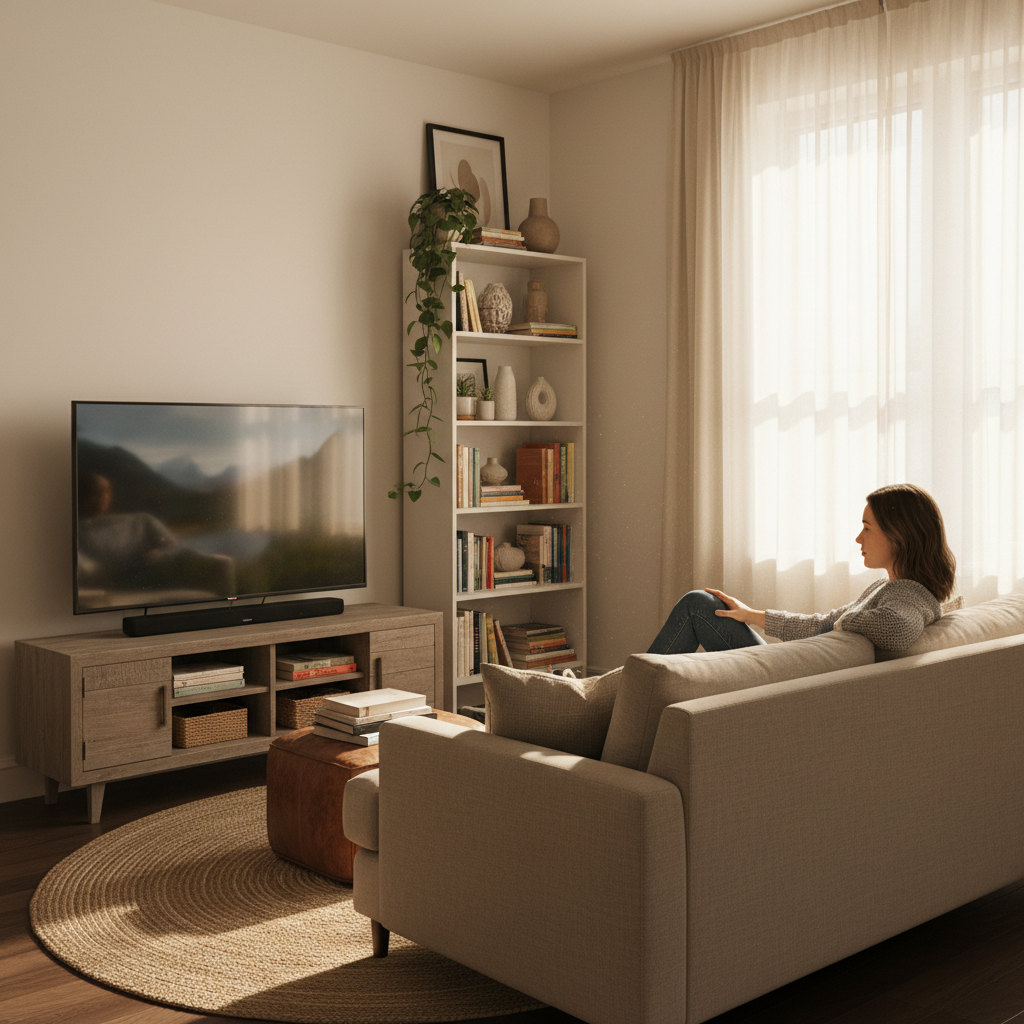
Audio installers will tell you room volume before they mention watts or channels, and there's a reason for that. A small living room doesn't just limit how loud you can go; it changes the physics of how sound behaves entirely. Reflections off walls arrive so quickly that a full surround system can fold in on itself, turning discrete rear channels into a blurry wash of reverb instead of the precise soundstage you paid for.
The question of soundbar vs. home theater system turns on a few specific variables: your room's square footage, whether you own or rent, and how far you sit from the screen. None of those are decorative considerations. Change any one of them and the right answer can flip.
Here's the tension most buyers don't see until after they've bought: the feature set that makes a home theater system impressive in a larger room is exactly what makes it disruptive in a smaller one. More speakers mean more acoustic energy in a tighter space, and tighter spaces are less forgiving of placement errors. That conflict is real, and it doesn't resolve itself by turning the volume down.
What Small Actually Means for Sound
In acoustic terms, a small living room is typically under 200 square feet, though rooms up to around 250 square feet with low ceilings behave similarly. Below that threshold, the distance between your listening position and any rear surround speaker shrinks to the point where the time-delay processing built into Dolby Atmos and DTS:X starts working against you rather than for you. Those formats were calibrated assuming rear speakers are at least six feet behind the listener; in many small rooms, that gap is three feet or less.
Put more precisely: it's not just about total area, it's about the ratio of speaker placement distance to room dimensions. A room that's 12 by 16 feet (192 sq ft) with speakers crammed into corners will produce more comb filtering and bass buildup than the same area with smart placement. The room shape matters as much as the number.
Renters face an additional constraint that homeowners often overlook. Running speaker wire along baseboards or through walls requires permission in most lease agreements, and wireless rear speakers (common in higher-end soundbar systems like the Sony HT-A9 or the Sonos Era 300 setup) add $150 to $300 to an already stretched budget. Budget for the full system, not just the receiver.
Bass buildup is the practical enemy in small rooms. A subwoofer powerful enough to do justice to a 5.1 system in a 300-square-foot room will almost certainly overwhelm a 150-square-foot one. The low frequencies stack up in room corners and along walls, creating a phenomenon called room modes that makes bass notes sound boomy and uneven rather than tight and controlled. A soundbar with a smaller, tuned subwoofer handles this more gracefully because it was designed with constrained environments in mind.
What a Soundbar Actually Does Well
The honest case for a soundbar isn't that it sounds as good as a properly set up 5.1 system. It doesn't. The case is that it sounds better than a poorly set up 5.1 system in a room that can't support one, which describes a surprising number of small living rooms in American apartments and townhouses.
A good three-channel soundbar (left, center, right) handles the most critical audio task in any home setup: dialogue intelligibility. The center channel carries roughly 70 percent of a film's mix, and getting that channel right matters more to most viewers than having discrete rear effects. Soundbars optimize for this. A home theater system's center channel speaker, sitting below your TV and competing with the room's acoustics, can actually perform worse in a small space if the room isn't treated.
The Sonos Arc, Bose Smart Soundbar 900, and Samsung HW-Q990C represent the current top tier of soundbars in the US market, ranging from around $699 to $1,299. Each uses psychoacoustic processing to create an impression of surround width from a single bar. It's not the same as true surround, but in a room under 180 square feet, the difference is smaller than you'd expect, and the absence of cables and speaker stands matters more than the spec sheet suggests.
That understates it. For renters in particular, a soundbar isn't a compromise; it's often the only practical option. A fully wired 5.1 system requires five speaker placements that may not exist in a studio apartment, plus a receiver that generates significant heat and needs ventilation. The practical footprint of a home theater system is much larger than its component list implies.
When a Home Theater System Still Wins
A component home theater system earns its place in a small room when three conditions align: you own the space, the room is closer to 220 to 250 square feet than 120 to 150, and you're willing to do acoustic treatment. Without all three, the investment often underperforms relative to a premium soundbar at half the price.
The table below compares both options against the criteria that actually matter in a small US living room.
| Criteria | Soundbar (Premium) | 5.1 Home Theater System (Entry-Mid) |
|---|---|---|
| Typical cost (US) | $400 to $1,300 | $600 to $2,000 (system) |
| Installation complexity | Low (1 cable + power) | High (wiring, calibration) |
| Small-room bass control | Better (tuned sub) | Variable (room-dependent) |
| Dialogue clarity | Strong (optimized) | Strong (if calibrated) |
| True surround sound | No (simulated) | Yes |
| Renter-friendly | Yes | Rarely |
| Upgrade path | Limited | Modular |
The upgrade path is where a home theater system justifies its complexity over time. A receiver-based system lets you swap speakers independently as budget allows, and a good AV receiver (the Denon AVR-S760H at around $349, for example) will outlast several generations of soundbars. If you're planning to stay in the space for five or more years and the room is on the larger end of "small," that modularity pays off.
Calibration matters enormously here. Modern AV receivers include room correction software (Audyssey on Denon/Marantz, YPAO on Yamaha, MCACC on Pioneer) that measures your room with a microphone and adjusts speaker levels and EQ accordingly. Used properly, this can tame the worst small-room acoustic problems. Skipping calibration in a small room and just connecting speakers is how people end up thinking home theater systems sound worse than soundbars. They don't; they just require more setup. Run the calibration.
If you skip room correction entirely and just connect a 5.1 system in a reflective, untreated small room, you'll spend more money to get audio that's muddier and harder to follow than a $500 soundbar would deliver. That's not a hypothetical. It's the most common expensive mistake in this category.
The One Situation Where Neither Option Is Right
Buyers who are convinced they need immersive Dolby Atmos height effects in a room under 150 square feet are in an awkward spot. Upward-firing Atmos speakers (the kind built into high-end soundbars and some home theater speaker packages) bounce sound off the ceiling to simulate overhead audio. In a room with a standard 8-foot ceiling and walls close enough to create early reflections, those ceiling bounces smear before they arrive. The effect is real in rooms with 9-foot or vaulted ceilings; in a typical apartment with a standard ceiling, it's mostly marketing.
The better question is whether you need height channels at all. Most streaming content on Netflix, Disney+, and Max includes Dolby Atmos mixes, but the height layer is the last thing most viewers notice. Prioritize a clean, wide front soundstage and tight, controlled bass. Both a quality soundbar and a well-calibrated 5.1 system can deliver those. Height channels in a small room with a standard ceiling cannot reliably deliver what they promise.
This article isn't for anyone furnishing a dedicated home theater room, a basement media room, or a living space over 300 square feet. Those situations have different acoustic realities and different budgetary math. If that's your situation, the calculus shifts considerably toward a full component system.
How to Make the Call
Check square footage, ceiling height, and renter status first. Those three inputs will resolve the decision for most people before you look at a single spec sheet.
- Under 180 sq ft, or a renter: go with a premium soundbar (Sonos Arc, Bose 900, or the Samsung HW-Q990C if you want the best simulated surround available).
- 180 to 250 sq ft, owner, willing to run calibration: a mid-range 5.1 system with a good receiver is worth the effort.
- Standard 8-foot ceiling regardless of size: skip height-channel marketing; it won't deliver in your room.
The reframe worth sitting with: the goal isn't to own the most capable audio system, it's to hear movies and music well in the room you actually have. A $700 soundbar calibrated to your couch position will outperform a $1,500 home theater system installed without room correction in most small American living rooms. The spec sheet doesn't know your room. You do.
I'd start with the room measurement before you start comparing products. Tape the floor, note where your TV sits, and figure out where rear speakers would actually need to go. That five-minute exercise eliminates half the options on any retailer's website and saves you from a return you won't enjoy.
One honest note on the alternative: some buyers in this range consider a good pair of bookshelf speakers plus a stereo amp instead of either option above. That's a legitimate route (the KEF LS50 Meta plus a NAD D 3020 V2, for instance, runs under $1,500 and sounds exceptional for music), but it trades surround capability entirely. Worth considering if you listen to more music than movies, but that's a different article.
The Bottom Line
If your living room is under 200 square feet, a soundbar is the right call for most people, not because it's the best audio technology, but because it's the best audio technology for that space. Rent the apartment, buy the soundbar.
If you own your home, have a room that stretches toward 250 square feet, and you're willing to spend an afternoon with a calibration microphone, a component 5.1 system built around a Denon or Yamaha receiver will give you genuine surround sound and a modular upgrade path no soundbar can match. But be honest about whether you'll actually run that calibration, because a flat 5.1 system in a small room is a pain to live with.
Buy for the room you have. Not the one in the review.