
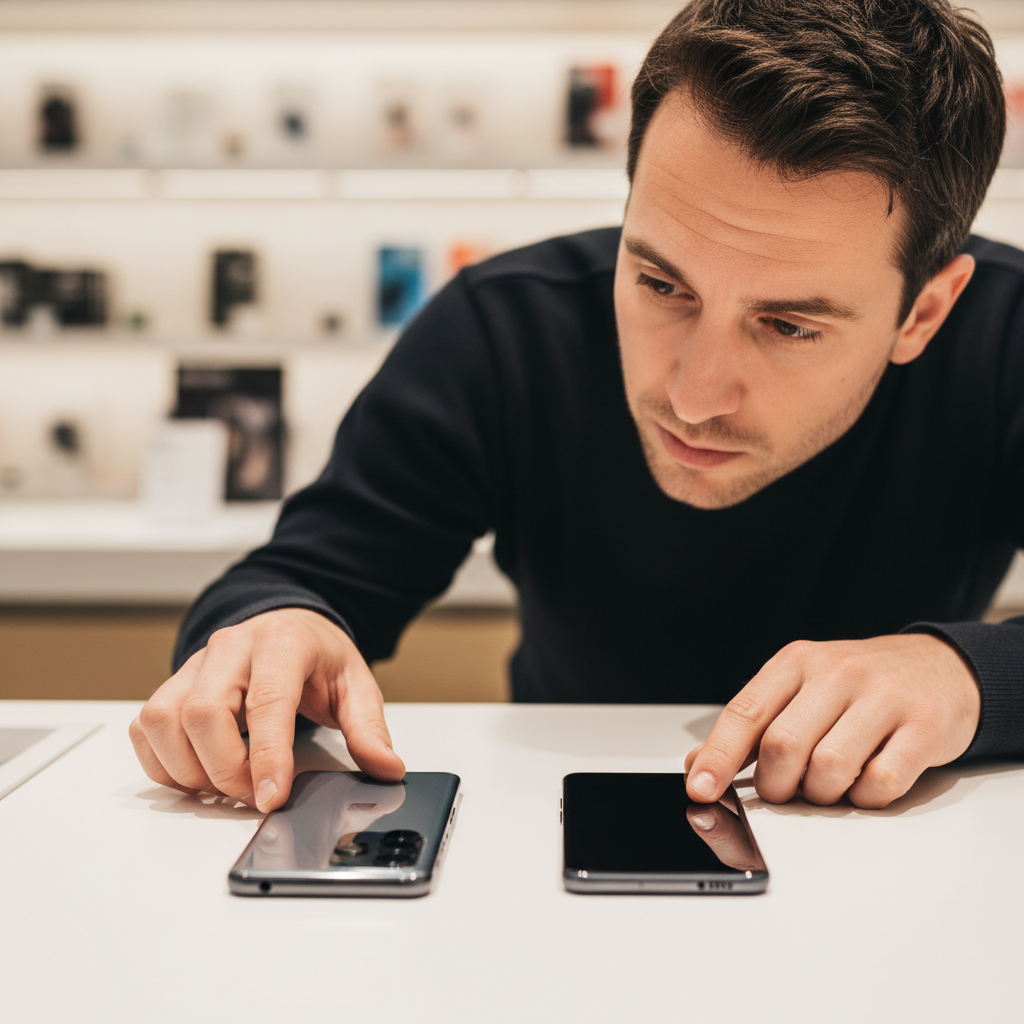
A flagship smartphone in 2026 will run you somewhere between $999 and $1,299 at full retail, and that gap from a $400 mid-range device has never been harder to justify on spec sheets alone. The question of whether a flagship phone is worth it over a mid-range has a real answer, but it depends on three variables most phone reviews skip entirely: your actual upgrade cycle, what you photograph, and whether your carrier's trade-in math changes the effective price.
The honest frustration here is that comparison articles treat this as a question about specs. It isn't. It's a question about depreciation curves, computational photography pipelines, and a chip performance ceiling you may never hit in daily use. If you've bought a flagship before and quietly wondered whether you actually needed it, you're not wrong to wonder.
Two factors complicate the answer in ways that aren't obvious until you run the numbers. First, mid-range processors have closed the gap on everyday performance faster than the marketing suggests. Second, flagship cameras no longer win on hardware alone, and the sensor advantage they carry matters enormously for some shooting contexts and almost nothing for others. Neither of those statements resolves which phone you should buy. But one of them probably tells you which category you belong in before you read another word.
What You Actually Pay: Retail Price vs. Real Cost
The sticker price comparison is the wrong starting point, but it's not useless. In the US in 2026, flagship Android devices from Samsung and Google sit at $1,099 to $1,299. Apple's iPhone Pro lineup starts at $1,099. Unlocked mid-range competitors from Google's A-series, Samsung's FE line, and OnePlus typically land between $349 and $499. That's a $600 to $900 delta at retail.
Where it gets complicated is carrier financing and trade-in credits. All three major US carriers (Verizon, AT&T, T-Mobile) run trade-in promotions that can reduce a flagship's effective cost to $400 or less when you're upgrading from a two- to three-year-old device. A mid-range phone rarely attracts the same promotion depth. So for a reader who upgrades every two to three years and has a trade-in-eligible device, the real out-of-pocket difference may shrink to $150 to $300, not $600 to $900. That reframe matters: this isn't a $1,000 decision for most people. It's a $200 decision dressed up as one.
But carrier promotions bind you to a 24- or 36-month installment contract, which means choosing wrong locks in that choice for years. Run the math before you walk into the store: take the full retail price of the flagship, subtract the carrier's trade-in credit for your current device, then divide by the months remaining in your contract. That per-month figure, compared against the same calculation for the mid-range, is what you're actually deciding between.
This article isn't a buying guide for someone upgrading from a one-year-old phone. If your current device is under 18 months old and runs current apps without friction, the upgrade calculus for either category is weak. Come back when your battery health drops below 80 percent or your device loses OS support.
Where Flagships Still Win: Camera and Sustained Performance
The camera gap is real, and it matters specifically in low-light photography, optical zoom above 3x, and video above 4K30. On those three axes, flagship phones in 2026 carry advantages that mid-range hardware cannot replicate through software alone. Google's Tensor G4 and Qualcomm's Snapdragon 8 Gen 4, both found in flagship devices, run on-device AI processing for night photography that physically smaller mid-range sensors cannot match regardless of the software stack applied to them. Sensor size is a physics constraint, not a feature toggle.
Or rather: the gap is real but unevenly distributed. If your primary photography is outdoor daylight shots, social media video at 1080p, and occasional portraits, a current mid-range device with a 50MP primary sensor will produce results that are genuinely indistinguishable in a feed scroll. The gap becomes visible when you crop heavily, shoot in dim restaurant lighting, or need stabilized 4K60 video for anything beyond casual use. Knowing which category you're in before you buy is the entire decision.
On performance, flagships maintain an advantage in sustained workloads: console-quality gaming, video editing on-device, running multiple large language model apps simultaneously. For a reader who uses their phone primarily for social media, navigation, streaming, and communication, a mid-range chip running at its ceiling is functionally identical to a flagship chip running well below its ceiling. The experience feels the same because it is the same for those tasks.
The long-term argument for flagships on performance is software support longevity. Samsung now promises seven years of OS updates for its Galaxy S flagship line. Google's Pixel 9 line carries the same seven-year commitment. Mid-range devices in 2026 typically receive three to four years of OS updates. If you keep phones for four or more years, a flagship bought today will receive security patches and new OS features through 2031 or 2032. A mid-range bought today may age out of support by 2028 or 2029. That's not a minor detail: an unsupported phone is a security liability, not just an inconvenience.
Where Mid-Range Phones Have Genuinely Closed the Gap
Everyday app speed is no longer a meaningful differentiator. The Google Pixel 8a, which shipped at $499, runs the same Tensor G3 chip as the Pixel 8 flagship. Samsung's Galaxy A55 carries a chip that handles every common app workload without noticeable lag. The performance gap that existed in 2020 and 2021, where mid-range devices stuttered on heavy apps, has largely closed for users who aren't gaming at high framerates or editing video on-device.
Battery life is a category where mid-range devices have actually pulled ahead in some comparisons. Because mid-range chips don't push maximum clock speeds to drive 120Hz LTPO displays with the same aggression, total daily drain is often lower per hour of use. A $429 phone with a 5,000 mAh battery and a chip running at moderate efficiency can outlast a $1,199 flagship that spends processor headroom keeping a high-refresh display fed.
Build quality is the place where the gap is most honestly visible. Flagship devices use Gorilla Glass Victus 2 or Ceramic Shield on the front, IP68 dust and water resistance rated to 6 meters for 30 minutes, and aluminum or titanium frames. Most mid-range devices in 2026 carry IP54 or IP67 ratings and polycarbonate or glass-hybrid builds. If you drop your phone regularly or work in wet environments, this isn't a cosmetic distinction.
The Upgrade Cycle Is the Decision
Here's the actual framework. How long you keep a phone determines which category makes financial and practical sense.
- Two years or less: mid-range almost always wins on value unless camera performance is your primary use case.
- Three to four years: the OS support longevity and camera durability of a flagship start to justify the premium, especially if carrier trade-in math closes the gap.
- Four or more years: flagship is the defensible choice, primarily because of the seven-year OS update commitment from Samsung and Google, and because camera hardware that's competitive today degrades more gracefully over time than mid-range sensors that start closer to their ceiling.
The buyer who is most likely to overpay for a flagship is someone who upgrades every 18 to 24 months and primarily shoots outdoor photos in daylight. That person is paying for camera and performance headroom they'll trade away before it matters. Cheap guides miss this entirely because they compare specs, not upgrade behavior.
I'd start with your trade-in value before you look at a single spec sheet. Pull up your carrier's trade-in calculator right now and enter your current device. If the credit reduces a flagship to within $200 of a mid-range on a 36-month plan, the per-month difference is under $6. At that margin, the seven-year update window and the sustained camera advantage are worth it for most buyers. If the credit is minimal and the delta stays above $400 effective, the mid-range is the rational choice for everyone except photographers and mobile gamers.
What happens if you skip this calculation and just pick based on specs? You either overpay by several hundred dollars for headroom you won't use, or you buy a mid-range that ages out of OS support in three years and becomes a security risk before you're ready to upgrade. Neither outcome is hypothetical.
When a Flagship Is the Wrong Choice
A flagship phone is the wrong buy if you're in one of these situations: your primary apps are messaging, browsing, and streaming; you upgrade more frequently than every two years; you're financing the device at a high APR because the monthly payment feels manageable. That last condition is worth naming plainly. Financing a $1,199 phone at 19.99% APR across 24 months costs roughly $120 in interest, on top of an already high device price. The mid-range at $449 financed on the same terms costs under $50 in interest. For a reader carrying credit card debt, the flagship is not just expensive, it's actively a bad financial decision regardless of its camera quality.
There's also a specific reader this article is not written for: someone who derives genuine professional income from mobile photography or mobile video production. At that level, the camera and stabilization gap between a current flagship and a mid-range is a workflow constraint, not a preference. Professional mobile creators should be buying flagships and evaluating them on ProRes video output, log color profiles, and third-party app compatibility, not on the cost-benefit framework above.
The condition where the flagship recommendation weakens most sharply is a short upgrade cycle combined with carrier financing. Someone who trades in every two years, finances at a non-zero APR, and uses their phone primarily for social content and communication is paying a sustained premium for features they rotate out before the value compounds. That's a real pattern. Buyers skip this consideration until they do the math after their third upgrade cycle and realize they've spent $800 more than a mid-range path would have cost them over six years.
The Verdict: A Framework, Not a Brand
If your upgrade cycle is three years or longer and your carrier trade-in credit brings the effective flagship price within $250 of the mid-range alternative, buy the flagship. The seven-year OS update window, the camera sensor advantage in low-light and zoom, and the sustained performance headroom compound meaningfully across that timeline.
If your cycle is two years or shorter, or your trade-in credit is minimal, the mid-range is the better financial decision for the majority of users. The performance gap for everyday tasks is gone. The camera gap is real but narrow enough for most use cases to be invisible in practice.
The deeper reframe is this: flagship phones in 2026 are not faster or better in any absolute sense for most users. They are longer-lasting, more capable in specific high-demand contexts, and more update-durable. That is a different value proposition than the one manufacturers advertise, and it only pays off if your behavior matches the timeline it requires.