
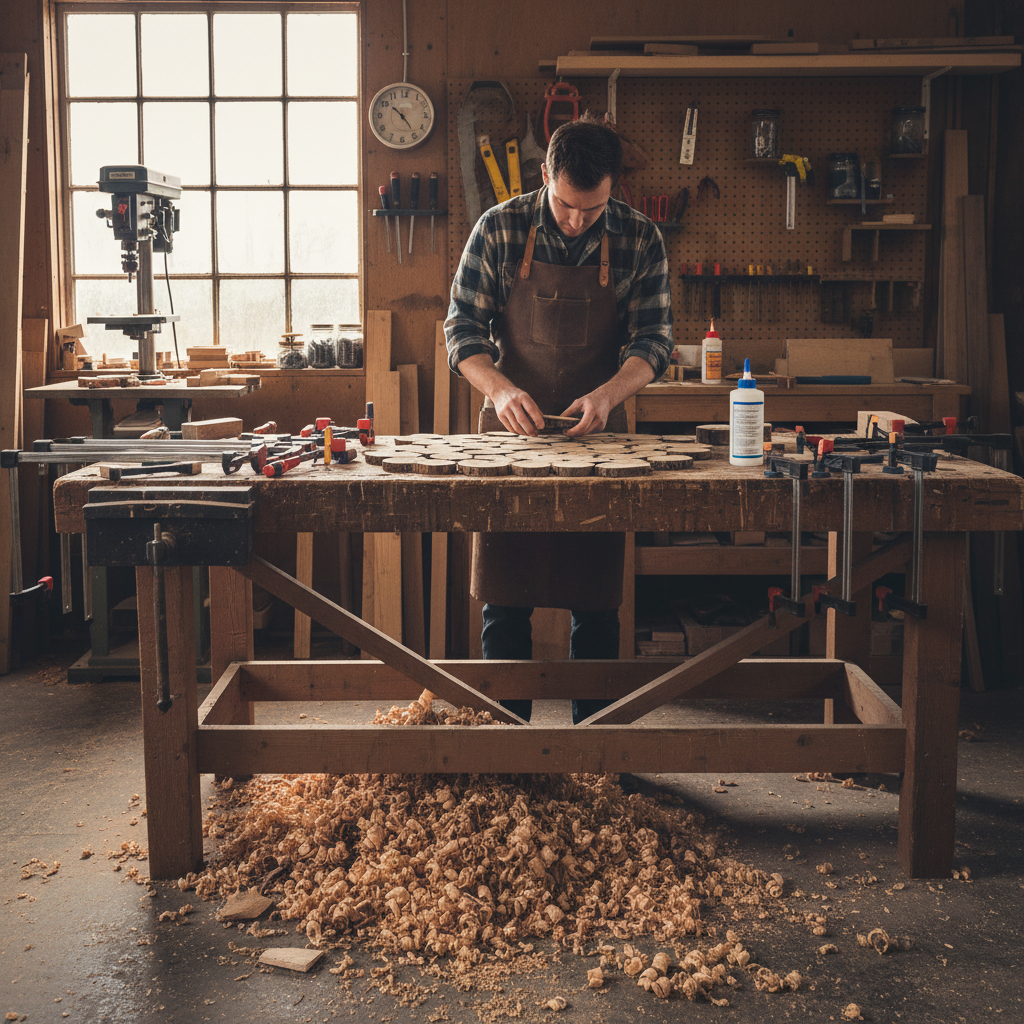
A woodworker with one weekend of shop time and a table saw can build an end-grain cutting board that outlasts anything from a kitchen store, but the process has a few failure points that most beginner projects hit hard. End-grain cutting boards earn their reputation because the wood fibers run vertically, so a knife edge slips between them rather than cutting across them. That's the mechanical reason they're gentler on blades and self-healing over time.
The tension is real, though: the same construction that makes end-grain boards so durable also makes them more likely to warp or crack than a simple face-grain board if the glue-up and finishing steps aren't handled correctly. Moisture is the enemy, and an end-grain board absorbs it from both faces simultaneously, which creates stress the wood has to resolve somewhere. Where it resolves that stress is the question that should stay in your head through every stage of this build.
This guide is written for beginners who have access to a table saw and a random-orbit sander, and who want to build one board well rather than rush through a batch. If you're looking for decorative live-edge slabs or face-grain serving boards, this isn't the right starting point.
Wood Species and Thickness: The Decision That Drives Everything Else
Hard maple is the standard starting point for a reason. It's dense enough to resist deep scoring, widely available at hardwood dealers across the US, and it glues cleanly with standard PVA wood glue. Walnut pairs well with maple for visual contrast and is similarly workable. Cherry is softer but still appropriate. What you want to avoid at this stage are open-pored species like oak and ash: their large pores trap food and bacteria in ways that are genuinely difficult to clean out, which matters when you're making something that contacts raw meat.
Or rather: it's not that oak boards are dangerous by definition, but the pore structure creates maintenance demands that a beginner board-maker is unlikely to anticipate. Stick with tight-grained hardwoods your first time through.
Thickness matters more than most beginner guides acknowledge. An end-grain board thinner than 1.5 inches is significantly more vulnerable to cupping because there isn't enough material depth to resist the differential moisture movement across the two faces. A board in the 2- to 2.5-inch range gives you stability and feels substantial on the counter. That thickness also means you'll need strips that start thicker than your target dimension before surfacing, so plan your lumber purchase accordingly.
Buy lumber that has been kiln-dried and acclimate it in your shop for at least a few days before milling. A common guideline among woodworkers is one week per inch of thickness, though the actual time depends on your shop's humidity relative to the lumber's current moisture content. The point is simple: mill dry wood, then let it rest again after milling before you glue.
Milling and the First Glue-Up
The basic process for an end-grain board involves two glue-ups, not one. Beginners often expect a single session; the two-stage structure is what actually produces the end-grain face pattern.
Start by ripping your hardwood into strips of consistent width, somewhere between 1.5 and 2 inches wide depending on your design. Joint and plane those strips so all four faces are flat and square. Then glue them face-to-face into a panel, alternating species if you're doing a two-tone design. This first glue-up produces a long laminated panel that looks like a standard face-grain board.
Use Titebond II or Titebond III for this glue-up. Both are PVA-based, both are rated food-safe once fully cured, and both have enough open time for a beginner to spread glue and get clamps in place without panic. Titebond III adds water resistance, which has real value in a cutting board context. Apply glue to both mating faces, not just one, and use enough clamps that squeeze-out appears along the entire joint line. No squeeze-out in a section means inadequate glue or inadequate pressure.
After the glue cures fully (overnight minimum, 24 hours is better), scrape off the squeeze-out and run the panel through a planer or sand it flat. Then crosscut that panel into slices perpendicular to the grain direction. Those slices, rotated 90 degrees and glued face-to-face again, become your end-grain board. The slice thickness determines the final board thickness, so cut them at your target dimension plus a little extra for the final surfacing pass.
- Rip strips to consistent width, joint and plane all faces flat
- First glue-up: face-to-face, produces a laminated panel
- Crosscut panel into slices perpendicular to the grain
- Second glue-up: slices face-to-face, end grain now faces up
The second glue-up is trickier because the end-grain faces absorb glue faster than face grain does. Apply a thin first coat, let it tack for a minute or two, then apply a second coat before clamping. This two-coat approach compensates for the absorption and ensures a solid bond.
Flattening After the Second Glue-Up
This is where many beginner projects go sideways. The second glue-up almost always produces a panel with some unevenness across the surface, either from clamp pressure variation or from slight thickness differences between slices. You need a flat board before finishing, and getting there without a wide drum sander or wide-belt sander takes patience.
If you have access to a drum sander wide enough to handle your board, use it. Run light passes, alternating direction between passes, until the surface is flat and the end-grain pattern is consistent. If you don't have a drum sander, a router sled is a reliable alternative: it's a jig that holds a router above the board and lets you traverse the surface in overlapping passes, cutting everything to a single reference plane. Plans for basic router sleds are freely available and the construction is straightforward for someone who can already build a cutting board.
A random-orbit sander alone won't get you to flat if the board has significant high spots. It'll round the edges and give you a smooth surface that still rocks. Use it for final surface prep after you've established flat by another method, starting around 80 grit and working up through 120 and 180. Don't skip grits; each grit removes the scratches from the previous one, and end grain shows scratches more than face grain does.
Food-Safe Finishing and the Warping Risk
Skip polyurethane and lacquer entirely. Film-forming finishes crack on end-grain boards because the wood moves seasonally and the finish can't flex with it. Once the finish cracks, moisture gets in, and you're done.
Mineral oil is the right base finish for a beginner's first board. It's inexpensive, widely available at pharmacies, genuinely food-safe, and it penetrates deeply into end grain to displace moisture and stabilize the wood. Apply it generously, let it soak for 20 minutes, wipe off the excess, and repeat. Three to five coats over several days is a practical target for a new board.
After the mineral oil has fully penetrated (the wood will stop absorbing new coats), a board cream made from mineral oil and beeswax adds surface protection and makes the board easier to maintain. This two-stage approach, deep penetration with oil followed by surface sealing with wax, is how most production cutting board makers approach the problem. The wax layer slows moisture uptake during use, which directly reduces the cupping and warping risk.
Here's the warping reality: if you finish only the top surface of the board and seal or skip the bottom, the two faces will exchange moisture with the environment at different rates. That differential is what causes cupping. Finish all six sides of the board with equal thoroughness. This single rule prevents most of the warping failures beginners experience.
| Finish Type | Food Safe | Flexibility | Beginner Recommended |
|---|---|---|---|
| Mineral oil | Yes | High (penetrating) | Yes |
| Beeswax and mineral oil blend | Yes | High | Yes |
| Raw linseed oil | No (toxic) | Medium | No |
| Polyurethane | Once cured, generally yes | Low (film-forming) | No |
| Tung oil (pure) | Debated | Medium | No for beginners |
Raw linseed oil comes up frequently in general woodworking conversations and sometimes gets applied to kitchen items by mistake. Don't. It contains compounds that are not appropriate for food contact surfaces. Pure tung oil is a more complicated conversation that's worth skipping for a first board.
When End-Grain Isn't the Right First Project
A face-grain cutting board, built from a single board or a few glued planks oriented the conventional way, is genuinely easier for a first project. It requires only one glue-up (or none at all), tolerates minor flattening imperfections better, and the warping risk is lower because the moisture movement is more predictable and one-directional.
If you don't yet have experience with glue-up clamping, jointing, or using a planer, building a face-grain board first will teach those skills with less margin for error. The end-grain project is a better second build, when the first one has shown you what your shop setup actually does under pressure. That framing misses something, though: plenty of beginners do succeed with end-grain as a first project, especially when they have access to a drum sander and aren't trying to build a large board. A 10-by-12-inch end-grain board is more forgiving than a 16-by-24-inch one. Scale matters.
If you ignore the flattening step and try to finish a board that still has high spots, you'll end up with a board that rocks on the counter and looks worse with every coat of oil. That's the most common failure mode, and it's entirely preventable.
Putting It Together
Start with hard maple or walnut, kiln-dried and acclimated. Mill your strips flat and square before the first glue-up. Use Titebond II or III, apply it to both faces, and clamp until you see squeeze-out across every joint. After the second glue-up, get the board truly flat before you touch the sander. Finish all six sides with mineral oil, then follow with a beeswax blend once the oil stops absorbing.
I'd start with a board no larger than 12 by 14 inches for a first attempt. Smaller boards are easier to flatten, easier to clamp evenly, and if something goes wrong you haven't lost a large quantity of expensive hardwood.
If you skip the two-coat glue method on the end-grain faces, the joints in the second glue-up are at real risk of failure under repeated wetting and drying cycles. Build the habit correctly the first time.