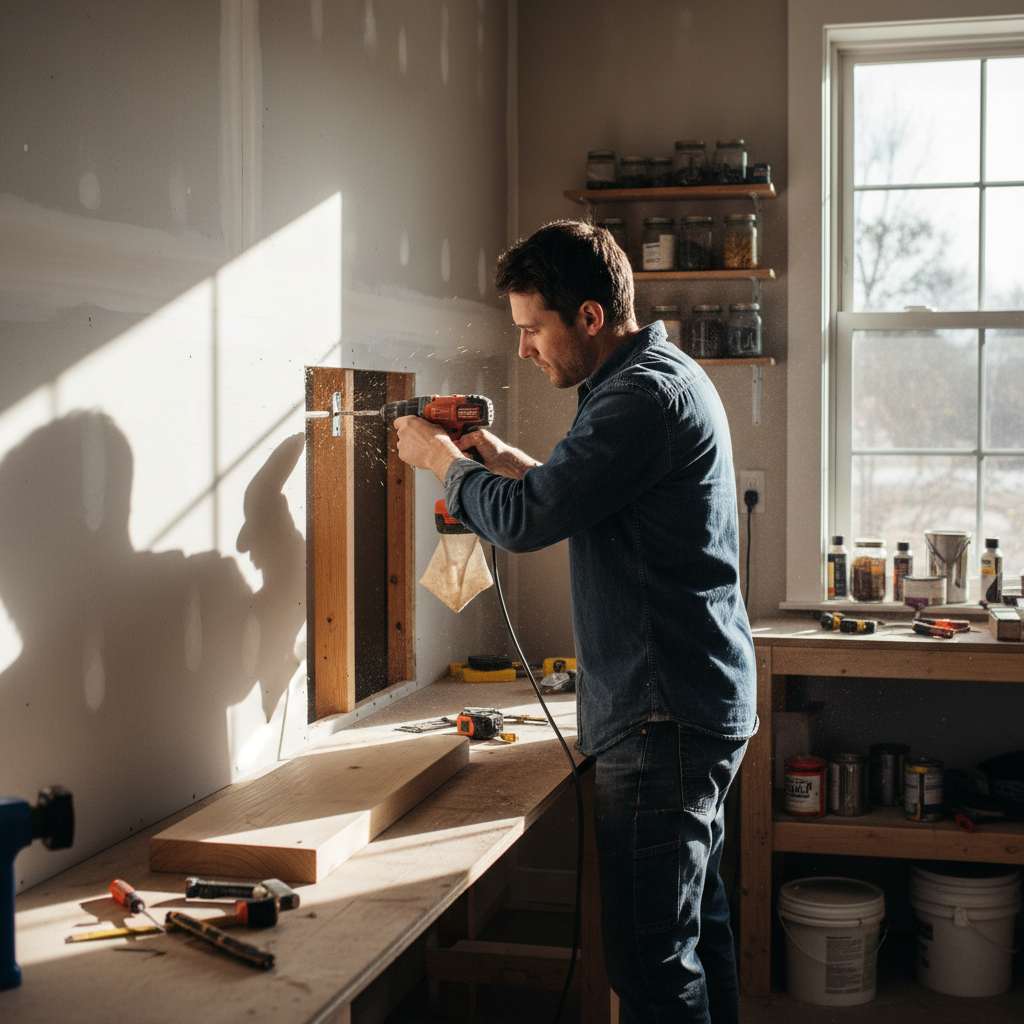
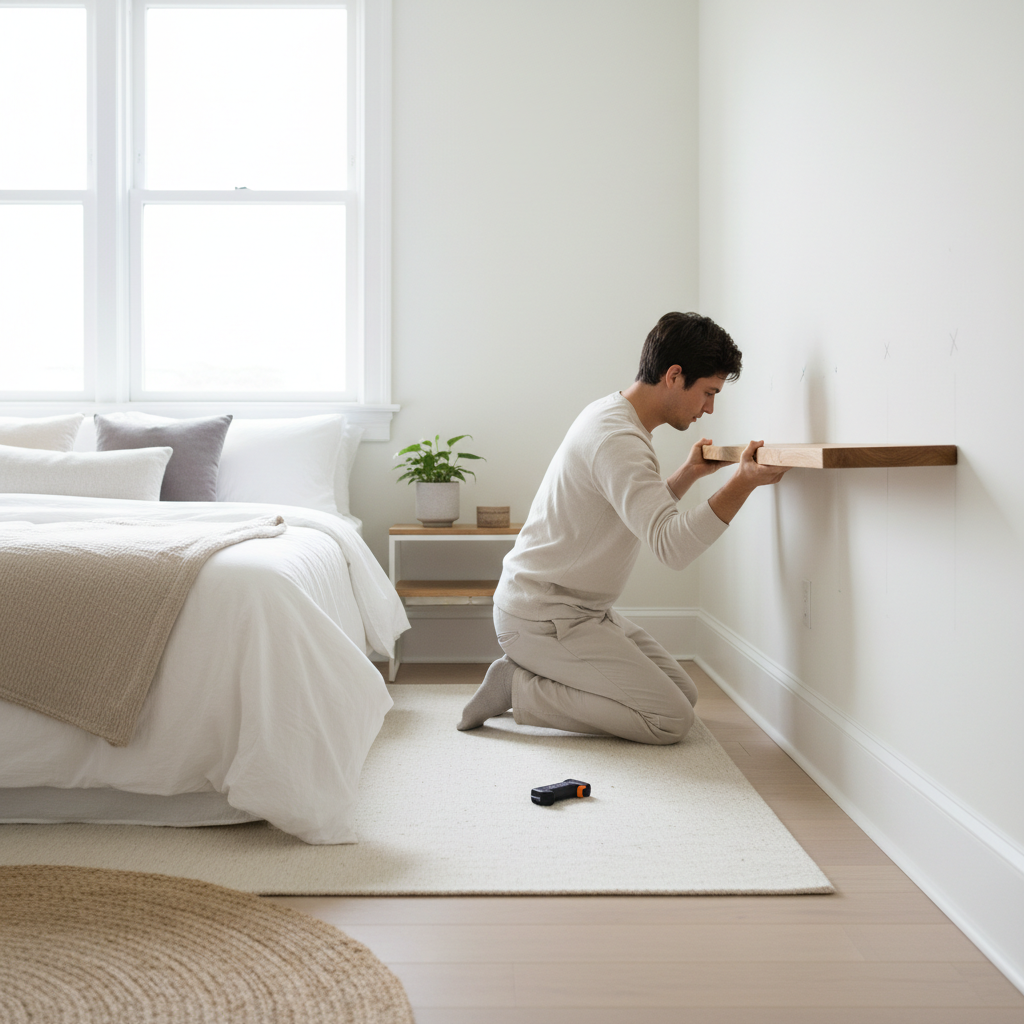
A carpenter will size up your wall before discussing anything else, and there's a reason for that: floating nightstands fail or succeed at the stud-and-drywall level, not the lumber yard. Whether you're priced out of the $150-and-up bracket at most furniture retailers or just want something that fits a specific wall recess, the DIY question deserves a harder look than "can I use a drill?"
The real tension here isn't skill versus budget. It's that building your own can genuinely outperform a bought unit on fit, finish, and cost simultaneously, but only when your wall situation, tool access, and time math all line up. Get one of those wrong and you'll spend a Saturday producing something shakier than the $59 option at IKEA.
Three variables dominate the decision: stud spacing and wall material, your realistic finishing time, and whether the dimensions you need even exist in the retail market. None of those is answered by watching a five-minute build video.
What a Floating Nightstand Actually Costs to Build
Raw material cost for a basic floating nightstand shelf, roughly 20 inches wide by 12 inches deep with a single drawer box, runs between $35 and $65 at a big-box store like Home Depot or Menards, using 3/4-inch plywood or a poplar board. That figure assumes you already own a circular saw, drill, pocket-hole jig, and sandpaper. If you're buying or renting tools, that $40 savings evaporates immediately.
Or rather: the cost comparison only holds when you treat tool ownership as sunk. If you need to buy even a $30 pocket-hole jig to get clean joints on a drawer face, the break-even point shifts. Factor in wood filler, primer, and a quart of paint or stain (around $18 to $30 combined) and a built unit costs $55 to $95 in materials alone, not counting your time.
On the retail side, wall-mounted floating nightstands in the US market span a wide range. Basic MDF units from Prepac or South Shore sit around $55 to $80. Solid wood options from companies like Crate and Barrel or Article climb to $180 to $350. That spread matters because it defines your realistic comparison: you're not choosing between DIY and a $300 walnut shelf. You're choosing between DIY and whatever is actually in your budget.
The derived math looks like this: if your material cost is $65, your time is 4 hours at your personal hourly value, and the closest retail match costs $90, DIY only wins financially if you value your time at under $6.25 per hour. That's a number most people don't compute before starting, and it's the one that should drive the decision.
Where DIY Wins and Where It Doesn't
DIY floating nightstands genuinely outperform retail in three situations. First, non-standard dimensions: if your bedroom wall has a 14-inch gap between a window casing and a door frame, you won't find a retail unit that fits it. Second, material matching: if your existing furniture is white oak with a specific stain, no $80 box-store shelf will match it. Third, load requirements: a built shelf attached directly to studs with 2.5-inch screws can hold significantly more than a wall-mounted retail unit relying on drywall anchors alone, typically 50 or more pounds versus 20 to 30 pounds for anchor-dependent hardware.
But DIY fails predictably in two scenarios. If your walls are plaster over wood lath (common in US homes built before 1950), anchoring a floating shelf cleanly requires extra hardware and technique that most beginner guides skip entirely. And if you're renting, any wall modification that requires patching multiple stud holes at move-out becomes a deposit calculation, not just a weekend project.
Buyers who should skip DIY entirely: anyone without a dedicated workspace for cutting and finishing, anyone in a rental without landlord approval, and anyone whose walls are concrete or brick (requiring masonry anchors and a hammer drill, which changes the project scope entirely). This article isn't for that reader. The math and method below assume drywall over wood-frame construction, which covers the majority of US residential walls.
What happens if you ignore the wall-type check and anchor into drywall without hitting a stud? The shelf holds fine until it holds about 8 pounds of books and a lamp. Then it comes off the wall, usually taking a fist-sized chunk of drywall with it. The repair cost alone can exceed what you saved on materials.
Comparing Your Real Options
The table below maps the four most realistic options for a US buyer-builder weighing a floating nightstand decision. These aren't hypothetical endpoints; they reflect what's actually available at the price points most people are shopping.
| Option | Estimated Cost | Fit to Non-Standard Sizes | Install Difficulty | Durability (Stud Mount) |
|---|---|---|---|---|
| DIY Plywood Build | $55 - $95 materials | Fully custom | Moderate (saw + drill required) | High (direct stud anchor) |
| IKEA LACK / Ekby shelf | $25 - $45 | Fixed sizes only | Low (included hardware) | Low - Medium (anchor dependent) |
| Prepac / South Shore MDF unit | $55 - $80 | Fixed sizes only | Low - Moderate | Medium (anchor + one ledger bolt) |
| Solid wood retail (Article, CB2) | $180 - $350 | Limited custom options | Low - Moderate | Medium - High |
The IKEA options are genuinely hard to beat on price if your wall fits their bracket spacing and your load is light. The Prepac and South Shore units are the realistic DIY competitors: they're the shelf you're building for $65 in materials. If your dimensions match and you don't need stud-level load capacity, buying one saves three to four hours and produces a cleaner drawer slide than most first-time builders achieve.
The reframe worth sitting with: this isn't really a build-versus-buy decision. It's a fit-versus-convenience decision, and the people who get the most value from DIY are those solving a problem retail can't solve, not those trying to save $20.
How to Build One That Actually Stays Up
If the math and wall-type check clear, here's how to build a floating nightstand that performs. Start with 3/4-inch birch plywood for the shelf body and a solid poplar or pine edge band to hide the plywood face grain. Cut your shelf top and bottom to identical dimensions first, then your side panels 3/4 inch shorter on each end to allow for the top and bottom to cap them.
Pocket-hole joinery (Kreg R3 or equivalent) is the right call for this project. Two pocket screws per joint on a shelf this size hold better than butt joints with finish nails, and they're faster than dado cuts for a first build. Predrill all holes before assembly. Sand to 150 grit before painting; 120 grit leaves sanding marks that show through latex paint.
For wall attachment, locate your studs with a quality stud finder (the Zircon e50 is accurate enough and costs around $25) and mark them clearly. A french cleat system, two interlocking 45-degree ripped boards, one screwed to the wall into studs and one attached to the shelf back, gives you the cleanest install and lets you remove the shelf without wall damage. The cleat board going into the wall needs 2.5-inch screws minimum, hitting at least two studs.
I'd start with the french cleat approach even if you've never used one. It forgives minor leveling errors because you can adjust the shelf left or right after mounting, and the mechanical advantage means the shelf can handle 60-plus pounds without flex. That's more than most retail floating units promise at any price point.
Finish with two coats of a water-based satin enamel (Benjamin Moore Advance or Sherwin-Williams Emerald Urethane both level well on flat surfaces). Don't rush the dry time between coats. A paint failure on a nightstand you built is a pain to fix without disassembly.