
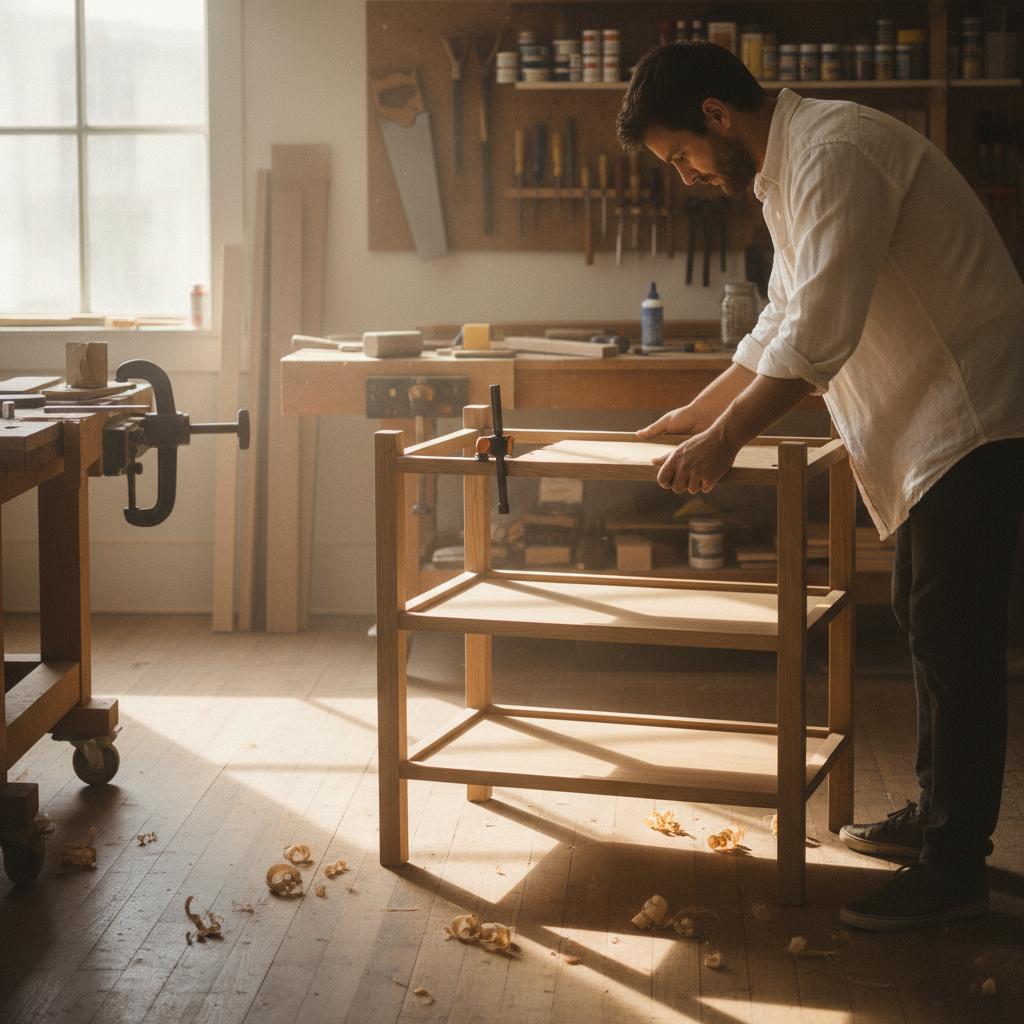
Carpenters will tell you to nail down your wheel hardware before you cut a single board, and there's a reason for that. The caster stem diameter determines your leg thickness, and getting it wrong means either wobbly wheels or legs too thin to hold weight. A wooden bar cart for home entertaining sounds like a weekend project, but the sequencing matters more than most guides let on.
The variables that actually shape this build are wood species, caster load rating, and your finish choice. All three interact. A cart built from pine with unfinished wood and bargain plastic casters might last a season before the surface clouds from condensation and the wheels skip on hardwood floors. That tension between quick-and-cheap and built-to-last is the real decision you're making here, and it's worth settling before you buy anything.
This guide covers a two-shelf rolling cart sized to hold a dozen bottles on the lower shelf and glassware on top, roughly 36 inches tall and 24 inches wide. If you're building something fixed to a wall or a full home-bar cabinet, this isn't the right starting point.
Choosing the Right Wood Before You Buy Anything
The single most common mistake on this build is grabbing whatever dimensional lumber is on sale. Poplar and hard maple are the two species worth considering for a cart that will actually hold up. Poplar runs about $2 to $3 per linear foot at most US lumber yards and home centers, machines cleanly, takes paint and stain evenly, and is stiff enough for shelf spans up to 24 inches without noticeable flex under a dozen bottles. Hard maple costs more, typically $4 to $6 per linear foot, but the surface is dense enough that it resists the ring stains and surface dents that show up on softer woods within the first year of use.
Pine is tempting because it's everywhere and cheap. But a bar cart surface takes condensation from cold glasses repeatedly. Untreated pine absorbs moisture and raises grain within a few months, leaving a surface that looks rough and feels tacky. If pine is your only option, seal it with at least two coats of oil-based polyurethane before the cart sees a single glass.
Or rather: the wood species choice is less about hardness and more about how the grain responds to repeated wet-dry cycles. A species with tight, interlocked grain (maple, poplar, even birch plywood for shelves) will stay dimensionally stable far longer than open-grained species like oak or ash, which look beautiful but tend to telegraph moisture movement through the finish over time.
For the shelf panels specifically, 3/4-inch birch plywood beats solid wood. It's dimensionally stable, won't cup or bow as humidity shifts seasonally, and the face veneer takes finish cleanly. Use solid lumber for the legs and stretchers, plywood for the shelves. That's a common guideline among furniture makers, and it holds here.
The Cut List, Dimensions, and Assembly Order
A 36-inch-tall by 24-inch-wide by 16-inch-deep cart (before casters) calls for the following parts, assuming 3/4-inch material throughout:
- 4 legs at 1.5 inches square by 32.5 inches long (casters add the remaining height)
- 4 side stretchers at 1.5 inches by 1.5 inches by 13 inches, connecting leg pairs on the 16-inch-deep sides
- 2 front and rear stretchers at 1.5 inches by 1.5 inches by 21 inches
- 2 shelf panels cut from 3/4-inch birch plywood at 21 inches by 13 inches
- 4 shelf cleats at 3/4 inch by 3/4 inch by 12 inches, to support the shelves from below
That stretcher arrangement gives you two shelf positions: the lower shelf sits roughly 6 inches off the ground (above the casters), and the upper shelf sits at about 20 inches from the ground, leaving 12 inches of vertical clearance for bottles below and 16 inches above the top shelf for glassware and mixing tools.
Assembly order matters here more than joint type. Build the two side frames first (each pair of legs connected by side stretchers with pocket screws or mortise-and-tenon if you have the tooling), let the glue cure fully, then connect the two side frames with the front and rear stretchers. Adding the shelves last, resting on cleats, means you can adjust shelf height slightly during dry-fit before committing to screws.
Pocket screws with 1.25-inch Kreg screws and wood glue are strong enough for this application if joints are clamped for 30 minutes minimum. The glue does the structural work; the screws are clamping pressure that doesn't require hardware. Don't skip the glue and rely on screws alone, especially at the leg-to-stretcher joints, which take the most racking stress when the cart is pushed across a room.
Casters: The Part Most Builders Get Wrong
Pick your casters before you finalize leg dimensions. That's not optional advice.
A loaded bar cart carrying 12 full 750ml bottles weighs roughly 30 pounds in bottles alone, plus the cart frame (call it 20 to 25 pounds for a poplar build at this size), plus glassware. You're looking at a realistic loaded weight of 60 to 80 pounds. Divide by four casters and you need each wheel rated for at least 25 pounds, with a safety margin. Casters rated at 40 to 50 pounds each are the correct spec for this build. Most of the decorative brass-finish casters sold for furniture projects at craft stores are rated at 20 to 25 pounds per wheel. That's not sufficient.
The wheel diameter affects both roll smoothness and cart height. A 2-inch-diameter wheel adds about 2.25 inches to total height (accounting for the stem or plate mount). A 3-inch wheel adds closer to 3.5 inches and rolls far more smoothly across tile grout lines and hardwood seams, which is relevant if your entertaining space has uneven flooring. I'd start with 3-inch swivel casters with a locking mechanism on at least two wheels so the cart stays put during use.
Stem-mount versus plate-mount: stem-mount casters thread into a pre-drilled hole in the leg bottom and require a leg thickness of at least 1.25 inches to hold the stem without splitting. Plate-mount casters screw into the leg bottom face with four screws and are more forgiving on thinner stock. For 1.5-inch-square legs, either works, but plate-mount gives you more surface area and a more secure connection long-term.
What happens if you skip the load rating check? A caster that's undersized doesn't fail dramatically. It rolls increasingly rough, then the stem starts to work loose, and within six months the cart develops a lean that no amount of tightening fixes. Replace the casters then and you're also patching the leg holes.
Finishing: Protecting the Surface Without Killing the Look
The finish on a bar cart does something a finish on a bookcase doesn't have to do: it gets wet. Repeatedly. Alcohol, citrus juice, and water all find their way onto bar surfaces, and each attacks different finishes differently.
Oil-based polyurethane in satin or semi-gloss is the most practical choice for this project. Apply three coats, sanding lightly with 220-grit between coats two and three. The third coat is what builds the moisture resistance you actually need. Two coats looks fine but gives you a thinner film that alcohol can penetrate over time, leaving white haze marks in the finish. Three coats eliminates most of that vulnerability.
Water-based polyurethane dries faster and has lower odor, which makes it appealing. But water-based formulations are generally softer than oil-based when fully cured, and on a bar surface that's a real trade-off. For a bedroom dresser or a bookshelf, water-based is perfectly adequate. For a bar cart, the extra cure time of oil-based (typically 24 hours between coats versus 2 to 4 hours for water-based) is worth it.
If you've chosen hard maple and want to showcase the grain, a Danish oil base coat followed by two coats of oil-based polyurethane gives you color depth with the surface protection. The Danish oil penetrates and enriches the grain; the poly coats on top provide the actual barrier. Don't use Danish oil alone on a bar surface; it's not a film finish and won't resist alcohol.
Check sq footage and ventilation first. Oil-based poly in an enclosed garage in winter is a health hazard, not just an inconvenience. Work outdoors or with active cross-ventilation, and give each coat the full cure window before bringing the piece inside.
When This Build Isn't the Right Fit
This design is a solid starting point for most home entertaining setups. But there are real situations where you'd be better served by a different approach.
If your floors are exclusively thick-pile carpet, a rolling cart is genuinely impractical regardless of caster quality. Casters on carpet create uneven loading that accelerates wear on the wheel bearings, and the cart won't roll smoothly enough to be useful. A fixed bar cabinet or a console table with a serving tray accomplishes everything a cart would without the mobility problem.
Renters who move frequently face a different issue: a cart this size, fully loaded, is difficult to transport without disassembly, and the assembled dimensions (roughly 36 inches tall, 24 inches wide) won't fit through a standard interior door horizontally. Design the shelves to be removable without tools (resting on cleats rather than glued in place) if you anticipate moving the piece.
And if your primary goal is a showpiece aesthetic rather than function, solid hardwood with hand-cut joinery will look significantly better than a pocket-screw construction in poplar. The build described here prioritizes durability and accessibility over craftsmanship display. Both are legitimate goals; they just require different approaches.
Putting It Together and Getting It Right the First Time
Buy your casters first and confirm the stem or plate dimensions before cutting legs. Then dry-fit every joint before applying glue, even if you've done this before. A dry-fit on this project takes 20 minutes and catches leg-length discrepancies before they're glued permanently.
Sand all parts through 150-grit before assembly, then 180-grit after the first coat of finish. Trying to sand inside a corner after assembly is a frustration that's entirely preventable. The finishing sequence that works reliably: seal raw wood with a thinned first coat (10 percent mineral spirits added to oil-based poly for better penetration), let it cure 24 hours, 220-grit scuff, second full coat, cure, light 220-grit scuff on any raised grain, third coat. Attach casters only after the finish on leg bottoms is fully cured, typically 72 hours for oil-based poly to reach handling hardness.
The build that holds up over years of use isn't the one with the fanciest joinery. It's the one where someone checked the caster rating, used plywood for the shelves, and put on that third coat of finish even though the second coat already looked good. Do those three things and the cart will outlast every piece of flat-pack furniture in the same room.