Woodworkers who cut a lot of sheet goods will usually tell you to get a track saw before almost anything else, and there's a reason that advice keeps surfacing. A full sheet of plywood is awkward, heavy, and genuinely dangerous to feed through a table saw alone. The track saw solves that problem differently: you bring the cut to the sheet instead of hauling the sheet to a blade.
For a beginner focused on sheet goods, a track saw for beginners sounds like a clean answer. It isn't quite that simple. The decision hinges on three things most tool guides skip past: how much floor space you actually have, whether you'll also need rip cuts in solid lumber, and what happens to your accuracy when you're working without a fence to guide you. Those aren't minor details. They determine whether a track saw is the right first investment or whether a different cutting setup would serve you better for less money.
Here's the tension worth holding before you buy: a track saw solves sheet goods beautifully, but a beginner who buys one and nothing else may hit a wall the first time a project calls for something the track simply can't do.
What a Track Saw Actually Does (and Doesn't Do)
A track saw is a circular saw that rides a straight aluminum rail, called a track or guide rail. The blade follows the rail with zero lateral play, so your cut is as straight as the rail is long. With a quality track saw setup, you can expect repeatably square crosscuts and rips across a full 4×8 sheet without clamping the sheet to a table or fighting warped edges.
The mechanism matters here. A track saw's anti-splinter strip, a thin rubber edge bonded to the bottom of the rail, compresses against the workpiece before the blade reaches the cut line. That compression holds wood fibers down as the blade exits, which is why track saw cuts on good plywood look almost finished-edge clean without a zero-clearance insert or scoring pass. A table saw can't replicate that behavior on crosscuts wider than the fence distance.
Or rather: a table saw can rip sheet goods, but crosscutting a 48-inch-wide panel safely requires a sled that many beginners don't build early enough. That's the gap a track saw genuinely fills.
What the track saw doesn't do: it won't replace a table saw for ripping solid lumber accurately to width, dadoing, or cutting joinery. If your projects include furniture with solid wood components, you'll eventually need another tool. The track saw is purpose-built for flat panels and long straight cuts. It does those things extremely well and almost nothing else.
The Real Cost Comparison: Track Saw vs. Table Saw for Sheet Goods
Entry-level track saws from Makita, Festool, and Triton sit in a wide price band. A Makita SP6000J1 with a 55-inch guide rail runs around $550 to $600 new. Festool's TS 55 REQ starts around $700 without the rail. Budget-brand track saws (Grizzly, WEN) come in under $250, though rail accuracy varies noticeably at that price point. A usable contractor table saw starts around $350 to $500, but you'll also need floor space to set it up and a practical way to support outfeed when a full sheet is passing through.
That puts it around $500 to $600 all-in for a mid-tier track saw setup versus $400 to $700 for a contractor table saw plus outfeed support. The numbers are close enough that price alone shouldn't decide the question.
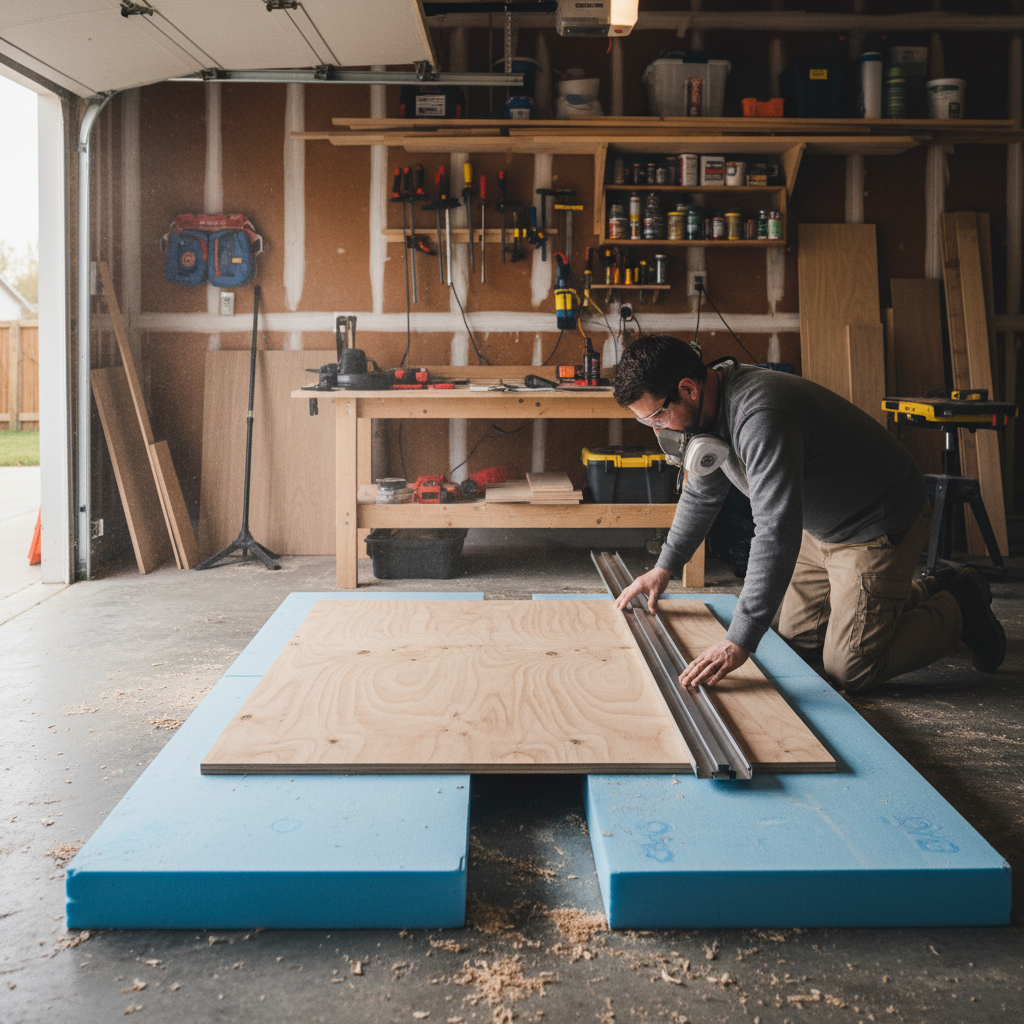
What should decide it is floor space. A table saw needs clear outfeed room equal to the length of your longest panel (8 feet for standard sheet goods) plus infeed clearance. In a one-car garage or a basement shop without dedicated saw clearance, that's a real constraint. A track saw needs only enough floor space to lay the sheet flat. You can cut on sawhorses, rigid foam insulation laid on the floor, or a pair of 2×4 supports. The whole setup collapses into a bag when you're done.
If you're working in under 300 square feet of shop space, the track saw is almost certainly the better starting point. A common guideline among shop builders is that a table saw requires at least 10 feet of clear infeed and outfeed distance, which translates to a room length of at least 14 to 16 feet when you add working clearance. Check your actual floor space first. Most beginners find they're working in less room than they assumed.
When the Track Saw Is the Wrong First Tool
Buy the track saw if you're building cabinets, plywood furniture, or shelving. Don't buy it first if your projects lean toward solid wood frames, turned legs, or anything requiring ripped-to-width lumber as a primary operation.
Here's the downside case that most track saw guides avoid: if your first several projects involve solid wood joinery and you buy a track saw instead of a table saw, you'll spend the first six months working around the gap. Track saws can rip solid lumber, but without a fence and outfeed support, maintaining consistent width over 6 to 8 feet of a solid board is difficult for a beginner. Errors accumulate. The cut that starts at 3 inches wide can arrive at 2-7/8 at the other end if the track shifts or the workpiece moves.
And if you ignore the tool choice entirely and keep relying on a standard circular saw with a clamped straightedge? You'll get acceptable results on rough cuts, but you're fighting the tool on every rip. Circular saws without a dedicated track wander more than beginners expect, and over a dozen or more sheets, that wandering adds up to wasted material and joints that don't close. That's the practical cost of deferring the decision.
The reader this section is not aimed at: someone building decks, rough framing, or outdoor structures. For construction lumber, a standard circular saw or a miter saw will serve you better than a track saw for years.
How to Decide: Four Questions Before You Buy
Skip the spec comparisons for a moment and answer these four questions about your actual situation.
First: what percentage of your cuts will be in sheet goods versus solid lumber? If sheet goods make up more than half your cutting volume now, the track saw earns its place quickly. If solid wood rips dominate, start with a table saw and rent or borrow a track saw when you need clean plywood crosscuts.
Second: what's your floor clearance? Measure infeed and outfeed from where a table saw would sit. Under 10 feet either direction: track saw wins on practicality alone.
Third: are you willing to learn dust collection now? Track saws paired with a shop vacuum and a good hose adapter produce remarkably clean cuts. Without dust collection, the chip ejection from a track saw is surprisingly heavy. This isn't optional if you're working indoors.
Fourth: do you have somewhere flat to support full sheets? Rigid foam insulation (2-inch XPS foam from any home center) laid on the floor is a legitimate work surface for track saw cuts. If you don't have floor space to lay a sheet flat, even the track saw becomes awkward.
The better question isn't whether a track saw is worth it in the abstract. It's whether you'll cut enough sheet goods in the next year to justify owning versus renting. Many tool rental outlets carry track saws. If you're cutting fewer than eight to ten sheets per project and building one or two projects a year, renting covers the need without the capital outlay. I'd start there before committing to a purchase, especially at the Festool price point.
Track Saw Setup for Beginners: What Actually Matters
Assuming you've decided to buy, three things determine whether the tool performs the way the reviews promise: rail length, track clamping, and blade choice.
Rail length first. A 55-inch rail handles rips on a 4×8 sheet with room to spare. A 27-inch rail (which some entry packages include) forces you to reposition mid-cut, which introduces alignment errors. Get at least 55 inches. If you're buying Festool or Makita, you can join two rails end-to-end with a connector for longer cuts, which is worth knowing for future projects.
Track clamping matters more than most reviews admit. The anti-splinter strip grips the workpiece, but on slick melamine or laminate surfaces, the track can still shift under cutting pressure. The fix is a pair of track clamps (Festool makes them, as do third-party options that fit Makita rails) at each end. This takes 60 seconds. Skipping it is the most common beginner mistake I see documented in shop forums, and it results in cuts that drift at the far end of the sheet.
Blade choice: the blade your track saw ships with is usually adequate for general plywood. For melamine-faced panels, switch to a 60-tooth or higher fine-crosscut blade. The tooth count isn't just marketing. Higher tooth counts on melamine reduce chipout on the face veneer, which matters when the cut edge will be visible in the finished piece. Check sq footage of melamine in your project first, then decide whether the blade upgrade makes sense before that specific job.
One parenthetical worth noting: some beginners confuse the guide rail FSK system (fixed-angle rail) with a standard track saw rail. They're not interchangeable. If you're shopping used equipment, confirm rail compatibility with your specific saw before buying.
The Verdict
If you're a beginner whose projects center on sheet goods, a track saw is worth the investment once your annual sheet volume justifies ownership over rental. For tight spaces and plywood-heavy work, it outperforms a table saw on pure practicality. But it's a purpose-built tool, not a Swiss Army knife, and beginners who expect it to replace a table saw entirely will hit its limits within the first solid wood project.
If your shop is under 300 square feet, your projects are cabinet boxes, shelving, or flat-pack furniture, and you're cutting at least 15 to 20 sheets a year: buy the track saw and don't overthink it. Pair it with a miter saw for crosscuts in solid lumber, and you'll cover most beginner projects without a table saw at all. If your shop is larger and solid wood frames make up most of your work, start with a contractor table saw and rent a track saw for plywood-heavy jobs. The rental math works in your favor until your sheet volume climbs.