
A decent circular saw runs $80 to $120 at any big-box hardware store, and that single fact changes the math on your whole first kit. Buy the wrong thing before that saw and you've already crowded out the tools that matter. Woodworking starter kits under $300 are absolutely real, but the budget only works if you sequence your purchases correctly.
Three variables determine whether that $300 gets you a functional shop or a drawer of regret: the projects you intend to build first, whether you start with hand tools or power tools, and how you handle the circular-saw-versus-jigsaw decision at the $80 to $100 price point. None of those questions have a single right answer, but the wrong answer to any one of them eats the entire budget. Kerf width and grain direction are the kind of details that separate a good first purchase from an expensive lesson.
The real tension here isn't price. It's that most beginners buy tools based on what looks complete on a shelf rather than what their first three projects actually need. That gap between the kit that photographs well and the kit that lets you finish a project is exactly where budgets collapse, and it's worth sitting with that friction before you spend a dollar.
Why Your First Three Projects Should Pick Your Tools
Carpenters and furniture makers will tell you to name your first project before buying anything, and the reason is mechanical: every project has a cut list, and every cut list demands specific tool geometry. A bookshelf built from dimensional lumber needs straight rip cuts. A small bench needs a way to drive fasteners flush. A picture frame needs precise miters. These aren't interchangeable needs, and a $300 budget can't cover all of them at full quality.
So pick one project. Not a category. A specific project with dimensions you've sketched on paper, even roughly. That sketch tells you whether you need a circular saw first or whether a jigsaw handles your initial geometry. It tells you if a random-orbit sander is day-one equipment or something you can defer until month two. The project is the decision filter that prevents you from buying a tool you won't touch for six months.
Or rather: the project doesn't just filter your purchases, it sets your skill sequence. A beginner who builds a simple shelving unit with a circular saw, a drill, and a tape measure learns more in one weekend than someone who owns twelve tools and hasn't committed to a first cut. Commit to one build. Let the build pick the kit.
This article covers tools for furniture and general woodworking projects using dimensional lumber and sheet goods available at US home improvement stores. It is not a guide to carving, turning, or fine joinery, and readers pursuing those specializations will need a different starting point entirely.
The Core Five: What to Buy First
Five tools cover roughly 80 percent of what beginners actually need for their first several projects. Buy these in order, stop when you hit $300, and do not substitute.
A circular saw is the foundation. Budget $80 to $110 for a corded 7-1/4-inch model from a brand with a US service network. Ryobi and Ridgid both sell reliable entry-level circular saws in this range through Home Depot, and both carry reasonable warranty support. Cordless saws cost more for equivalent cut capacity, so corded is the smarter call at this budget. If you already own a jigsaw, you don't need both on day one, but the circular saw handles sheet goods and dimensional lumber with far less effort.
A drill-driver follows immediately. A corded drill is cheaper, but a 20V lithium-ion drill-driver in the $60 to $80 range gives you enough battery runtime for a day's work and doubles as a screw gun. Ryobi's 18V and Ridgid's 18V lines share battery platforms across tools, which matters when you eventually add an orbital sander or jigsaw from the same ecosystem. Platform loyalty at the beginning saves real money later.
A tape measure, a combination square, and a set of layout pencils eat roughly $25 to $35 combined, and they are not negotiable. The combination square is doing double duty here: it marks 90-degree crosscuts and checks whether your circular saw fence is truly square to the blade. A $12 combination square from a hardware store handles this fine. Skip the digital angle finders and laser levels. You don't need them yet.
That framing gets you to roughly $175 to $225, depending on whether you catch a sale. The remaining $75 to $125 covers sandpaper in 80, 120, and 220 grit, wood glue, clamps (two 6-inch F-clamps minimum, four is better), and a random-orbit sander if anything is left. The sander runs $30 to $50 for an entry-level corded unit and dramatically improves your finish quality. If you're hand-sanding your first project, you'll buy the sander for your second. Buy it now.
Hand Tools vs. Power Tools: The Actual Trade-off
The hand-tools-first argument is real, but it applies to a specific type of woodworker, not to beginners in general. Hand tools reward patience, quiet work environments, and projects where fit and finish matter more than speed. They also have a steeper skill curve for straight cuts than most first-time builders expect.
Power tools get beginners to finished projects faster, which matters more than the purists admit. A finished bookshelf teaches you more about wood movement, grain orientation, and joinery decisions than six months of practicing hand-plane technique without a completed project to show for it. The feedback loop from finishing a project is irreplaceable.
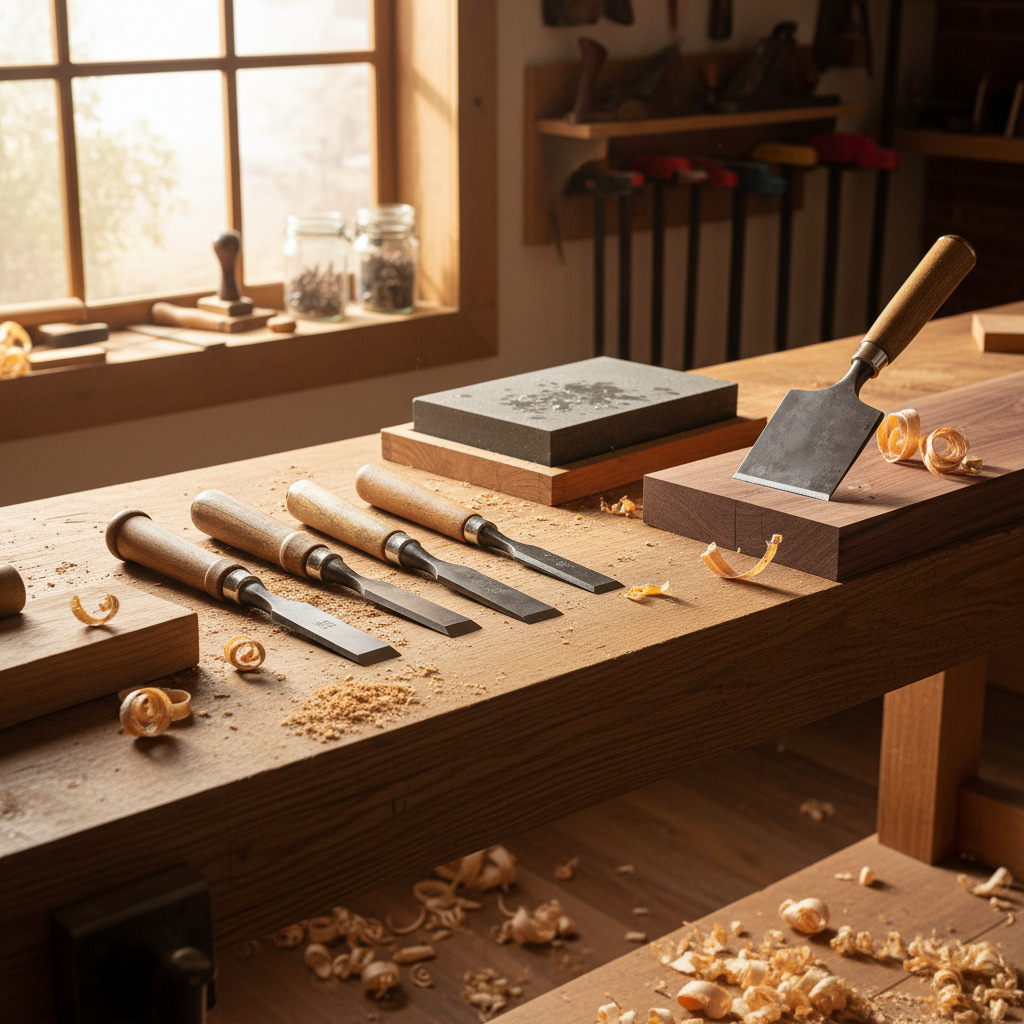
That said, the hand-tools argument wins in one specific scenario: if your workspace is a small apartment, a shared garage with noise restrictions, or anywhere that a circular saw creates a genuine problem, a quality hand saw, a block plane, and a sharp set of chisels can build the same first project with a lower noise profile and zero power cord management. A Suizan Japanese pull saw runs about $25 and cuts cleaner than most entry-level circular saw blades on thin stock. For tight spaces, that's a real option.
What I'd actually recommend is this: don't treat it as a binary. Buy the circular saw and the drill first because they're load-bearing for the widest range of projects. Then add one or two hand tools, specifically a quality pull saw and a 3/4-inch chisel, as your third purchase block. The hybrid kit outperforms either pure approach at the $300 price point.
Check your workspace dimensions, noise tolerance, and first project's cut list before you commit: those three variables together determine whether power-first or hand-first is the right call for you specifically.
What Happens If You Skip the Clamps
Glue joints need clamping pressure to cure properly. Skip the clamps and you get a joint that looks fine for a week and fails under load. Two F-clamps and a bottle of Titebond II run about $25 total, and they are doing structural work in every glued assembly you build.
The woodworkers who skip clamps on their first project almost always buy them for their second, after watching a joint open up or a panel bow. That's $25 spent twice. Buy them first.
Beyond clamps, the most common budget mistake is buying a full set of chisels or a router before finishing a single project. Routers are genuinely useful tools. They're also $80 to $150 entry-level investments that require a separate table or careful freehand technique to use well, and they solve joinery problems you probably won't encounter until your third or fourth project. Put the router on a wish list. Put the clamps in your cart now.
Reading the $300 Budget Honestly
Here's what the budget actually looks like when you write it down:
| Tool | Budget Range | Priority |
|---|---|---|
| Circular saw (corded, 7-1/4 in.) | $80-$110 | Day 1 |
| Drill-driver (20V lithium-ion) | $60-$80 | Day 1 |
| Tape measure + combination square | $20-$30 | Day 1 |
| Random-orbit sander (corded) | $30-$50 | Day 1 |
| Clamps (4x F-clamp, 6 in.) | $20-$30 | Day 1 |
| Wood glue + sandpaper pack | $15-$20 | Day 1 |
| Pull saw or hand saw | $20-$30 | Month 1 |
The low end of that list lands at $245. The high end reaches $350, which means you need to make one trade-off: either defer the pull saw or catch the circular saw on sale. Home Depot and Lowe's both run tool promotions around Memorial Day, Labor Day, and Black Friday that routinely put corded circular saws at $60 to $70. Timing one purchase to a sale keeps you under $300 without sacrificing anything structural.
What the list does not include: a workbench, a miter saw, a router, a table saw, or a pocket-hole jig. All of those are useful. None of them belong in a $300 starter kit. The miter saw alone starts at $150 and duplicates what a circular saw with a good fence does for first projects. Buy the five core tools, build something, and let your second project tell you what to add next.
When This Kit Isn't the Right Starting Point
The power-tool-first kit described here works well for builders tackling furniture, shelving, and basic cabinetry from dimensional lumber or plywood. It does not work well for everyone.
If your primary interest is hand-cut joinery, traditional furniture making, or any work where machine marks are unacceptable, a $300 hand-tool kit centered on a quality No. 4 bench plane, a set of four chisels, a marking gauge, and a quality handsaw delivers more long-term value. The skill ceiling is higher and the setup cost lower, but the learning curve in the first month is steeper. That's a legitimate trade-off, not a flaw.
If you have no dedicated workspace, buying a circular saw without a stable workbench creates a safety problem. A hollow-core door on sawhorses costs about $60 and solves this, but that $60 comes out of the $300. Factor it in before you buy the saw. Cutting sheet goods on the floor is not a technique issue; it's a real injury risk that a proper cutting surface eliminates.
Beginners who skip building a stable work surface and then find themselves supporting a circular saw on an unstable pile of scrap wood are the readers this warning is written for. Set up before you cut.
Building the Kit Without Starting Over
Start with the circular saw and the drill-driver. Those two tools, bought new from a store with a return policy, give you the core cutting and fastening capacity for nearly every beginner project. Add the measuring and layout tools the same day. That's your first purchase block, and it should land between $165 and $220.
Within the same month, add clamps, sandpaper, and wood glue. This block rarely exceeds $40, and it completes your functional kit. You can build a shelf, a small table, or a set of wall-mounted storage with what you have now.
After your first completed project, you'll know what the kit is missing. Maybe that's a jigsaw for curved cuts. Maybe it's a pocket-hole jig for faster face-frame assembly. Maybe it's a second battery for the drill. Let the project tell you. Buying tools in response to real project friction is how a starter kit becomes a real shop without waste. And if you never finish that first project, no additional tool purchase was going to help anyway.