Any decent woodworker will tell you to buy a good hand plane before almost anything else, and there's a reason that advice keeps coming up. The tools you reach for first as a beginner woodworker set the whole trajectory of how you learn to work wood, not just what you can build right now.
The problem is that the standard beginner lists online tend to be built around affiliate revenue, not around what actually makes sense for someone starting out in a garage in Ohio or an apartment in Chicago. They recommend a drill press before you've ever held a chisel. They pitch $400 router tables to people who haven't cut a straight line yet.
Your first tool purchases depend on three things that most lists ignore entirely: how much shop space you actually have, whether you're starting with hand tools or power tools, and what kind of projects you're planning to make in the first six months. A person building small boxes needs different tools than someone framing raised garden beds. None of those answers are the same, and getting this wrong in your first $300 of purchases is genuinely discouraging.
Here's the tension worth sitting with before you buy anything: hand tools teach you wood in a way that power tools simply don't, but power tools let you finish projects fast enough to stay motivated. That tradeoff doesn't resolve neatly. It depends on you.
What Hand Tools Actually Do the Work
Start here regardless of where you eventually land on power tools. A sharp chisel, a decent marking gauge, and a good combination square will teach you more about wood grain and joint-making than any YouTube series. These aren't romantic choices; they're the tools that build the underlying skill.
The combination square is the first purchase I'd recommend for every beginner without exception. A reliable one from Starrett runs around $60 to $80, and it checks your square, marks your lines, and tells you when your cuts are drifting. Cheaper squares from hardware store house brands often aren't actually square, which defeats the entire purpose. Buy once here.
Or rather: a combination square isn't just a layout tool. It's a calibration tool for your whole workflow. Every time you mark a cut line or check a glue-up, you're trusting that square. If it's off by even a degree, the error compounds across every joint in your project. This is why a name-brand square at $70 is one of the only beginner purchases where spending more is genuinely non-negotiable.
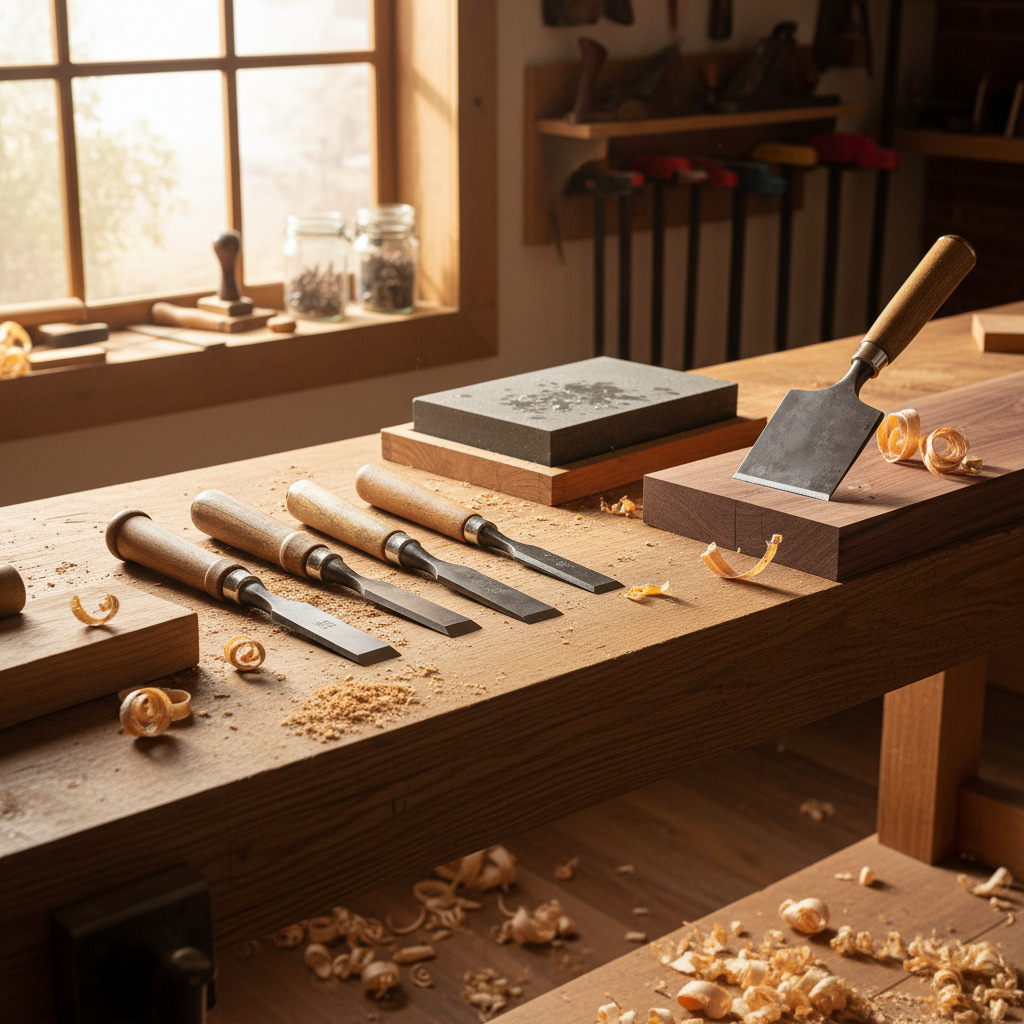
Beyond the square: a set of three bench chisels (1/4 inch, 1/2 inch, and 3/4 inch are the working sizes for most beginner joints), a mallet, and a marking knife round out your layout and joinery basics. Budget around $80 to $120 for a decent chisel set from a brand like Two Cherries or Narex, both of which hold an edge reasonably well without needing a metallurgist's touch to sharpen.
One hand tool most beginners skip until they're frustrated: a card scraper. It costs about $8, removes mill marks that sandpaper smears into the grain, and produces a surface that looks finished rather than merely smooth. Buyers skip it, hit their first finish coat, and wonder why their oak looks muddy.
The First Power Tool Debate
Most beginner lists recommend a circular saw or a drill as the first power tool. The drill recommendation is right. The circular saw recommendation is more complicated.
A cordless drill and driver is the most universally useful power tool a beginner can own, period. Get a 20V brushless model from DeWalt, Milwaukee, or Makita. Budget $120 to $180 for a kit that includes two batteries and a charger. Brushless motors last longer and run cooler than brushed motors, which matters when you're a beginner making inefficient cuts and running the tool harder than you need to. Don't buy a bare tool and a cheap battery; the battery platform matters for future purchases.
The circular saw question is trickier. A circular saw is genuinely useful for breaking down sheet goods, cutting 2x lumber, and rough-dimensioning boards you bought at the home center. But it requires a straight-edge guide or a quality fence to cut accurately, and most beginners don't buy those accessories alongside the saw. The result is a tool that makes frustrating, inaccurate cuts until you figure out the system around it. If you're going to buy a circular saw, budget another $30 to $40 for a good aluminum straight-edge guide at the same time. Makita's 7-1/4 inch circular saw is a sensible first choice around $110 to $130.
What you probably don't need yet: a router, a table saw, a random-orbit sander (get it eventually, but not first), or a miter saw before you've built anything. That said, if your first six months of projects lean toward furniture with clean crosscuts, a 10-inch sliding compound miter saw from a brand like Ridgid becomes useful faster than a circular saw would. The projects you're planning matter more than any generic list.
If you ignore the power tool sequencing advice and buy a router as your second tool, you'll spend more time reading router manual PDFs than making anything. That's not hypothetical.
Sharpening: The Step That Decides Everything Else
Buy sharpening gear before your second chisel. This is the step that separates woodworkers who make progress from those who spend six months wondering why their joints don't fit.
A dull chisel doesn't just work harder; it works differently. It tears fibers instead of cutting them, it skids off layout lines, and it requires force that translates into unpredictable results. Sharp tools require less force and more control, which is exactly what beginners need.
The simplest entry-level sharpening system that actually works: a combination waterstone in 1000/6000 grit from King or a comparable Japanese stone brand, and a basic honing guide to hold your chisel at a consistent angle while you learn. The stone costs around $30 to $50; the honing guide costs $15 to $25. Total outlay is under $75, and it will keep your chisels and plane irons in working condition indefinitely.
Don't buy a bench grinder yet. You'll use it later for re-establishing bevels on neglected tools, but for new chisels that just need regular maintenance, the waterstone system is enough and faster to set up.
The better question is whether you'll actually use a sharpening system consistently. Beginners who set it up at the bench next to their chisels do. Beginners who store it in a drawer don't. That framing matters more than which sharpening method you choose.
When Hand Tools Alone Are the Wrong Answer
Hand tools are wonderful, and this article leans toward them for good reason. But there's a specific beginner type for whom starting with hand tools is genuinely bad advice: the person who works full time, has two hours on a weekend, and wants to finish a project within a month rather than a year.
If that's you, buying a decent random-orbit sander ($60 to $80 from DeWalt or Bosch), a pocket-hole jig system like the Kreg Jig K4 (around $100), and a cordless drill will let you build functional furniture from pre-dimensioned lumber within a weekend. The joints won't be mortise-and-tenon. They'll hold fine in a bookshelf or a coffee table. You'll build momentum.
The downside: pocket-hole joinery doesn't teach you wood. You won't develop the feel for grain direction, the understanding of how wood moves seasonally, or the layout skills that underpin more serious work later. Starting here and never going further is a real pattern. If you want to eventually build furniture you'd be genuinely proud of in ten years, treat the power-tool-first path as an on-ramp, not a destination.
This article isn't for the person who wants to build a deck or put up trim. Those projects need different tools entirely, and that's a separate conversation.
A Practical Starter List With Honest Prices
Below is a two-track list reflecting the hand-tool-first path and the power-tool-first path. Prices are approximate US retail as of 2024 and will vary by retailer. Neither list is exhaustive; both are sequenced so each purchase enables the next.
| Tool | Hand-Tool Path | Power-Tool Path | Approx. US Price |
|---|---|---|---|
| Combination square (Starrett or equivalent) | Buy first | Buy first | $60-$80 |
| Bench chisels (1/4", 1/2", 3/4") - Narex or Two Cherries | Buy first | Buy third | $80-$120 for set |
| Sharpening stone (1000/6000 combo) + honing guide | Buy second | Buy with chisels | $45-$75 combined |
| Cordless drill/driver 20V kit - DeWalt, Milwaukee, or Makita | Buy third | Buy second | $120-$180 kit |
| Circular saw (7-1/4") + straight-edge guide | Buy fifth | Buy third | $140-$170 combined |
| Card scraper | Buy fourth | Buy fourth | $8-$15 |
| Random-orbit sander - DeWalt or Bosch | Buy sixth | Buy fifth | $60-$80 |
| Pocket-hole jig (Kreg K4) | Optional | Buy first or second | $95-$110 |
The hand-tool path gets you to around $400 before you own a single power tool beyond a drill. The power-tool path gets you building joinable furniture for about the same money but skips the skill foundation until later. Neither path is wrong. Both benefit from buying the combination square before anything else, because every cut you make depends on it.
One thing worth noting: this list deliberately excludes workbench and clamps, both of which matter enormously but are often better sourced second-hand. Check Facebook Marketplace and estate sales for clamps especially; a set of six pipe clamps for $40 at an estate sale beats $120 retail every time.
What to Skip and What to Buy Used
Buy new: chisels, combination squares, and any cordless tool where battery platform lock-in matters. These are purchases where quality and compatibility have compounding value.
Buy used without hesitation: hand planes, older Stanley or Record bench planes in particular. A No. 4 or No. 4-1/2 bench plane in decent condition from eBay or an estate sale runs $30 to $60 and, once tuned up (flattened sole, sharpened iron, adjusted frog), performs as well as a $200 new plane. The tuning process also teaches you how the tool works. That's not a small thing.
Skip entirely for now: dovetail jigs, router tables, lathe, biscuit joiner, and thickness planer. These all have their place in a more developed shop. Buying a thickness planer before you've learned to flatten a board by hand means you'll never fully understand what the planer is doing for you. And understanding your tools is most of what separates competent woodworkers from people who own expensive equipment and make mediocre furniture.
Buy second-hand with caution: table saws and band saws. An old contractor saw with a warped table is genuinely dangerous and worth nothing; a well-maintained one is worth a lot. Unless you know how to assess these tools, wait until you've spent time with someone who can show you what to look for.
So: combination square first, sharpening gear second, then chisel set or cordless drill depending on your path. Check square, sharpening stone grit, and battery voltage compatibility before checkout. That three-item sequence covers 80% of beginner woodworking for the first several months.
Getting Started Without Wasting Money
If you already bought a few tools that didn't work out, you're not behind. You're in the majority. The beginner tool mistake isn't spending too much on the wrong tools once; it's continuing to buy tools before using the ones you have.
Use each new tool until you've finished at least one project with it before adding the next. This isn't romantic minimalism; it's how you learn whether the tool fits your workflow before committing to a whole ecosystem around it. Someone who builds three projects with a hand saw before buying a circular saw understands the circular saw's value in a way that someone who bought both on the same shopping trip simply doesn't.
Starting with a combination square, a sharp chisel set, and a cordless drill gets you to functional woodworking. Everything else extends your range. The tools that make you a better woodworker aren't the expensive ones; they're the ones that reveal how wood behaves when you work it carefully.